
Rugby League Betting Odds in 2026
 Available in US
Last checked against current operator terms and the Gambling Commission’s public register on 27 October 2026 · verified against Gambling Commission records.

Rugby league splits opinion the way few sports do. Supporters of Super League clubs in England and Wales, of NRL sides across Australia and New Zealand, and of the international sides fielded by International Rugby League follow a 13-a-side game decided by tries, conversions and the occasional drop goal from beyond the forty-metre line — and they want a price before kick-off, in play and after the hooter. This guide is for that reader. It compares ten UK-licensed bookmakers on the rugby league markets they actually publish, the way those prices are built, and the rules that decide whether a winning slip is paid.
The territory is narrow by design. Rugby league sits behind football and horse racing in the volume of money matched in Great Britain, and only a slice of the licensed betting brands put serious resource into its pre-match and in-play book. Most of what follows rests on the public register of the Gambling Commission, on each operator’s own published terms, and on the everyday workings of fractional and decimal odds. There is no value in writing around that — rugby league is a niche that rewards people who have done their reading.
How UK Bookmakers Stack Up on Rugby League
| Brand | Gambling Commission licence | What the operator’s own terms say on rugby league |
|---|---|---|
| 888sport | 39028 — 888 UK Limited | Pre-match and in-play betting, Cash Out, Bet Builder, daily price boosts and a live bet feed; Cash Out availability depends on the market and the live status. |
| BoyleSports | 39469 — Boylesports Enterprise | Standard Super League and NRL pricing under its sports betting rules; cash settlement after the official result unless the market specifies otherwise. |
| Matchbook | 39504 — Triplebet Limited | Betting exchange model — punters back and lay against each other rather than against the book; Bet Builder, multiples and in-play offered, with live streaming on horse racing and greyhounds. |
| VBet | 44662 — SCGO Limited | Super League, NRL, World Cup and Challenge Cup pricing; cash-back welcome credit settled as a free bet on the first settled sports wager. |
| Fafabet | 57385 — Taichi Tech Limited | Full Super League and NRL cards with ante-post Championship odds; Best Odds Guaranteed on UK and Irish racing from 9am but not on rugby league. |
| Betfred | 39544 — Petfre (Gibraltar) Limited | One of the longer-established GB sportsbooks, covering twenty-one sports with rugby league forming part of its seasonal rotation. |
| Geoff Banks | 54095 — GB Sports Advisors Limited | Ante-post prices on rugby league outrights alongside live in-play pricing on Super League and NRL fixtures. |
| Octobet | 62545 — Octopus Game Limited | Mainstream Super League and NRL markets; welcome offer settled half in a free bet and half in a casino bonus for new customers. |
| Tote | 54779 — TDCO Limited | Pool-style bookmaker — stake returns plus an industry deduction, settled on the official result including extra time. |
| DAZN Bet | 48756 — DZBT Limited | Standard pre-match and in-play book across Super League, NRL and World Cup fixtures; debit, e-wallet and paysafecard deposits from £5. |
Ten brands, one register, ten different combinations of product and price. The rest of this guide works through what each line of that table means for a punter who actually wants to back Wigan on Friday night or lay the Roosters on Sunday morning.
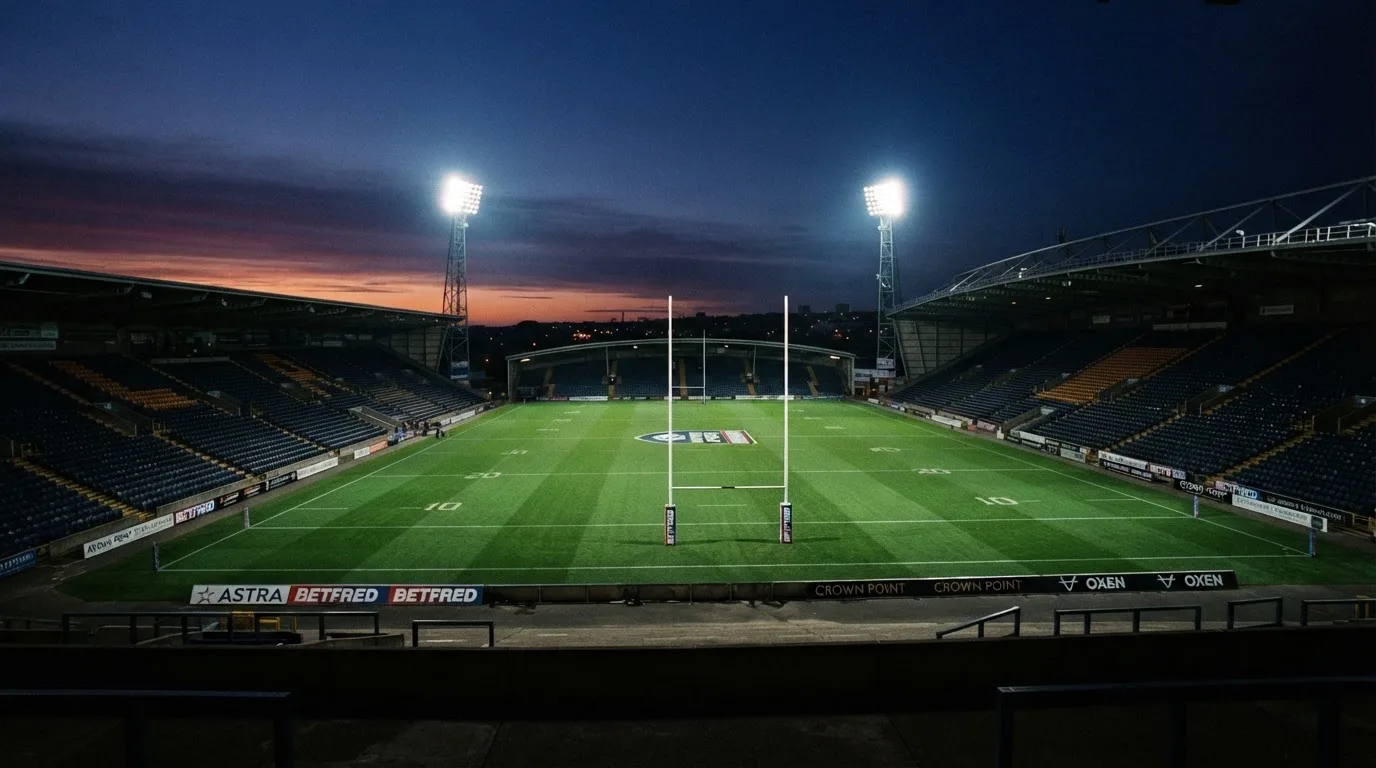
What Rugby League Looks Like to a Punter
The shape of the game shapes the markets. Rugby league is contested by thirteen players a side over eighty minutes split into two halves of forty, and the attacking side has the right to six tackles before the ball turns over — six plays to break the line, then a handover and the opposition has its own set. That possession cycle is what produces tries, the four-point score for grounding the ball in the in-goal area; a successful conversion kicks two more, a penalty goal two, and a drop goal one (two when kicked from beyond the forty-metre line). Match totals on tries, first try scorer, half-time and full-time handicap all draw on that rhythm, and so does the wholesale of the betting product.
Two competitions anchor the calendar for British punters. Super League is the elite European club competition, contested across a regular season that finishes in a four-team play-off series ending in the Grand Final; the NRL is the Australian and New Zealand club equivalent that runs through the southern winter. International Rugby League runs the rest: the World Cup now sits in the autumn on a four-year cycle, with regional championships, England and Great Britain tests, and origin contests between the states of New South Wales and Queensland filling the gaps. A bookmaker’s rugby league product is, in practice, the depth of its Super League and NRL menus during the season and the depth of its World Cup and international menu every November.

Who Regulates the Market in Great Britain
Every brand named in the comparison holds a Gambling Commission operating licence and is on the Commission’s public register. The register is searchable by business name, trading name, domain or account number, and it is the only place a check can be made that a brand’s remote betting licence is current. Account numbers from the table above are the figures to enter in the “Public Register” search at the Commission’s site; an exact match on the operator’s business name and the site domain confirms a real licence. The Commission’s register is updated continuously, and the entries here were verified against it on the date recorded at the top of this guide.
The framework is the Gambling Act 2005, covering England, Scotland and Wales. Northern Ireland is a different jurisdiction with its own, older law — a GB licence does not authorise activity in Northern Ireland and operators that target customers there need separate approval. Since the Gambling (Licensing and Advertising) Act 2014, an operator whose remote facilities are used in customers in Great Britain needs a Commission licence wherever its business is based, including in Gibraltar, Malta or Curaçao; an offshore licence alone does not satisfy GB law.
The licences that matter for rugby league punters are the remote general betting standard (real events) licence for ordinary bookmakers, and the remote betting intermediary (trading rooms) licence for exchanges. Spread betting is a different regulator entirely — the Financial Conduct Authority oversees financial spread bets, and Spreadex, which is regulated by both authorities, makes plain on its homepage that losses on its spread bets can exceed the initial deposit. A punter choosing between a fixed-odds book, an exchange and a spread firm needs to know which of those three licences applies to the brand, and the only place to check is the Commission’s register or, for spread betting, the FCA register.
Responsible Gambling in the Licensed Market
Every online operator serving Great Britain is required to be a member of GAMSTOP, the national multi-operator self-exclusion scheme. Self-exclusion can be set for six months, one year or five years, with a further option of a five-year period that auto-renews; once the minimum period has elapsed the exclusion continues for a further seven years unless the customer requests it lifted. GAMSTOP covers online sites and apps — high-street bookmakers run a separate, in-shop self-exclusion scheme. Anyone who has signed up to GAMSTOP and tries to open an account at a licensed brand will be refused; the same protection does not apply at unlicensed offshore sites, which is one of the practical reasons for sticking with the licensed field where a self-exclusion is in place.
The licensed bookmakers also share an obligation to check identity before a customer can deposit or gamble — name, address and date of birth have been a precondition since 7 May 2019, including when the first deposit is placed in conjunction with a free bet or a bonus. The same checks, plus public-record affordability screening where deposits minus withdrawals exceed £150 over a rolling 30 days, apply once a customer starts playing. That figure has been in force since 28 February 2025; it is a vulnerability check, not a credit check and not an income check. Stage two of the Commission’s programme on financial risk assessments was announced in July 2026, but no start date has been set and the guidance as of 27 October 2026 is still “announced, in stages, no start date” — that wording is what to write down in any note.
Customer-controlled limits are a Commission requirement rather than a state-set ceiling. Operators must offer a deposit limit on a fixed time frame, with the first set of changes applied since 31 October 2025 and a second phase scheduled for 30 September 2026; a deposit or loss ceiling set by the state for betting was not found, and the only statutory ceiling currently in force is the £150 vulnerability check threshold described above. Help outside the operators themselves is provided by GamCare (which runs the National Gambling Helpline), by GambleAware, by NHS gambling clinics and by Gamblers Anonymous. The bookmakers’ own safer-gambling pages link directly to those services.
Bonuses and Free Bets — What They Cost
Sports welcome offers at the licensed bookmakers follow a familiar pattern: a small qualifying bet, a free-bet return if the first bet loses, a stake-back or a matched deposit, with the smaller print governing whether the free-bet stake itself is paid back with a win. BoyleSports qualifies a £10 first bet for £20 in free bets for UK customers; VBet offers £10 back as a free bet if a first-ever losing bet settles; Octobet’s offer settles half as a free bet and half as a casino bonus; bet365, 888sport and Sky Bet publish variant welcome structures tied to a similar deposit-qualifying or first-bet frame. The values change through the season; the structure is stable.
What makes the offer worth anything is the small print that comes back to condition the free bet. Two constraints are worth naming before a punter claims any of them. The first is the wagering cap the Commission now applies to bonuses — in force since 19 January 2026, no wagering requirement above 10x the bonus base is allowed, and mixed-product promotions that bind sports to casino, bingo or lottery have been banned. The second is the rule that any free-bet return still carries: free bets almost everywhere are paid as stake-not-returned, meaning a winning free bet returns profit only and not the original stake, so the headline “£20 in free bets” is a £20 claim, not £20 of assured cash. Where the headline is a “risk-free” or “no sweat” structure that refunds a losing first stake as a free bet, the same stake-not-returned rule applies to the refund and the £20 is recoverable only as a free bet.
Each operator states its own minimum odds, its own expiry on free bets and its own rules on which markets qualify. The default position is to read the offer page before claiming, and to weigh whether the wagering and the market minimum on the qualifying bet leaves the offer worth taking in the first place.
In-Play Betting and Cash Out
Every brand in the comparison supports in-play betting across Super League and NRL once the match is underway. The book is at its widest through Super League Saturday and through the NRL Sunday morning slot the British market trades as a Bank Holiday fixture; it narrows in midweek, when a mid-table Super League match might carry only match betting and a handicap line against a few props. Cash Out is separately conditional: a bookmaker will offer to settle the bet back at the live price of the bet at that moment, with a margin that the bookmaker keeps and the punter accepts in exchange for closing the position. Where Cash Out is offered, the market carry of live pricing is what makes it tradeable; some firms suspend Cash Out near the end of each half, after a sin-bin or during a video review, on the grounds that the live price is too thin to trade against.
Live streaming of rugby league is not universal across British bookmakers. Matchbook streams horse racing and greyhounds alongside its exchange product; bet365 streams selected events worldwide subject to geographic rights. In the broader set, the live product is the live betting feed and the visual tracker rather than a video stream of the match itself. A punter looking for a video feed of Super League should check the operator’s live page in the hour before kick-off; that is the only place a per-event confirmation will appear.
Predictions, Strategy and the Math
Rugby league is the kind of sport that lends itself to injury-driven form swings and to the long scoreboard runs that come with a six-tackle possession cycle. The market pattern is similar to any fixture-list sport: bookmakers’ early prices are sharpest for the headline Super League and NRL matches and looser for the second-tier Championship and the internationals; prices tighten as kick-off approaches because the betting volume moves the line; and prices drift through the match itself as the live market repriced.
Three working habits sit well with that shape. The first is to read the team sheets and the social media of the major clubs for last-minute changes — Rugby Football League sides publish seventeen-player squads an hour before kick-off, and the NRL teams publish on game-day mornings Australian time. The second is to compare the price on the outright with the price available on the same-game exchange — Matchbook lay and back prices feed off each other and the gap between them is sometimes wider than the headline. The third is to keep stakes consistent regardless of form, and to set a fixed stop-loss for the evening the moment the first bet loses outright.
A practical note on a base-rate selection. A two-way market priced at 1.91 and 1.91 is a market the bookmaker has priced with roughly 4.7 per cent margin on each side combined — the punter’s share of every £1 staked is around 95.3 per cent and the bookmaker keeps the remainder, before any commission or premium charge. A market at 1.80 and 1.80 sits closer to 11.1 per cent margin and a punter’s share at 88.9 per cent, which is a meaningful step on the expected return across a season. The next section works through what that looks like in numbers.
Bet Types and How the Odds Are Built
The market vocabulary is a short one. Single bet — one selection, settled on the outcome. Combination bet (or multiple) — two or more selections whose odds multiply, all of which must win for the bet to be paid. Each-way — half the stake on the win price and half at the place price, doubling the stake for the cost of the place leg. Handicap — a virtual lead applied to one side, settled on the result after the handicap is applied. Total points (over/under) — the bookmaker sets a line and the back or lay settles on whether the total points go over or under it. Match betting — the simplest contest of straight win or draw, settled on the official result unless the operator specifies eighty minutes only.
How odds are built determines how the price translates to return. The decimal price is the multiplier on the stake — 6.00 returns six pounds for every pound staked, so a winning £10 bet at 6.00 pays £60 and the net profit is £50. The fractional price is the ratio of profit to stake — 5/1 pays five pounds of profit for every pound staked, the same 6.00 in decimal terms. Shorter prices express as evens (= 2.00 in decimal) and the conventional vocabulary calls anything shorter than evens “odds-on”, with 1/2 (= 1.50 in decimal) sitting firmly in odds-on territory. Most British bookmakers publish fractional and decimal forms side by side, both from the same underlying figure; the conversion is decimal = (a ÷ b) + 1.
The bookmaker’s margin is the slice of every pound wagered that the firm keeps in expectation, and it is the same figure under a different name as the overround. A two-way market priced at 1.90 and 1.90 implies a payout share of 1 ÷ ((1 ÷ 1.90) + (1 ÷ 1.90)) = 0.95, or 95.0 per cent, and a margin of 5.0 per cent. The same market at 1.80 and 1.80 implies a payout share of 1 ÷ ((1 ÷ 1.80) + (1 ÷ 1.80)) = 0.889, or 88.9 per cent, and a margin of 11.1 per cent. That spread, between five and eleven per cent, is what a punter sees on a typical Saturday afternoon across a single bookmaker’s rugby league card. Markets with more than two outcomes — first try scorer, half-time / full-time — pack a margin of between seven and fifteen per cent, with the bookmaker’s cut coming largely out of the longer-priced outcomes.
A worked illustration: with decimal odds of 1.90 for each side of a two-way market (fractional 9/10, or “ten to eleven”), the backer’s return on a winning £10 bet is £19.00 — the original £10 stake plus £9.00 of profit — and the bookmaker’s margin on that market is 5.0 per cent. Shift both sides to 1.80 (fractional 4/5, “five to four on”) and the punter’s share drops to 88.9 per cent and the margin rises to 11.1 per cent — the £10 winning bet still pays £18.00, but the bookmaker keeps a larger slice of every pound wagered into the market across losers and winners. A price band of 5 to 11 per cent margin is typical for mainstream rugby league match betting at the licensed bookmakers; markets on the same-game props lean wider, exchange prices lean narrower on the deep fixtures, and ante-post markets stay closer to the upper end of the band until the final is fixed.
Tournaments and Competitions — Where the Calendar Lives
The rugby league calendar is anchored by four competitions the licensed bookmakers cover to the inch. Super League runs from February to a September play-off series culminating in the Grand Final at Old Trafford; the NRL runs from March to early October with a State of Origin window in June that catches out most pre-publication schedules; the Rugby League World Cup is the headline international event on its current four-year cycle; and the Challenge Cup runs alongside Super League to a Wembley final in mid-summer. Below that sit the Championship and the Championship 1 (League 1), the State of Origin and the women’s NRLW, the regional Championships of Queensland, New South Wales and England, and the various international windows.
Each tournament rewards a slightly different kind of price watching. Super League is a tight twelve-team contest with strong betting volume; NRL is a seventeen-team competition on the other side of the world that begins at the worst possible time for a British audience, but it has the depth of market that rugby league anywhere else struggles to match. The World Cup is an odds-on favourite-tournament — bookmakers price the host nations tightly and the outsiders loosely, and the right market to play is the outright winner with a small stake rather than match-by-match trading. Outright ante-post markets for Super League, the NRL and the World Cup are where the early-value shopper will find the widest bookmaker margins; prices firm sharply once the first ball is kicked.
The settlement rules vary by competition. The Sky Bet rugby league rules that other GB bookmakers mirror settle Super League and NRL match betting on eighty minutes of play rather than on the official result, which means extra time does not count for the standard W/L market; most other markets settle on the official result including extra time. The same rules refund a winning wager on a whole-number handicap line when the line is hit exactly, and they push a postponed match forty-eight hours ahead before making the bet void; that combination is the practical difference between a settled bet and a held stake. Always read the rulebook before tying a stake to a specific market.
The Ten Operators in Detail
Ten licensed bookmakers carry the table above, in the order in which research sets them; each gets a paragraph that earns the place it occupies and closes on what sets it apart for a rugby league punter rather than restating the licensing line the table has already given.
888sport
888sport carries full Super League and NRL cards through the season and pulls out daily boosted odds on the headline matches — the kind of price that sits on the homepage for a day and is then gone. The operator’s Cash Out is offered on selected markets only and is suspended whenever the live book is suspended, which means a punter who relies on closing a position close to kick-off needs to plan around that. The Bet Builder is the relevant product for same-game multiples on rugby league, where the firm builds the price itself rather than letting the punter assemble it. The price shaping and the day-to-day marketing are what carry 888sport for rugby league; the welcome offer is conditional and should be read alongside the small print on what counts as the qualifying bet.
BoyleSports
BoyleSports is well established in Irish and British sport and supports a full pre-match card for rugby league, with the standard array of match betting, handicaps, totals and try scorers. The BoyleSports welcome package is a £10 qualifying bet for £20 in free bets in the UK — modest, but the structure is straightforward, and the free bets are usable on the sports product. The firm is also anecdotally strong on ante-post outright markets for Super League and the World Cup, which suits an end-of-season punter more than a weekly trader. BoyleSports is the bookmaker’s bookmaker: small welcome structure, deep catalogue, and not much to write home about beyond the basics.
Matchbook
Matchbook is a betting exchange, not a sportsbook — the punter backs and lays against other customers rather than against the firm itself. Commission rates vary by account tier and the structure is different from a fixed-odds book: Matchbook trades thinner margins on the headline markets in exchange for a commission on net winnings, and shows liquidity the way a stock exchange shows depth. The product in rugby league is mainstream Super League and NRL only — secondary fixtures are sparsely traded and the price can lag the fixed-odds book by a tick or two. The trade-off is worth it for a punter who wants to lay a short-priced favourite rather than back it, since an exchange is the only place on a British licensed site to do that without an offshore account.
VBet
VBet places its welcome offer behind a first-bet structure — £10 back as a free bet if a £10 first bet loses — which is a useful offer for someone who is new to rugby league betting because the loss is recoverable as a free bet, not as cash. The product is broader than the offer suggests: Super League, NRL, the Challenge Cup and the World Cup appear in the catalogue, and live betting is offered through the main Super League and NRL windows. The welcome return is a free bet, so the stake is not paid back on a winning free bet, and that condition will be familiar from the Vbet terms.
Fafabet
Fafabet’s Best Odds Guaranteed offering is for horse racing only and does not apply to rugby league markets — that distinction matters for the punter who scans the homepage and assumes the Better Odds feature runs across the whole catalogue. Fafabet covers a full Super League and NRL card for rugby league alongside the rest of its sports product, and the welcome structure is more of a sportsbook-with-racing texture than a rugby-league-specialist texture. For an outright market shopper the Fafabet page is worth checking; for the match-by-match in-play punter, the firm sits in the middle of the field.
Betfred
Betfred is one of the better-established GB sportsbooks and carries a broad catalogue across twenty-one sports, with rugby league sitting at the centre of the catalogue during the Super League and NRL seasons. The welcome structure is variable through the year and the firm runs its own weekly specials on the bigger matches. The firm’s heritage advantage is in trade: bookmakers that have taken the price for a long time on Super League tend to have a sharper card on the second-tier fixtures, because they have built the form database for the second tier that newer bookmakers do not have. That’s the practical case for Betfred over a newer brand for a Championship and Championship 1 punter.
Geoff Banks
Geoff Banks is a smaller-volume bookmaker with rugby league ante-post prices and live in-play pricing on Super League and NRL. The product is narrower than a flagship sportsbook, but the firm is the kind of smaller book the in-the-know punter takes a side bet with — the prices are sometimes ahead of the headline books on outright markets and on the longshot end of the match card. The trade-off is the size of the book; Geoff Banks’ liquidity on a modest match is thinner, and a winning punter with a large stake might find the firm protects its book by capping the price on the larger selections.
Octobet
Octobet’s sports welcome package splits half to a free bet and half to a casino bonus for new customers, which is the mixed-product structure the Commission’s rules now restrict — a sportsbook that qualifies a customer for a casino bonus has to be on the right side of the cross-product rules from 19 January 2026. For a rugby-league-only punter, the casino half is redundant; the value sits in the matched-bet half, where the rule applies. The book is mainstream with regard to the catalogue, sitting in the same group of licensed firms that cover the Super League and NRL matches without going wider into the second-tier competitions.
Tote
Tote is the only pool-style bookmaker in the licensed UK field, and the difference matters for a rugby league punter. Returns are computed by dividing the pool of bets by the number of winning tickets, less an industry deduction — the result is published after the race or the match settles, which means the dividend is not known in advance. The product is one of older heritage for racing and a niche for sports, and a rugby league punter trading a Tote dividend is trading a different animal from a fixed-odds book. Tote settles on the official result, including extra time, where most fixed-odds books on match betting settle at eighty minutes.
DAZN Bet
DAZN Bet has a clear payments posture that is unusual among the licensed sportsbooks — deposits start at £5 across debit card, Apple Pay, Paysafecard, Trustly and Skrill, and at £20 by PayPal, with no fees for processing. That profile suits the lower-stake punter who wants a small-stake bet on a Friday-night match without having to put down the typical £10 minimum. The catalogue is mainstream on the Super League and NRL side, with a thinner second-tier coverage than a longer-established bookmaker. Welcome structure varies through the season; the £5 deposit level is the practical edge for someone who wants to keep the outlay to the price of a coffee.
Where This Guide Started and Where It Stops
The lane for a UK rugby league punter is narrow but well-marked. The licensed bookmakers are the only set with the operator-side protections — GAMSTOP coverage, the Commission’s complaints route, an approved dispute-resolution body — that the GB regulatory framework was built to provide. Within that set, the difference between brands is in product and price: which firms run what rugby league catalogue, which run a tight pre-match book, which keep the in-play feed open, which stream the matches, and which let the punter lay rather than back.
The check that none of the rest of the guide replaces is the live register entry for each brand. Account numbers are in the comparison table; the register is updated daily; a check takes the time of a single search. That is the practical answer to the reader who asks whether the brand in this guide is the same brand that takes the bet tomorrow.
Frequently Asked Questions
How do I bet on rugby league in the UK?
Open an account with a bookmaker licensed by the Gambling Commission, complete the identity check (name, address and date of birth) that the regulator requires before any stake, fund the account and pick a market from the rugby league section. The simplest bet is match betting — choose Wigan to win and the bet is settled either as a winner if Wigan win the match or as a loser if they do not. Combination bets and each-way stakes work the same way they do across any sport.
How can I confirm a bookmaker holds a Gambling Commission licence?
Search the Commission’s public register by the brand’s business name, trading name or account number; the licence categories listed against the entry should match what the brand claims on its homepage. For spread betting, check the Financial Conduct Authority register. A live entry on the register is the only practical confirmation; a banner on a site’s homepage is not a substitute.
How is my payout worked out from stake and odds?
Multiply the stake by the decimal odds. A £10 bet at 6.00 returns £60, of which £50 is profit and £10 is the stake. The fractional price 5/1 is the same number in different form: profit divided by stake equals 5. A combination bet multiplies the odds of every leg together — a treble at 2.00, 3.00 and 4.00 has combined odds of 24.00.
What is the bookmaker’s margin and how does it show up in the odds?
The margin is the slice of every pound wagered the bookmaker keeps in expectation. A two-way market priced at 1.91 for each side has a margin of 4.7 per cent and a punter’s share of 95.3 per cent. The same market at 1.80 and 1.80 has a margin of 11.1 per cent and a punter’s share of 88.9 per cent. The narrower the margin, the better the long-run return on a winning strategy.
Which safer-gambling tools does a licensed bookmaker have to offer?
Identity verification before the first deposit, a deposit limit the customer sets on a fixed time frame, time-out and self-exclusion options, mandatory enrolment with GAMSTOP for online customers, signposting to GamCare, GambleAware and the NHS gambling clinics, and periodic affordability checks for customers whose net deposits exceed £150 over a rolling 30 days. Spread betting firms regulated by the FCA are not under the same conditions and offer different protections appropriate to financial products.
Rugby, cricket & Gaelic – Free bets
Content created by the «Free bets» team
