
Football accumulator bets in Great Britain: how an acca is built, settled and paid
 Available in US
A single football bet pays when one selection wins. A football accumulator only pays when every leg on the slip wins, and the price the bookmaker offers climbs with each leg added. That is the whole idea, and that is also the trap. The marketing leans on the long price — “win £1,000 from a £5 stake” headlines sell more than the work it takes to land one — while the conditions that govern an accumulator sit in a different paragraph and rarely make the front page. This guide takes the second paragraph seriously. It explains how an accumulator is built and settled, where the margin hides in the multiplied price, how the British licence frame treats the bettor, and which of the ten bookmakers the Gambling Commission register lists for Great Britain deserve a place on a shortlist for accumulator play.
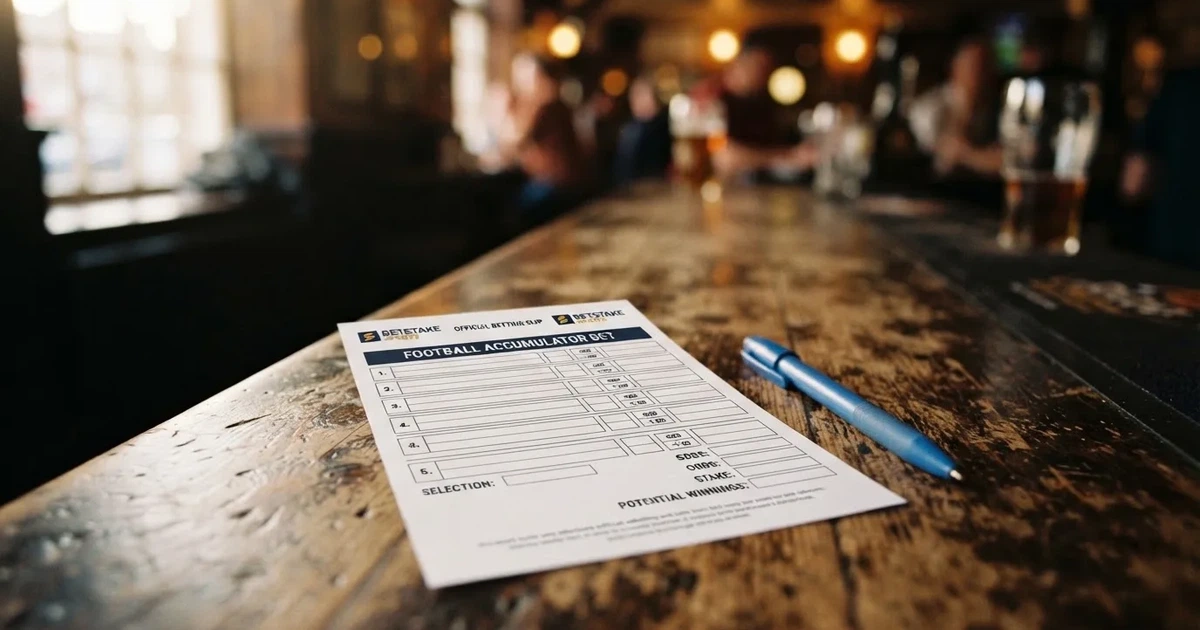
The figures and licence references below were checked against the Gambling Commission’s public register and the operators’ own terms as of 27 October 2026.
The ten football-accumulator bookmakers the register lists, and the rule that earns them a place
The brands below are the ten bookmakers this comparison ranks for football-accumulator play. Each holds a remote general betting licence with the Gambling Commission for customers in Great Britain, and each is on the Commission’s public register against the licensee named in the table. A place on this list is not a licence, and a licence is not a recommendation — the comparison takes the next sections to say what each operator actually offers an accumulator bettor.

| Brand | Gambling Commission account and licence holder | What the operator’s own terms state on accumulators |
|---|---|---|
| Betfred | Account 39544 — Petfre (Gibraltar) Limited | Acca-friendly app with Bet Builder, Extra Places and acca-style features on the main coupon |
| Lottoland | Account 38991 — EU Lotto Limited | Sportsbook bundled with lottery, casino and scratchcards; standard sports acca available |
| Sporting Index | Account 27343 — Sporting Index Limited | Fixed-odds sports alongside financial and sports spread products; standard acca on fixed-odds events |
| Swifty Sports | Account 58957 — Swifty Global (UK) Ltd | Cash Out, daily price boosts, in-play and live streaming; Bet Builder listed as coming soon |
| BetMGM | Account 39198 — LeoVegas Gaming PLC | Welcome offer priced as acca free bets; full sportsbook acca on the main coupon |
| Fafabet | Account 57385 — Taichi Tech Limited | Best Odds Guaranteed on UK and Irish racing; football acca covered on the sportsbook |
| Ladbrokes | Account 54743 — LC International Limited | Acca Boosts, in-play and odds boosts on horse and greyhound bets; full acca on the football coupon |
| DAZN Bet | Account 48756 — DZBT Limited | Cash Out, Bet Builder, daily bet boosts and in-play; cash out may not be available |
| Dabble | Account 65677 — Dabble Sports UK Ltd | Welcome offer framed as a £10 free bet; full sportsbook acca on the football coupon |
| Fitzwilliam Sports | Account 48760 — SBKI Limited | Prices tied to Oddschecker averages; standard football acca on the coupon |
A registered account number is not a guarantee of safety on its own — it is a confirmation that the Commission has licensed the named holder to take remote bets in Great Britain, that the holder sits inside the Commission’s social responsibility code, and that the customer has the Commission’s complaints route if something goes wrong. None of that changes how an accumulator pays out, but it changes what happens when it does not.
What a football accumulator is, and what changes once a second leg joins
An accumulator is a single bet that links two or more selections. The slip carries each leg as its own match result, but the bet settles as one: every leg must win for the stake to return anything, and one losing leg loses the whole stake. The price the bookmaker offers is the product of the prices of each leg, which is why decimal odds suit accumulators and why the headline number climbs quickly — a four-fold at decimal odds of 1.50, 2.00, 2.50 and 3.00 pays 22.50, a £10 stake returns £225 if all four win and £0 if any one of them does not.

The legs do not have to come from the same match. A typical football accumulator combines outright picks across Saturday’s Premier League fixtures, a Champions League tie in the evening and a Tuesday night FA Cup replay. The bookmaker does not care where the goals come from; what the bookmaker cares about is that the multiplied price carries a margin on each leg, which is what gives the operator its edge across the whole slip.
That margin is the most important figure on the page, and most readers never see it. A decimal price of 1.50 carries an implied probability of 66.67 per cent; of 2.00, 50 per cent; of 2.50, 40 per cent. Across one market — the 1X2 home-draw-away of a single match — those three probabilities should add up to 100 per cent. They do not, because the bookmaker has shortened each price. If the three prices of one match add up to 107.5 per cent in implied probability terms, the bookmaker keeps 7.5 per cent of every unit bet on the market. Multiply that across four legs and the edge the operator holds on the slip is closer to a third of the stake than a tenth, which is what makes an accumulator such an expensive bet to clear over many slips.
How a winning accumulator pays back
The return on a winning accumulator is straightforward: stake multiplied by the combined decimal odds. A £10 stake at a four-fold of 1.50, 2.00, 2.50 and 3.00 returns £225. The profit — what the bettor keeps after the stake — is £215. A combined price of 22.50 means a one-unit stake wins 21.50 units of profit.
The same arithmetic on a £10 stake on three illustrative selections — 1/2 (1.50), evens (2.00) and 6/4 (2.50) — gives a combined decimal price of 7.50 and a return of £75 for a £10 stake. The other side of the same coin is the cost of the multiplied margin: every leg carries the bookmaker’s edge, and the longer the slip, the more the bettor is paying for the chance of a longer price.
Where the bookmaker’s margin hides in the odds
A bookmaker’s margin is what the operator keeps of every unit bet on a market. On a single 1X2 football market with home, draw and away priced at 1.50, 4.00 and 6.00 in decimals, the implied probabilities are 66.67 per cent, 25 per cent and 16.67 per cent. They sum to 108.33 per cent. The payout share — what the bookmaker returns across all outcomes — is the reciprocal of that, which comes to 92.31 per cent. The margin is 100 per cent minus the payout share, which is 7.69 per cent of every unit bet on this market. On a Premier League match with sharper prices the margin on 1X2 typically sits between 3 and 7 per cent; on lesser-known leagues, on player specials or on long-shot markets it can run into double digits, and an accumulator multiplies that margin across every leg.
That is why two accumulators with the same number of legs at the same average price can pay very different amounts in expectation. One bookmaker’s average margin across the coupon might be 6 per cent and another’s might be 9 per cent, and the difference compounds across the slip.
What happens when one leg ties
A leg that ties — a match priced at 2.00 for the home win that ends level — is settled as a push in most fixed-odds accumulators, and the leg is removed. The payout odds are reduced to match the remaining selections: a four-fold at 22.50 becomes a treble at the price of the three remaining legs. The stake does not return any partial amount; the bet continues at the lower price, and the bettor either wins on the remaining legs or loses on whichever of those legs does not come in.
This rule varies by bookmaker. Some operators void the whole accumulator when a leg pushes. Others treat a push as a loss when the original price was offered at enhanced odds. The operator’s terms state which rule applies, and a bettor building a slip should check the relevant line before placing the bet.
Each-way accumulators and what the place terms cost
An each-way accumulator is two bets of equal stake on the same slip: one for every leg to win, and one for every leg to place. The stake doubles. The place terms — a quarter of the win odds for four or five places, a fifth of the win odds for six or seven — vary by sport, market and operator. On a horse-racing each-way accumulator the place terms are well-known; on a football each-way they are rarer and usually limited to outright markets such as top scorer or promotion, where each-way terms apply because not every selection can win. The price the bookmaker quotes for an each-way accumulator already accounts for the doubled stake, and the punter pays the doubled stake whether every leg wins, every leg places, or the slip loses outright.
Full-cover bets and the difference from a flat accumulator
A Trixie is a full cover bet on 3 selections made up of 4 bets. A Yankee covers 4 selections in 11 bets. A Heinz covers 6 selections in 57 bets and a Super Heinz covers 7 selections in 120 bets. The difference from a flat accumulator is that the bettor is paying for every combination of the selections across the slip, which insures partially against a losing leg — a Trixie on three selections pays out on any two of the three winning, because the doubles and the treble both have a winning combination — and prices the bet accordingly. The total stake on a Trixie at £2 per line is £8, not £2; the total stake on a Super Heinz at £2 per line is £240. A bettor paying £2 per line on a Super Heinz and winning all seven legs takes the multiplied price of all seven, which is a longer number than any flat accumulator of the same seven selections — and a longer stake that has to be covered whether the bet wins or loses.
How an accumulator settles, and what to read in the bet slip
The bet slip is the contract. It states the stake, the selections, the decimal odds and the combined price. A punter who has placed an accumulator at Betfred, Ladbrokes, BetMGM, DAZN Bet or any of the other bookmakers on the register above receives the multiplied price across the legs the slip carries. Cash Out is offered on some accumulators by some operators, and the cash-out figure is a live estimate of the current value of the slip — what the bookmaker would pay to settle the bet early. The estimate carries its own margin, which is why a cash-out figure is almost always less than what the bettor would receive by letting the bet run.
In-play accumulators settle as the legs complete. A bettor building a five-fold on a Saturday afternoon sees each leg settle as the final whistle blows; the slip updates live, and a losing leg turns the slip red. The bookmaker settles the bet at the end of the day in most cases, because some legs run into the evening. Where a leg is postponed — a Tuesday match called off for weather — the rule varies: some operators void the leg and reduce the accumulator to the remaining selections; others settle the leg at a SP equivalent if a price is available, or rule the leg a non-runner if neither a SP nor a result exists. Non-runner rules are in the operator’s terms.
At -110 moneyline odds a $110 stake returns $210 including the stake; if each win is rolled into the next bet, a $100 parlay on N events pays $100 × (210/110)^N. That is the US equivalent of the same multiplied-price mechanic, and the same arithmetic applies to British fractional odds — a 5/1 leg at a £10 stake returns £60 if it wins alone, and that £60 becomes the stake on the next leg of an each-way roll-up where the operator allows it.
How the Gambling Commission frame treats the accumulator bettor
The Gambling Commission, a non-departmental public body sponsored by the Department for Culture, Media and Sport, licenses the whole commercial betting market in Great Britain under the Gambling Act 2005. The Act covers England, Scotland and Wales; Northern Ireland is outside it and has its own older law, so a “GB licence” regulates Great Britain and never Northern Ireland. Since the Gambling (Licensing and Advertising) Act 2014 an operator whose remote facilities are used in Great Britain needs a Commission licence wherever the operator itself is based — a Curaçao, Maltese or Gibraltar licence is not a substitute, and the sections that give the Commission that power are 33 and 36 of the 2005 Act as amended.
No statutory list of permitted bets exists. An operator holds a licence for a category — remote general betting standard (real events) is the category that covers a standard football accumulator — and offers markets under its own rules and the Licence Conditions and Codes of Practice. The operator’s terms sit on top of the LCCP, and the Commission’s public register is the test of whether a brand holds a licence: it can be searched by business name, trading name, domain or account number, and a brand whose name appears on the register against the licensee that operates it is licensed to take remote bets in Great Britain. There is no state monopoly, no cap on the number of licences, and no statutory ceiling on stakes — operators set their own maximums.
In-play betting on football is offered by GB bookmakers under those same licence conditions and customer-protection duties. Betting exchanges run on a betting intermediary licence, which is a separate category. Financial spread betting is regulated by the Financial Conduct Authority, not the Commission, which is why a brand such as Sporting Index carries both an FCA registration for spread betting and a Commission licence for fixed-odds betting — the fixed-odds acca lives under the Commission, and the spread products live under the FCA.
The minimum age to bet is 18. Name, address and date of birth are verified before a customer can deposit or gamble, including with a free bet or bonus — the verification rules took effect on 7 May 2019, and no licensed operator offers anonymous play. The verification is one of the costs a licensed operator pays to keep its licence, and it is one of the protections the bettor receives in return: the operator knows who is on the other side of the bet, and the Commission’s complaints route is open if the operator mishandles the account.
What the bonus rules do to an accumulator
A promotion rule in force since 19 January 2026 caps wagering requirements on bonuses at 10x. A £10 bonus at 50x needed £500 of bets; under the cap no more than £100 of wagering applies to that bonus. The cap binds the bonus; the acca bettor reading this section needs to know whether the offer on the table carries a wagering requirement at all, and at what multiple.
Mixed-product promotions — an offer that requires gambling on two or more product types, such as “bet on football to get free spins” — are banned under the same rule. A bet on football that unlocks a sports free bet is still on the table; a bet on football that unlocks casino spins is not. The cap’s application to free bets that carry no wagering condition is not established.
Credit cards are out for gambling
Credit cards have been banned for gambling in Great Britain since 14 April 2020, including credit-card-funded payments through an e-wallet. The LCCP condition that delivers the ban is 6.1.2. Debit cards and bank-based payments are not covered by that ban. A bettor funding an accumulator must do so from a debit card, a bank transfer or an e-wallet funded from one of those — a credit card will be declined at the cashier of any licensed operator.
What the bettor pays tax on, and what the operator pays
The bettor pays no tax on betting winnings in Great Britain. General Betting Duty is the operator’s tax on gross profits, currently 15 per cent; from 1 April 2027 a new remote betting rate of 25 per cent applies within it, while remote bets on UK horse racing, self-service betting terminals in licensed premises, pool betting and in-person betting stay at 15 per cent. Spread betting carries its own rates (3 per cent financial, 10 per cent other). Until 1 April 2027 the remote rate stays at 15 per cent. Whether operators pass duty on through odds is not established, and no assumption is made here — the bettor sees the odds the operator quotes, and that is what the bettor pays.
What GAMSTOP does to a self-excluded bettor
GAMSTOP is the national multi-operator online self-exclusion scheme and a mandatory licence condition for online operators since 31 March 2020. Self-exclusion periods are six months, one year, five years, or five years with auto-renewal; after the minimum period the exclusion stays in place for a further seven years unless the customer asks GAMSTOP to remove it. GAMSTOP covers online sites and apps; betting shops use a separate service. Every GB-licensed online operator takes part, which means a self-excluded customer cannot open a new account with any of the ten brands on the list above while the exclusion is live.
What an accumulator costs the bettor over many slips
The arithmetic is straightforward and unforgiving. The bookmaker’s margin on a single 1X2 football market typically sits between 3 and 7 per cent on a Premier League match and climbs into double digits on lesser-known leagues and on specials. An accumulator multiplies that margin across every leg, which is what makes an accumulator such an expensive bet to clear over many slips.
A punter placing a four-fold on a Saturday at an average per-leg margin of 6 per cent is paying roughly 22 per cent of stake to the bookmaker in expectation — that is the geometric mean of the four leg margins applied to the slip. The same four-fold at an average per-leg margin of 9 per cent costs the punter closer to 32 per cent. The headline price the climber is told is what the bettor wins when every leg wins; the headline cost is what the bettor pays across the slips that lose, and that cost is set by the multiplied margin.
This is the part the marketing does not reach. A boosted odds headline of “£1,000 from a £5 stake” tells the bettor what the winning slip returns. It does not tell the bettor what the losing slips cost, and the gap between the two is the multiplied margin.
What a free-bet welcome offer really costs
A £10 free bet on a four-fold at an average margin of 6 per cent is worth roughly £6 in expected return to the bettor — that is the free-bet stake multiplied by the typical acca payout share across many slips. A free bet whose stake is not paid back is worth less than its face value to the bettor, and the difference is the multiplied edge the bookmaker holds. A free-bet stake that is paid back — the rarer structure — is worth more, because the stake adds to the return rather than disappearing on a loss.
The welcome offers at the ten operators on the register above come in several shapes. A BetMGM welcome offer for new UK customers who deposit £10 or more and place a sports bet within 7 days is four £10 free bets (two football accumulators of 4+ selections and two sports multiples of 2+), valid for 7 days with minimum odds and opt-in required. A Dabble welcome offer is “Bet £10, Get £10 in Free Bets” on a first deposit, with minimum odds applying, a 7-day free bet expiry and the stake not returned. A Sporting Index new-customer offer is a £10 fixed odds bet at minimum odds of 1/2 unlocking three £10 fixed odds free bets, three £5 Total Goals spread bets, three £5 Winning Favourites spread bets and a £1 Race Index spread bet — the qualifying bet cannot be placed in play or cashed out early. Each offer carries its own minimum-odds rule and its own exclusion of in-play or cash-out, and each offer prices the free bet at the stake-not-returned value.
What acca insurance covers, and what it does not
Acca insurance is a refund offer on a losing accumulator. The refund usually takes the shape of a free bet rather than cash, which is the rule the reader has to read: a “money-back” offer that pays in free bets is not a money-back offer. The refund typically caps at a stake figure lower than the slip’s full stake and applies to accumulators above a minimum number of legs. The marketing calls it insurance; the cost is that the refund is paid in a stake that cannot itself be insured, and the multiplied margin is the same on the refunded stake as it was on the original.
What acca boosts pay, and what they cost
An acca boost is a percentage uplift on the multiplied price, applied by the bookmaker as a token to accas of a minimum number of legs. The boost is funded by the operator from its own margin, which is why the boost is more common on accumulators the bookmaker wants to encourage than on accumulators the bookmaker wants to discourage. The boost applies to the win price; it does not change the multiplied margin of the underlying legs. A bettor who values the boost at face value is valuing the marketing word over the multiplied edge.
How to read the shortlist above, and what to check before placing the bet
A place on the table at the top of the page is a confirmation that the brand is licensed for remote general betting in Great Britain and that the operator’s own terms address the acca product. It is not a confirmation that the operator is the cheapest, the safest or the best for a given bettor’s needs. The next section takes each operator in turn and says what the brand offers an accumulator bettor, what the brand’s own terms say about the bet, and where the brand sits against the others.
A bettor about to place an accumulator at any of the ten operators should check four things before clicking “place bet”:
- the minimum odds on each leg — many welcome offers exclude selections below a price threshold, and a low-priced favourite can void the offer;
- whether the operator accepts cash out on accumulators, and whether the cash-out figure carries its own margin;
- the in-play rule, because a leg settled in-play is settled at the price the operator took when the match went live;
- the each-way rule if the bet is an each-way acca, because the place terms and the doubled stake govern what an each-way slip pays back.
The ten operators, in the order the comparison covers them
The ten brands the comparison ranks for football-accumulator play are listed below in the order research covers. The licence account number, the licence holder and what the operator’s own terms state about accumulators are in the table at the top of the page; the sections below say what each operator actually offers.
Betfred
Betfred’s app features Bet Builder, Sub Switch, Racing Post data, Extra Places, live casino and bingo. The Bet Builder is the most relevant tool for an accumulator bettor who wants to combine selections from the same match — a same-game multi on a Premier League fixture is a sub-market of the acca coupon, and Betfred’s app puts it in the bet slip alongside the cross-match acca. Extra Places applies to horse racing rather than football, and is a separate product from the acca boost. The licence account number is 39544, held by Petfre (Gibraltar) Limited; the licence category is remote general betting standard (real events).
The verdict: Betfred suits a bettor who wants a single app for a same-game multi and a cross-match acca, and who values Racing Post data on the racing side. The acca boost and the Bet Builder are the differentiators; the lack of an in-play-specific acca product is a gap the operator’s in-play coupon partially closes.
Lottoland
Lottoland UK combines casino, lottery betting, sports betting and scratchcards in a single product. The sportsbook carries a standard football coupon with acca markets, and the licence covers remote general betting standard (real events). The licence account number is 38991, held by EU Lotto Limited. The product is unusual on a list of football-accumulator bookmakers because lottery betting is the headline product, not the sportsbook, and a bettor who values a sports-only app will find the sportsbook buried in the product mix.
The verdict: Lottoland suits a bettor who plays lottery alongside football and values a single sign-in for both. The brand’s sports acca is a bundled product rather than a standalone feature; for the bettor prioritising football depth, other specialists offer more.
Sporting Index
Sporting Index is regulated by the FCA for spread betting and by the Gambling Commission for fixed-odds betting. The fixed-odds sportsbook carries a standard football coupon, and the welcome offer is the unusual one on the list — a £10 fixed odds bet at minimum odds of 1/2 unlocking three £10 fixed odds free bets, three £5 Total Goals spread bets, three £5 Winning Favourites spread bets and a £1 Race Index spread bet. The qualifying bet cannot be placed in play or cashed out early. The licence account number is 27343, held by Sporting Index Limited.
Spread betting losses can exceed the deposit, and that risk lives in the spread products, not the fixed-odds sportsbook — the fixed-odds acca at Sporting Index carries the same risk profile as the fixed-odds acca at any other licensed operator. The licence account is for fixed-odds; the FCA registration is for spread. The bettor who values the welcome offer for its fixed-odds free bets and ignores the spread products gets a competitive product; the bettor who values the welcome offer for its spread products takes on a different risk class.
The verdict: Sporting Index suits a bettor who wants a fixed-odds sportsbook alongside a spread product and is comfortable with the FCA-side risk class. This sportsbook serves as a reliable fixed-odds venue, though the welcome offer prioritises the spread-betting ecosystem over the accumulator slip.
Swifty Sports
Swifty Sports offers Best Odds Guaranteed, Cash Out on markets including horse racing and football, daily price boosts, live streaming and in-play betting. Bet Builder is listed as coming soon on the app store listing — a bettor who values a same-game multi at Swifty Sports today has to wait, and a bettor who values it tomorrow should check whether the launch has happened. The licence account number is 58957, held by Swifty Global (UK) Ltd.
The verdict: Swifty Sports suits a bettor who values in-play and live streaming and is comfortable waiting for the Bet Builder. The cash-out product and the daily price boosts are the immediate differentiators; the Bet Builder is the one to watch.
BetMGM
BetMGM’s sports welcome offer for new UK customers who deposit £10 or more and place a sports bet within 7 days is four £10 free bets (two football accumulators of 4+ selections and two sports multiples of 2+), valid for 7 days with minimum odds and opt-in required. The free bets are framed as acca products, which is unusual on the list — most welcome offers price the free bet as a single or a treble, not as a four-fold. The licence account number is 39198, held by LeoVegas Gaming PLC.
The verdict: BetMGM suits a bettor who wants the welcome offer to be an acca product and is willing to build a four-fold acca to use it. The free bet structure rewards the bettor who plans four selections, not the bettor who plans one.
Fafabet
Fafabet pays Best Odds Guaranteed on UK and Irish horse racing win and each-way bets from 9am on race days. If the starting price is bigger than the original price, the bigger odds are paid. The football coupon carries a standard acca product; the racing-side product is the differentiator. The licence account number is 57385, held by Taichi Tech Limited.
The verdict: Fafabet suits a bettor who splits the stake between football accumulators and horse racing and values Best Odds Guaranteed on the racing side. Best Odds Guaranteed is the primary advantage here; the accumulator itself is a standard, competitive offering for the average punter.
Ladbrokes
Ladbrokes offers odds boosts on horse and greyhound bets, Best Odds Guaranteed on UK and Irish horse races, in-play betting and Acca Boosts. Acca Boosts is the relevant differentiator for an accumulator bettor — a token applied to accas of a minimum number of legs, priced by the operator from its own margin. The licence account number is 54743, held by LC International Limited; the licence category is remote general betting standard (real events) and remote betting intermediary, the latter because Ladbrokes runs an exchange alongside the sportsbook.
The verdict: Ladbrokes suits a bettor who values Acca Boosts on the coupon and is comfortable on a sportsbook-and-exchange product. The exchange category is a sign of the operator’s breadth; the acca product on the sportsbook is competitive with the rest of the list.
DAZN Bet
DAZN Bet offers Cash Out, Bet Builder, daily bet boosts and in-play betting. Cash Out availability is not guaranteed and bets stand if it is unavailable — the rule the bettor has to read. The licence account number is 48756, held by DZBT Limited.
The verdict: DAZN Bet suits a bettor who values Cash Out and Bet Builder and is comfortable with the rule that a cash-out figure may not be available. The Bet Builder is the relevant tool for a same-game multi; the daily bet boosts apply to singles and multiples on the coupon.
Dabble
Dabble’s welcome offer is “Bet £10, Get £10 in Free Bets” on a first deposit for new customers, with minimum odds applying, a 7-day free bet expiry and the stake not returned. The licence account number is 65677, held by Dabble Sports UK Ltd.
The verdict: Dabble suits a bettor who wants a simple £10 free bet welcome offer and is comfortable with the stake-not-returned structure. The brand’s value lies in its streamlined sign-up and social-leaning offer, while the accumulator engine delivers standard sportsbook functionality.
Fitzwilliam Sports
Fitzwilliam Sports bases prices on Oddschecker’s average price for each selection. The model is unusual on the list — most operators price the coupon themselves, with the Oddschecker average as a benchmark; Fitzwilliam uses the benchmark as the price. The licence account number is 48760, held by SBKI Limited. The product carries Apple and Google mobile apps.
The verdict: Fitzwilliam Sports suits a bettor who values the Oddschecker-tied pricing model and is comfortable on a smaller sportsbook. The acca product is competitive with the rest of the list on price; the brand sits below the larger operators on product breadth.
Frequently asked questions on football accumulator bets
How do football accumulator bets work?
An accumulator links two or more selections into a single bet. Every leg must win for the stake to return anything — one losing leg loses the whole stake. The price is the product of the prices of each leg, so the headline climbs with each leg added. The bookmaker’s margin is multiplied across the legs, which is what makes an accumulator expensive to clear over many slips.
Where can I place football accumulator bets?
At any GB-licensed bookmaker with a remote general betting licence for real events — the brands on the list above are ten such operators, each on the Gambling Commission’s public register against the named licence holder. The Commission’s register can be searched by business name, trading name, domain or account number, and it is the test of whether a brand holds a licence.
How does an accumulator work in football betting?
The legs do not have to come from the same match. A typical football accumulator combines selections across Saturday’s Premier League fixtures, an evening Champions League tie and a midweek cup replay. The bookmaker settles the bet as one: every leg must win, and one losing leg loses the whole stake. A leg that ties is settled as a push in most fixed-odds accumulators, and the leg is removed.
How can it be checked that a bookmaker holds a Gambling Commission licence?
By searching the Commission’s public register by business name, trading name, domain or account number. A brand whose name appears on the register against the licensee that operates it is licensed to take remote bets in Great Britain. A GB-licensed online operator is also a GAMSTOP member and is bound by the LCCP, the social responsibility code and the 10x bonus cap.
How is the return on a bet worked out from the stake and the odds?
The return on a winning bet is the stake multiplied by the combined decimal odds. A £10 stake on three illustrative selections at 1/2 (1.50), evens (2.00) and 6/4 (2.50) gives a combined price of 7.50 and a return of £75 for a £10 stake. The profit — what the bettor keeps after the stake — is £65. A combined price of 7.50 means a one-unit stake wins 6.50 units of profit.
What is the bookmaker’s margin and how can it be seen in the odds?
The margin is what the bookmaker keeps of every unit bet on a market. On a 1X2 market with home, draw and away priced at 1.50, 4.00 and 6.00 in decimals, the implied probabilities sum to 108.33 per cent, the payout share is 92.31 per cent, and the margin is 7.69 per cent. Across an accumulator the margin is multiplied by every leg, which is why a longer acca is more expensive to the bettor in expectation than the headline price suggests.
Bet types & in-play – Free bets
Content created by the «Free bets» team
