
Where to bet on futsal online in 2026: ten UK-licensed bookmakers, weighed up
 Available in US
Futsal betting occupies a strange corner of the British market. It is a recognised FIFA sport with its own World Cup, its own continental competitions and a calendar that runs almost year-round, yet the number of bookmakers that price a competitive 1X2 line on a Tuesday-night Liga Placard fixture can be counted on one hand. The game itself is fast, low-scoring and stop-start in a way that punishes casual models. The betting on it rewards the same habits that reward any other specialist market: knowing the competition, watching the live product, and reading the fine print of whatever promotion arrives with the next deposit. This page is a comparison of ten Gambling Commission-licensed bookmakers that carry futsal markets in some form, set against the rules, the offers and the maths that decide what a wager on the sport is actually worth.

Current as of 27 October 2026, checked against the Gambling Commission’s public register of operating licence holders.
How the ten UK-licensed futsal bookmakers stack up
Ten operators from the British register make up the working shortlist, ordered below by what they offer to a futsal punter rather than by an overall quality score. The list deliberately mixes the household names with the smaller, more specialised brands, because the market does. Each card in the longer write-up later in this article goes deeper than the table can; the table exists to put the licence number and the operator’s own futsal terms in front of the reader in one place.

| Brand | Gambling Commission remote licence | What the operator’s own terms say about futsal |
|---|---|---|
| NetBet | 039170-R-319343-032, held by Netbet Enterprises Limited | Daily Boosts, Profit Boosts, a Bet Builder and free bet offers across the sportsbook, with futsal typically folded into the wider football-style menu rather than given its own landing page |
| Kwiff | 044448-R-323408-017, held by Eaton Gate Gaming Limited | Surprise-price element on selected markets; futsal coverage appears on the main sportsbook alongside football, with the same in-play product |
| LiveScore Bet | 056859-R-332720-005, held by LiveScore Betting and Gaming (Gibraltar) Limited | Bet Builder allowing up to ten selections, with match result, both teams to score, totals and player markets that read across to futsal fixtures when listed |
| BetTom | 064959-R-339314-003, held by Bet Tom Limited | Sports welcome package centred on free bets, with futsal priced under the standard sportsbook rather than a dedicated vertical |
| Octobet | 062545-R-337248-006, held by Octopus Game Limited | New-customer sports welcome package with a free bet and a small casino side; futsal under the wider sports menu |
| Betway | 039372-R-319367-029, held by Betway Limited | Free Bet Club returning up to £10 weekly after the qualifying spend; futsal markets listed within the standard sportsbook, with in-play pricing where liquidity exists |
| Coral | 054743-R-330863-014, held by LC International Limited | Sports welcome offer of free bets on a qualifying £20 stake, plus the wider Ladbrokes Coral product across sports and exchange where applicable |
| Betfred | 039544-R-319290-010, held by Petfre (Gibraltar) Limited | Long-established sportsbook with a wide fixture list; futsal is one of the smaller sports on the menu, priced alongside other indoor football variants |
| BetUK | 039198-R-319450-029, held by LeoVegas Gaming PLC | Free-bet welcome package broken into four £10 tokens split between football accas and multiples; futsal falls under the football-style acca system |
| DAZN Bet | 048756-R-327274-019, held by DZBT Limited | Sportsbook with a strong football product; futsal sits within that, and the deposit minimums and payment method restrictions are set out on the help pages |
The licence numbers are the live identifiers on the Commission’s register at the snapshot date for this page, and they are the test of whether a brand is permitted to take a futsal wager from a customer in Great Britain. A bare domain on a banner is not. None of the ten is “the only” licensed brand: the register lists several hundred remote betting licences, and any one of them may list futsal markets. What the ten share is that they appear consistently in futsal pricing when the season is live, and that their own terms say something specific about the relevant subject — promotions, the bet builder, or the in-play product — that a reader can check.
The fundamentals a futsal punter needs before placing a bet
Futsal is five-a-side football with the clock stopped for dead balls, played indoors on a hard court with a heavier ball. The shape of the game, and therefore the shape of a sensible bet on it, follows from a handful of rules that anyone betting on a match should know cold. A futsal match is two 20-minute periods with the clock stopping at dead-ball situations, with one one-minute timeout per team per period, which is why in-play pricing fragments around stoppages rather than running continuously like an outdoor football match. The court itself is the standard international size of 40 m by 20 m, with the ball a size 4 — smaller and heavier than an outdoor football and with a noticeably lower bounce, which shapes the style of play and the kinds of goal that get scored. Each team fields five players, one of them the goalkeeper, with up to nine substitutes permitted and unlimited substitutions, so a coach can rotate an entire outfield five during a stoppage without stopping play, and the bench matters more than in football.
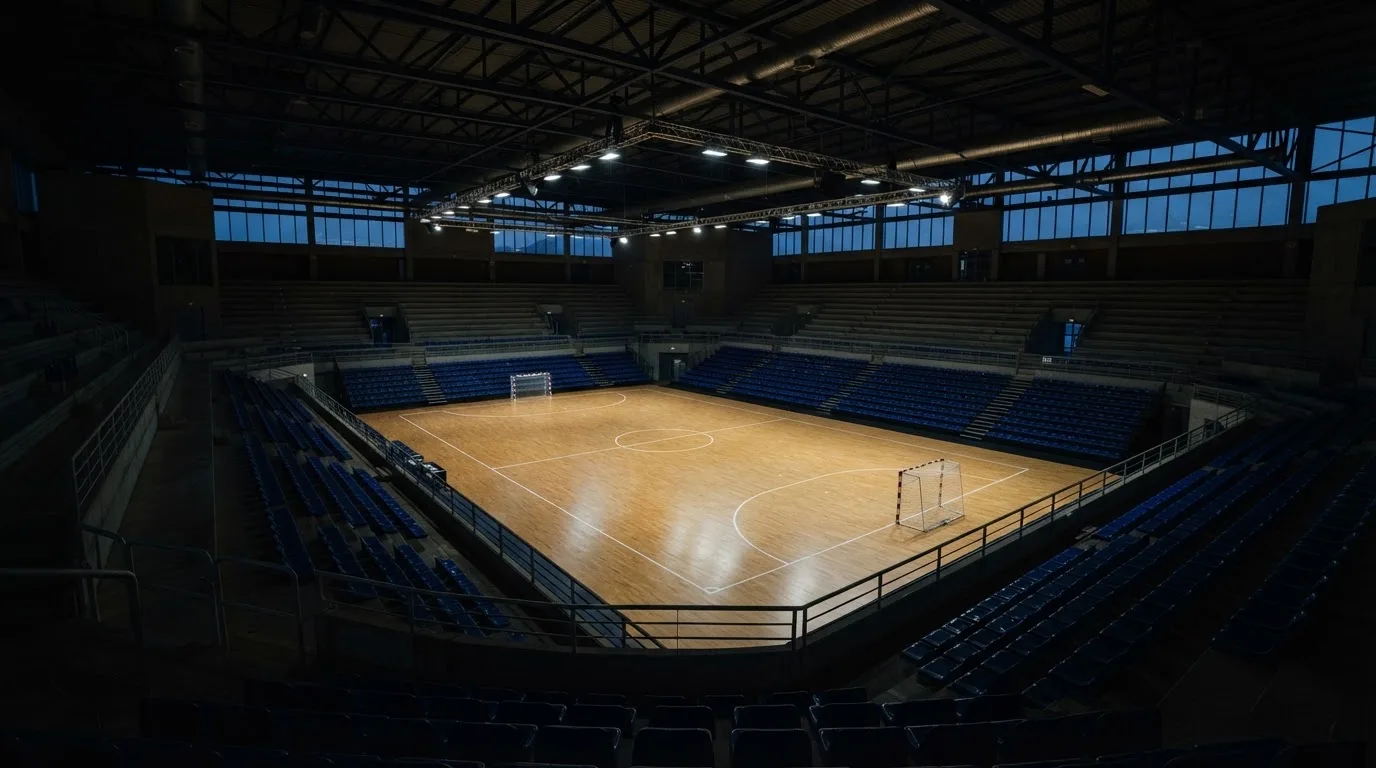
The disciplinary rule that most shapes in-play markets is the accumulated-foul count: in futsal, from the sixth accumulated foul in a period the opposing team gets a direct free kick from the second penalty mark, ten metres from goal, with no wall allowed to be formed. That mechanism converts late-period foul pressure into a structured goalscoring chance that the markets do not always price in. The women’s game has its own international calendar too: the first FIFA-organised futsal World Cup was held in 1989 and the inaugural FIFA Futsal Women’s World Cup took place in the Philippines in 2025, so the women’s bracket is no longer a curiosity but a priced fixture list at the bigger operators.
Futsal itself did not emerge in a major federation office. The game originated in 1930 in Montevideo, Uruguay, created by Juan Carlos Ceriani for YMCAs; FIFA is now the highest governing body, and the rules above come from the FIFA Futsal Laws of the Game as adopted by national federations. None of this decides a wager, but a punter who cannot tell a sixth foul from a sixth corner is reading the wrong sport.
How a Great Britain bookmaker is licensed, and why that licence decides everything else
The whole British online betting market is licensed under the Gambling Act 2005 by the Gambling Commission, a non-departmental public body sponsored by the Department for Culture, Media and Sport. Since the Gambling (Licensing and Advertising) Act 2014 an operator whose remote facilities are used in Great Britain needs a Commission licence wherever it is based — the test is where the customer sits, not where the brand is incorporated, so a Curaçao, Maltese or Gibraltar licence is not a substitute. Northern Ireland sits outside the 2005 Act and has its own older regime; a “GB-licensed” brand is licensed to serve customers in England, Scotland and Wales, not Northern Ireland, and any operator serving the Northern Irish market follows the separate rules.
There is no state monopoly and no cap on the number of licences. Five licence categories cover the remote sports-betting product a futsal punter meets: remote general betting standard (real events), remote general betting standard (virtual events), remote general betting limited, remote pool betting and remote betting intermediary. The ten brands in the comparison hold real-events general betting licences; a betting exchange sits on a betting intermediary licence and follows its own rate structure. The Commission’s public register is the whole test of who holds one, and it can be searched by business name, trading name, domain or account number. A licensed operator uses .com as well as .co.uk, so the domain proves nothing in either direction: it is the register that proves the licence. No figure for the number of licence holders is quoted on this page without that access date, because the register is updated continuously and a count taken yesterday is stale today.
Financial spread betting — where the loss can exceed the original stake — is regulated by the Financial Conduct Authority, not the Commission, and a brand licensed for one is not automatically licensed for the other. A handful of operators run both licences, but the test of which regulator covers a particular product is which regulator’s register the activity sits under. The minimum age to bet is 18 across the board. Since 7 May 2019 every licensed remote bookmaker has verified the customer’s name, address and date of birth before allowing a deposit or a wager, including a free bet or a bonus, which is why the “register, deposit instantly, bet in under a minute” experience that some marketing implies is not what the rules permit. Verification is upstream of the bonus, upstream of the deposit, and upstream of the bet.
What may be bet on, and how a licensed operator decides
There is no statutory list of permitted bets or markets. The Gambling Act does not enumerate which sports a bookmaker may price; instead, an operator holds a licence for a category and offers markets under its own rules and the Commission’s Licence Conditions and Codes of Practice. That is why futsal can be listed by one operator, dropped the next season by the same operator, and priced simultaneously by a competitor across a different market set — none of them is breaking a rule, and each is exercising the rule. The implication for a futsal punter is that the actual menu, the markets and the in-play depth are properties of each brand’s trading desk, not of the law.
In-play betting on real sporting events is offered by GB bookmakers under their general betting licences. The controls — when in-play can be suspended, how a voided selection is treated, the maximum stake while a market is live — sit in each operator’s licence conditions and customer-protection duties, not in statute, so the comparison between brands on in-play depth is a comparison of products rather than of legal entitlements. Esports are treated like any other event for licensing purposes, virtual sports sit on their own category, and bets on politics, TV shows and novelty markets are offered by GB bookmakers with no statutory prohibition in place. Betting exchanges run on a betting intermediary licence; rates and rules specific to an exchange are stated only from that exchange’s own terms.
The off-course pool betting a punter meets on horses or dogs is a separate licence and duty and does not appear in this comparison, because none of the ten is being run as a pool operator for futsal. No statutory cap on stakes in sports betting was found: operators set their own maximum stakes and may restrict individual customers, and the limit that applies while a bonus is being cleared is not the same as a flat stake limit. A figure quoted as a “max stake” without saying which market and which condition it applies to is not a fact; it is a slogan.
Player protection, and the rules a licensed brand has to honour
GAMSTOP is the national multi-operator online self-exclusion scheme and a mandatory licence condition for every online operator since 31 March 2020; every GB-licensed remote bookmaker on the comparison page is a GAMSTOP member. Exclusion periods are six months, one year, five years, or five years with auto-renewal, and after the minimum period the exclusion stays in place for a further seven years unless the customer asks GAMSTOP to remove it. GAMSTOP covers online sites and apps; the separate offline scheme covers betting shops. A customer who has self-excluded is not a customer the operator is allowed to accept, and the operator’s duty under the LCCP is to check, not to rely on the customer to declare.
A financial vulnerability check (LCCP condition 3.4.4, in force since 30 August 2024) applies to licensed remote betting when a customer’s deposits minus withdrawals exceed £150 in a rolling 30 days (since 28 February 2025). It is a public-record check — for example a bankruptcy register or a county court judgment — not an income check and not a credit reference check, and it sits behind the deposit button rather than ahead of it. Financial risk assessments — the “affordability checks” reported in the press — have been announced in a staged plan in a Commission article of 7 July 2026 with no confirmed start date, and on this page are written as “announced, staged, no start date”, never as “in force”.
Deposit limits (Remote Technical Standard 12) require operators to offer a gross deposit limit on a fixed time frame. The first changes have applied since 31 October 2025, a second phase was postponed to 30 September 2026, and whether that second phase is live at the moment of writing is not established. There is no state-set deposit or loss ceiling: the limits are the customer’s choice within the framework the operator offers. The help available to a punter who wants it includes GamCare and the National Gambling Helpline, GambleAware, the NHS gambling clinics, and Gamblers Anonymous, all named in the responsible-gambling footers of the licensed brands in this comparison.
The offers on the table, and what each one actually costs
The promotion rules in force since 19 January 2026 cap wagering requirements on bonuses at 10x — a £10 bonus at 50x would have needed £500 of bets; under the cap no more than £100. The cap applies to the wagering requirement, not to the money value of the bonus. Mixed-product promotions, an offer that requires gambling on two or more product types such as betting, casino, bingo and lottery — “bet on football to get free spins”, the standard example — are banned. Whether the cap applies to free bets with no wagering condition, and any cap on the money value of a bonus, are not established from the public sources, and on this page the offers are described as each operator’s own terms state them, not reinterpreted into the cap.
Coral’s sports welcome offer is “Get £40 in Free Bets when you bet £20”: a deposit and sports bet of £20 or more at minimum odds of 2.0 (1/1), with £40 in free bets issued within seven days and expiring seven days after issue, for new GB customers who opt in. The £40 is paid in free bets, not in cash; a free bet’s stake is not returned with a win, so the headline figure is not the figure in the punter’s pocket after a winning selection. BetUK’s sports welcome package follows the same pattern with a £10 deposit and bet, with four £10 free bets issued (two football accumulators of four or more selections and two multiples of two or more), each valid for seven days. BetTom and Octobet both structure their welcome around a 50% back as a free bet of up to £50 — a £50 free bet costs the customer a £100 deposit-and-bet to unlock, and the upper end of the offer is not the typical end. Betway’s recurring Free Bet Club gives up to £10 in free bets every week after opt-in, with the qualifier being £25 or more of sports bets, paid as two £5 free bets.
The arithmetic that decides whether any of these is worth taking sits in three places: the wagering requirement (or its absence on a free bet), the minimum price of a qualifying selection, and the expiry of the free bet itself. A free bet that expires in seven days costs nothing to claim and nothing to forfeit if missed, so the question is whether the markets on offer during those seven days warrant a stake. A wagering requirement, on the other hand, asks the customer to bet a multiple of the bonus before any of the bonus becomes withdrawable, and the multiple — under the cap, no more than 10x — is what the offer actually costs in time and in expected margin from the markets used to clear it. On this page the offers are described as each operator’s terms state them, not as a value judgement, and the value judgement sits in the operator write-up further down.
What a live futsal market gives you that a pre-match one does not
Futsal is a clock-stopped sport, and that single fact reframes what “live” means. A two-period game with stoppages for dead balls and a one-minute timeout per team per period does not flow continuously the way an outdoor football match does, and a bookmaker’s in-play product on a futsal match prices a fragmented timeline: a corner kick, a sixth-foul free kick, a timeout, a goal kick. The markets most useful in-play on futsal are short-term: the next goal, the result of the next dead-ball situation, the next corner, and the over/under for goals scored in the next five minutes of effective play. Pre-match outrights — match result, double chance, totals — tend to be the same shape as the equivalent football bet, and most GB bookmakers who price futsal use the football-style template.
The deeper a bookmaker’s trading desk on futsal, the more granular the in-play offering. A handful of operators price futures on the major national leagues and the Futsal Champions League, and one or two push the menu into the second tier of European competitions, but the depth outside the top events is thin. The reason is straightforward: liquidity on a third-tier futsal match is low, and a trading desk that prices it thinly protects itself from being picked off by a sharper customer. A punter looking for live futsal markets at scale should look first at whether the brand offers a Bet Builder on the sport, whether it carries in-play outrights at all, and whether the cash-out button is live on futsal selections.
Cash out on futsal works in principle the same way it does on football: the operator offers to settle the bet early at a price derived from the current state of play and the remaining selections. In practice, cash out is only as deep as the underlying market, and on a thinly-traded futsal match the cash-out price is the operator’s own valuation, which can be wide of the pre-match price. The offer to cash out is at the operator’s discretion, and a market may be suspended from cash out for stretches around goals, timeouts and sixth-foul free kicks.
What a “futsal tip” actually means in this market
No serious futsal tipster exists in the public British market in the way that football tipsters do, and the reason is structural: the volume of priced fixtures is too low to support a statistical edge in the way a football model can support one, and the bookmaker’s margin on a thin market is wider than on a deep one, so the punter’s expected return before any skill adjustment is worse. A futsal betting tip is, in practice, a futsal match read by someone who has watched enough of the league to know the lineups, the rotation patterns and the foul discipline of the teams involved. Software that claims to turn a futsal fixture into a probability from a database alone is, on the evidence of the priced markets in the British licensed books, no better than the bookmaker’s own overround.
Bankroll management on a thin market matters more than on a deep one, because the variance of a small sample is higher and the temptation to over-stake a confident read is greater. A unit size that is a fixed percentage of the bank — one per cent to two per cent per selection — is the standard practice in any specialist market, and on futsal the practice is more important than the headline tip because the headline tip itself is rarely worth more than the underlying line. The honest framing: most published futsal betting tips lose, in aggregate, to the bookmaker’s margin, and the value of a tip is the value of the discipline behind it rather than the value of the prediction.
Forecasting software that aggregates team form, head-to-head results and disciplinary data sits in the same place: it improves the read on a specific fixture, it does not turn the market profitable on its own. A punter who wants to spend on data should spend on the league they intend to bet on, not on a generic “futsal stats package”, and should expect to read the output rather than to feed it into a model that prints picks.
The bet types and odds formats that futsal uses
The odds format on a British licensed site is fractional by default and decimal by choice. Fractional odds of 5/1 mean a £1 stake returns £6 (£5 profit plus the £1 stake); 11/4 means £2.75 profit on a £1 stake plus the stake returned; evens (1/1) means the stake returned twice. The conversion from fractional to decimal is decimal = a ÷ b + 1, so 5/1 becomes 6.00, 11/4 becomes 3.75, and 1/1 becomes 2.00. British bookmakers may also show American odds, but the product for the customer is the same. The starting price (SP) is the industry term for the price taken at the off; best odds guaranteed (BOG) means the bookmaker pays the higher of the SP and the price the customer took when the bet was placed, and it is standard on horse racing rather than on futsal.
The bet types a futsal punter meets are mostly the same as the bet types a football punter meets, because the market is built on the football template. Singles, doubles, trebles and accumulators (the British “acca”) work identically. Each-way betting is a horse-racing concept: two bets of equal stake, one on the win and one on the place, with the place terms set by the operator; each-way is unusual on a futsal outright and is not a standard product on the sport. The multi-leg system bets — Trixie (four bets), Patent (seven), Yankee (eleven), Lucky 15 (fifteen), Super Yankee or Canadian (twenty-six), Heinz (fifty-seven) and Goliath (two hundred and forty-seven) — all multiply the unit stake by the number of bets, so a Lucky 15 at £1 per bet costs £15 in total, and a Goliath at 10p per bet costs £24.70 in total. BTTS (both teams to score) and a bet builder that combines markets from a single match are now standard on a GB-licensed sportsbook.
The return on a single bet is straightforward: a winning £10 stake at decimal odds 3.75 returns £37.50 (£27.50 profit plus the £10 stake). On a combination bet the prices multiply, so two legs at 2.00 and 3.00 combine into one price of 6.00, and a £10 stake returns £60. The arithmetic is identical to football; the only futsal-specific wrinkle is that the markets are thinner and the overround is wider on most events.
How the bookmaker’s margin shows up in the odds
The price a bookmaker offers on a market is not a fair probability; it is a fair probability marked up by the bookmaker’s margin, also called the overround. On a two-way market the margin can be read off the two prices directly. Take a futsal match priced at 1.90 / 1.90 in decimal — an example, not a quoted price. The payout share for a £1 stake split one way on each outcome is 1 ÷ (1/1.90 + 1/1.90) = 1 ÷ 1.0526… ≈ 0.95, so the bookmaker is returning 95p of every £1 staked across the two outcomes in the long run. The margin is 1 minus the payout share, so the margin on this illustrative 1.90 / 1.90 market is roughly 5 per cent.
In the real market the two prices on a two-way futsal selection are rarely identical, and the more lopsided the prices the more the margin varies by outcome. As a band: a tight two-way market at GB-licensed sportsbooks typically runs a margin somewhere in the 4-7 per cent range when the prices are close to evens, and the margin widens sharply on outrights priced 1.20 against 5.00, where the favourite’s price carries a heavier overround and the underdog’s price carries less. The headline number to read is the payout share, because it is what every £1 staked across the two outcomes returns over the long run; the margin is the inverse of that share and is what the operator keeps of every pound bet.
The point for a futsal punter is that the margin is the tax on the activity, and it sits inside every price whether the bettor notices it or not. On a deep market with a 4 per cent margin a £100 bet costs £4 in expected return over the long run; on a thin market with an 8 per cent margin the same £100 costs £8. The arithmetic does not care which team wins, which league it is, or which bookmaker offers it; the prices carry the cost. A punter who compares only the headline price — “this bookmaker has 2.10 on the home win, the other has 2.05” — sees a small spread that may not be the small spread it looks like; a punter who compares the implied margins sees the real spread, and that is the comparison that pays.
The sports and tournaments a British punter can actually price
Futsal at the international level sits under FIFA, and the global calendar pivots on the FIFA Futsal World Cup, held every four years. The next men’s World Cup is the natural anchor for the international market in any given year, with continental qualifiers running in between. UEFA runs the UEFA Futsal Champions League (formerly the UEFA Futsal Cup) at club level, with a group stage and a four-team final tournament; the CONMEBOL Libertadores da América de Futsal is the South American club competition, and several national federations run their own top-flight leagues. Spain’s Liga Nacional de Futsal (LNFS) is the deepest national league for liquidity purposes, with Portugal’s Liga Placard and Brazil’s Liga Futsal close behind. The women’s bracket has its own calendar, anchored by the FIFA Futsal Women’s World Cup in the Philippines in 2025 and the continental equivalents.
The fixture list a British licensed sportsbook actually prices is narrower than that calendar, and the operator write-ups further down note where the futsal menu sits on each brand. The typical experience is: LNFS and the top of Liga Placard priced as standard, the UEFA Futsal Champions League priced through the group and knockout stages, the FIFA Futsal World Cup priced comprehensively during the tournament, and lower-tier events either absent or available only as outrights on the tournament winner. Live in-play coverage tracks the pre-match menu and rarely extends beyond it.
Tournament-level outrights (winner, top scorer, group-stage qualification) are where most bookmakers’ futsal product is deepest, and the price on a tournament winner is often the best price the bookmaker offers all year on the sport. The reason is that the tournament pool is small, the bettor pool that takes an early outright is also small, and the bookmaker’s exposure on a single tournament winner is capped by the staking plan. A punter who wants exposure to the sport without watching every fixture should price the outrights early and revisit them as the tournament progresses.
The operator write-ups
Each write-up below covers the same ground: the licence, the futsal product on offer, the welcome package or recurring promotion that touches the sport, and the verdict on what kind of punter the brand is for. Where a specific figure exists — a free bet value, a minimum price, an app age rating, a deposit minimum — that figure is on the page; where nothing is available, the section is silent on the subject rather than padded. The verdicts differ by design: a brand that does well on price may do badly on the welcome, and a brand that does well on the welcome may carry a thin futsal menu. The choice is the reader’s.
NetBet — a wide sportsbook with a football-shaped futsal menu
NetBet runs a Gambling Commission remote betting licence under account 39170, with the licence held by Netbet Enterprises Limited. The sportsbook offers Daily Boosts and Profit Boosts on selected markets, a Bet Builder with instant dynamic odds, free bet offers on the major sports, and a stats package covering the major leagues. Futsal on NetBet is priced under the standard sports menu rather than a dedicated landing page, which means the menu reads across from football: match result, double chance, totals, both teams to score, and a Bet Builder that combines markets from a single match when the match is priced. The in-play offering on futsal is consistent with the rest of the in-play product: present on the bigger fixtures, sparse lower down.
The verdict: NetBet suits a punter who already bets on football and wants futsal added to the same slip without a separate account. The Boosts are the headline feature and they apply when they apply; a punter looking for a specialist futsal menu or for in-play on the second tier of European futsal will not find it here.
Kwiff — the surprise-price angle
Kwiff is licensed by the UK Gambling Commission and is operated by Eaton Gate Gaming Limited under Commission account 44448. The brand’s signature is the surprise-price element, where a stake on a selected market is occasionally upgraded at the bettor’s price, applied automatically. The surprise-price mechanic does not publish a fixed boost size; the surprise is the feature, and the published terms govern when the price is upgraded. The futsal menu is built on the same sportsbook template as the football menu, with a Bet Builder on the bigger fixtures and in-play pricing where liquidity exists.
The verdict: Kwiff suits a punter who values the surprise-price mechanic on top of an otherwise standard GB sportsbook. A punter pricing a specific futsal fixture for value will price the standard market rather than the surprise-price version, because the surprise is by definition not guaranteed.
LiveScore Bet — the bet builder and the LiveScore heritage
LiveScore Bet runs under Commission account 56859, with the licence held by LiveScore Betting and Gaming (Gibraltar) Limited. The Bet Builder is the headline product: up to ten selections from a single match, covering match result, both teams to score, corners, total goals, player scoring and card markets. The same template applies to futsal where the match is priced, with markets selected from the standard football set. LiveScore Bet’s heritage is the LiveScore scores service, so the in-play experience is built around the live scores product and around a calendar the user is already inside.
The verdict: LiveScore Bet suits a punter who already uses the LiveScore scores app and wants the bet slip built around the same fixtures. A punter pricing a futsal Bet Builder for value should compare the LiveScore Bet price against the equivalent price on a sharp bookmaker, because Bet Builder prices carry their own overround.
BetTom — the half-back free bet
BetTom holds Commission account 64959, with the licence held by Bet Tom Limited. The sports welcome offer is 50 per cent back as a free bet of up to £50, with a matching 50 per cent back up to £50 as free slot funds for casino play. The offer is split between sports and casino, and the free bet stake is not returned with a win. Futsal sits inside the standard sportsbook, with the same football-style market set on the bigger events.
The verdict: BetTom suits a punter who wants a half-stake free bet matched to a sports and casino welcome. The 50 per cent structure means a £100 deposit-and-bet unlocks the £50 ceiling; a smaller deposit-and-bet unlocks a smaller free bet, and the futsal menu does not change the offer.
Octobet — the parallel half-back structure
Octobet holds Commission account 62545, with the licence held by Octopus Game Limited. The sports welcome offer mirrors the BetTom shape: 50 per cent back as a free bet of up to £50, with a £10 casino bonus for new customers. The structure is the same and the futsal product is the same shape as the rest of the comparison: a sportsbook menu that reads across from football.
The verdict: Octobet suits a punter shopping the 50 per cent-back welcome offers across the licensed market. The headline free bet and the casino side are the trade; the futsal menu is the standard football-shape set.
Betway — the recurring Free Bet Club
Betway holds Commission account 39372, with the licence held by Betway Limited. The recurring offer is the Free Bet Club: up to £10 in free bets every week after opt-in, with the qualifier being £25 or more of sports bets, paid as two £5 free bets. The free bet stake is not returned with a win. The futsal menu is built under the standard sportsbook, with in-play pricing on the bigger fixtures and a Bet Builder on the bigger matches. The wider Betway product carries a casino and a poker vertical that are outside the comparison but available to a customer with one account.
The verdict: Betway suits a punter who will be betting through the week anyway and who values the weekly free bet over a one-off welcome. A punter pricing a single futsal fixture will price the standard market; the Free Bet Club is a recurring top-up, not a one-off welcome.
Coral — the £40-on-£20 welcome under LC International
Coral runs under Commission account 54743, with the licence held by LC International Limited; LC International is the shared licensee for several brands in the Entain group, and the licence is for remote general betting standard (real events) and a remote betting intermediary component. The sports welcome offer is “Get £40 in Free Bets when you bet £20”: a deposit and sports bet of £20 or more at minimum odds of 2.0 (1/1), with £40 in free bets issued within seven days and expiring seven days after issue, for new GB customers who opt in. The minimum price is the bite: a qualifying bet at odds shorter than 2.0 does not count, and the seven-day expiry on the free bet cuts off a leisurely plan to spend it.
The verdict: Coral suits a punter who will bet £20 at minimum odds of 2.0 anyway and who wants the £40 of free bets as a top-up. The minimum price excludes heavy-favourite accumulators from the qualifier, so a punter using a short-priced acca to clear the offer will not unlock the free bets. The futsal menu is built under the standard sportsbook, with the wider Coral product available in the same account.
Betfred — the long-established sportsbook
Betfred holds Commission account 39544, with the licence held by Petfre (Gibraltar) Limited. The Betfred sports app is published by Done Brothers (Cash Betting) Ltd and covers 21 sports plus over 2,000 casino-style games in the wider app. The sportsbook is long-established on the British market and the futsal menu is built under the standard sportsbook. Betfred’s strength is the depth of the menu on the bigger sports; on a specialist sport like futsal the offering is the standard football-shape set.
The verdict: Betfred suits a punter who values an established British sportsbook and a wide menu across the major sports. The futsal product is standard rather than specialist, and a punter pricing a specific fixture should compare the Betfred price against the market.
BetUK — the four-token free bet welcome
BetUK holds Commission account 39198, with the licence held by LeoVegas Gaming PLC; LeoVegas Gaming PLC is a public company and the licence is held at the parent level, with the BetUK brand running as a UK-facing sportsbook and casino. The sports welcome offer is four £10 free bets to a new customer who deposits £10 or more and places a sports bet within seven days of registering: two football accumulators of four or more selections and two multiples of two or more selections, each valid for seven days, with opt-in required. The structure forces the punter into multi-leg bets on the free bets, which carry their own overround.
The verdict: BetUK suits a punter who wants the welcome paid in four tokens rather than one and who plans to use the tokens on multi-leg bets. The token structure is the trade; a punter pricing singles on the free bet stake cannot, because the offer specifies multiples.
DAZN Bet — the football-shape product with a low deposit minimum
DAZN Bet holds Commission account 48756, with the licence held by DZBT Limited. Deposits start at £5 by debit card, Apple Pay, Paysafecard, Trustly and Skrill, and at £20 by PayPal, with no processing fees stated by the operator. The sports menu is built on the football template, with futsal priced under the wider sportsbook. The DAZN heritage is in sports broadcasting rather than sports betting, and the brand’s strength is the live-event product rather than the depth of any one sport.
The verdict: DAZN Bet suits a punter who wants a low deposit minimum on a sportsbook with a strong live-event product. The £5 deposit floor is the lowest in the comparison; a punter pricing a futsal fixture will price the standard market on the DAZN Bet sportsbook.
What the comparison shows
The ten brands share a single set of rules under the same Gambling Commission licence regime, and that is the shared shape. Where they differ is in the product on top of the licence: the welcome offer, the recurring promotion, the bet builder depth, the deposit minimum, the in-play menu. A futsal punter who wants the best welcome pays attention to Coral’s £40-on-£20 structure and the minimum odds of 2.0; a punter who wants the lowest deposit minimum pays attention to DAZN Bet’s £5 floor; a punter who wants the deepest bet builder pays attention to LiveScore Bet’s ten-selection product; a punter who wants a recurring free bet pays attention to Betway’s weekly Free Bet Club. None of these is “the best” — the comparison does not work that way — and each is the best for the particular kind of punter who values that feature above the others.
The bookmaker’s margin is the cost that sits underneath every choice, and it does not vary by brand in the way the offers do. The 4-7 per cent band on a tight two-way market is the working range on GB-licensed sportsbooks when the prices are close to evens, and the wider margins on heavy favourites and on thin markets are the cost of the activity whatever the brand. The headline number to read is the implied margin of the price, because that is what the bet actually costs.
A few words on what the comparison is not. It is not a recommendation to sign up; the choice of brand is the punter’s, and the comparison sets the options out. It is not a tip on which team wins the next futsal match; no model can answer that with confidence, and the page does not pretend one can. It is not a forecast of which welcome offer will pay out the most free bet value; the value depends on the markets the punter chooses to spend the free bet on, and the page describes the offer rather than valuing it.
Frequently asked questions
How does a punter bet on a futsal league?
A licensed British bookmaker lists the league under its sports menu — most commonly the LNFS in Spain, Liga Placard in Portugal or a UEFA Futsal Champions League group — opens the match page, and offers the standard market set: match result, double chance, both teams to score, totals and a Bet Builder on the bigger fixtures. The bet is settled on the result at the end of regular time unless the operator’s terms specify otherwise, and the in-play product follows the same markets where liquidity allows. A punter looking for a deeper menu on a second-tier league should price the match at more than one brand, because the league menu varies by operator.
How can a punter check that a bookmaker holds a Gambling Commission licence?
The Gambling Commission publishes a public register that can be searched by business name, trading name, domain or account number; the licence number on this page is the live identifier on the register at the snapshot date. A licensed operator uses .com as well as .co.uk, so the domain proves nothing in either direction; the test is the register. Every brand on the comparison page sits on the register, and a punter who wants to check can search the register at the Commission’s website under the brand’s name.
How is the return on a bet worked out from the stake and the odds?
For a single bet the return is stake times the decimal odds, and the net profit is stake times the odds minus one. A £10 stake at decimal odds 3.75 returns £37.50, of which £27.50 is profit and £10 is the stake returned. On a combination bet the odds of the legs multiply into one price, so two legs at 2.00 and 3.00 combine into 6.00, and a £10 stake returns £60 if both legs win. A free bet works the same way on the win, but the stake is not returned with the win, so a £10 free bet at 3.75 returns £27.50 rather than £37.50.
What is the bookmaker’s margin and how can it be seen in the odds?
The margin is the share of every pound staked that the bookmaker keeps over the long run, and it sits inside every price. On a two-way market priced 1.90 / 1.90 the payout share is one divided by the sum of the reciprocals — roughly 95 per cent — and the margin is the inverse, roughly 5 per cent. On a lopsided market the margin varies by outcome, and the headline number to read is the implied margin of the price the punter is taking. The margin is the cost of the activity, and it is the same whether the bet wins or loses.
How do fractional odds such as 5/1 convert to decimal odds such as 6.00?
The conversion is decimal equals the numerator divided by the denominator plus one. 5/1 becomes 5 + 1 = 6.00; 11/4 becomes 2.75 + 1 = 3.75; 1/1 (evens) becomes 1 + 1 = 2.00. The decimal odds carry the stake, so a £10 stake at 6.00 returns £60; at 3.75 returns £37.50; at 2.00 returns £20. The fractional odds do not carry the stake, so 5/1 on a £10 stake returns £60 in total (£50 profit plus the £10 stake), 11/4 returns £37.50 (£27.50 profit plus the stake), and evens returns £20 (£10 profit plus the stake).
Which tools for controlling play does a licensed bookmaker have to offer?
A GB-licensed remote bookmaker is required to offer GAMSTOP self-exclusion as a mandatory licence condition; the operator must honour the customer’s exclusion. The operator must also offer a deposit limit on a fixed time frame under the Remote Technical Standards, a time-out facility, and access to safer-gambling information. The financial vulnerability check kicks in when a customer’s net deposits exceed £150 in a rolling 30 days; it is a public-record check rather than a credit check. Financial risk assessments are announced, staged, with no confirmed start date. The help available outside the operator is GamCare, the National Gambling Helpline, GambleAware, NHS gambling clinics and Gamblers Anonymous.
Football – Free bets
Content created by the «Free bets» team
