
The Goliath Bet: What It Is, What It Costs and Who Takes It
 Available in US
A Goliath bet is a full cover multiple spread across eight selections. It breaks those eight picks into 247 separate bets covering every combination of two, three, four, five, six, seven and eight of them, with no singles included. The shape is mechanical: a bettor who wants one line on every possible combination of eight results without leaving any pair or treble off the slip uses a Goliath, pays 247 times the unit stake, and waits for the dust to settle. It is the largest of the standard full cover bets, sitting above the Super Heinz at 120 bets and the Heinz at 57.
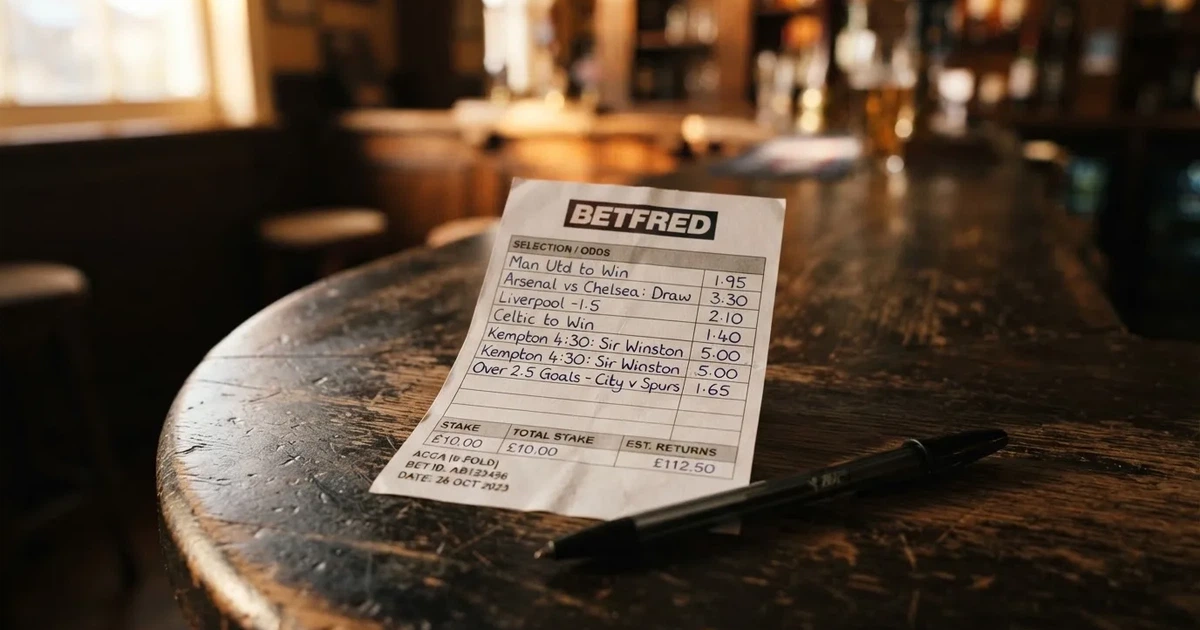
The cost is the part most punters underestimate. A Goliath at £1 a line costs £247. At 10p a line it is £24.70. Whatever any single leg returns, the overall payout is the sum of the 247 lines that win. The remaining lines still cost the same unit stake. The bookmaker’s margin sits inside every price on the slip, and the more legs a Goliath carries, the more edges the bettor is paying for. The reason to read this page before placing one is not the gimmick of 247 bets but the arithmetic of how that number lands on a betting slip and what it asks of a bankroll.
Data current as of 27 October 2026 against the Gambling Commission’s public register and the named operators’ own terms.
Reviewed bookmakers offering Goliath and full cover bets
The ten bookmakers below all hold a Gambling Commission remote licence for general betting on real events in Great Britain, and each one is checked against the public register. A Goliath is a standard market at mainstream UK bookmakers; specific availability depends on the sport and the event, so the table covers what the operator states about its multiples, accumulators and full cover bet products rather than promising Goliath as a button on the slip.
| Brand | Gambling Commission licence and holder | Operator’s terms on full cover and multiple bets |
|---|---|---|
| Fafabet | Account 57385, held by Taichi Tech Limited | Fafabet pays Best Odds Guaranteed on UK and Irish horse racing win and each-way bets from 9am on race days; if the starting price is bigger than the original price, the bigger odds are paid. Each-way terms apply to singles, doubles and combination bets. |
| Betway | Account 39372, held by Betway Limited | Betway’s full cover and accumulator products follow its general sports rules; minimum stake and maximum payout limits vary by sport and market. Free bet tokens credited on settlement cannot be used on certain market types. |
| Bar One Racing | Account 56516, held by Bar-One Racing Limited | Bar One Racing operates as BAR 1 Betting with shops across Ireland and sponsorships at Dundalk, Fairyhouse, Navan, The Curragh, Curraheen Park and Cork; the online arm supports accumulators and combination bets. |
| Unibet | Account 45322, held by Platinum Gaming Limited | Unibet has operated since 1999; its UK site runs under a Gambling Commission licence and supports full cover bets across sports. Combination bet settlement follows the general sports terms and per-event rules. |
| DAZN Bet | Account 48756, held by DZBT Limited | DAZN Bet offers Cash Out, Bet Builder, daily bet boosts and in-play betting; cash out availability is not guaranteed and bets stand if it is unavailable. Multiple bet settlement is governed by the operator’s terms. |
| Midnite | Account 101839, held by Midnite Limited | Midnite supports in-play events, an acca builder, popular accas and price boosts with maximum-stake limits shown per market. Free bet terms apply to the welcome offer and any ongoing promotion. |
| Sporting Index | Account 27343, held by Sporting Index Limited | Sporting Index combines fixed-odds and spread betting; full cover bets on fixed-odds selections settle under the fixed-odds terms, with the spread products governed by separate spread betting rules. |
| BetMGM | Account 39198, held by LeoVegas Gaming PLC | BetMGM supports accumulators and combination bets; minimum stake, maximum payout and any sport-specific restrictions are set per market. The welcome offer splits free bets into acca and multiple categories. |
| Fitzwilliam Sports | Account 48760, held by SBKI Limited | Fitzwilliam Sports bases prices on Oddschecker’s average price for each selection, and supports accumulators and multiple bets across the sports it prices. Apple and Google mobile apps carry the same product. |
| Octobet | Account 62545, held by Octopus Game Limited | Octobet offers Best Odds Guaranteed on UK and Irish horse racing, up to £150 per customer per race. Combination bet and full cover bet terms follow the operator’s general sports rules. |
The names are the read. None of these ten is “the only” licensed brand — the Commission’s register lists far more, and a slot in any comparison is not a licence in itself. Every GB-licensed online operator takes part in GAMSTOP and is bound by the same advertising and safer-gambling rules; what differs is product depth, price and the small print on each bookmaker’s multiples.
Verdict on the reviewed set
A Goliath is mechanical, not magical. The bookmaker’s edge compounds across 247 lines, so the operator that prices closest to the true odds on each leg returns the most when the bet lands. A punter comparing sites for a Goliath should check the maximum payout ceiling per bet at each bookmaker — a long-priced multiple with one winner at 100/1 can run into the cap before settlement, and a high cap or no cap matters more on a Goliath than on a single. Spreadex, which offers fixed-odds sports alongside its FCA-regulated spread book, sits outside this set because its headline product is financial spread betting, where losses can exceed the deposit.
The fundamentals of how a Goliath is built
A Goliath is one entry on a betting slip that the bookmaker splits into 247 separate bets. Eight selections feed it. The 247 lines are: 28 doubles, 56 trebles, 70 four-folds, 56 five-folds, 28 six-folds, 8 seven-folds and 1 eight-fold accumulator. No singles. No Lucky-style singles wrapper. The shape follows the general rule of a full cover bet, which is every available multiple bet over a given number of selections, with the singles stripped out.

The arithmetic of the line count is the binomial coefficient. For a full cover bet on *n* selections, the number of bets of size *k* is *n* choose *k*, summed over *k* from 2 to *n*. For a Goliath (*n* = 8) the sum is 28 + 56 + 70 + 56 + 28 + 8 + 1 = 247. The same rule gives the Canadian on 5 selections (26 bets: 10 doubles, 10 trebles, 5 four-folds and 1 five-fold), the Heinz on 6 (57 bets: 15 doubles, 20 trebles, 15 four-folds, 6 five-folds and 1 six-fold) and the Super Heinz on 7 (120 bets). A Lucky 15 on 4 selections carries 15 bets because it includes 4 singles plus the 6 doubles, 4 trebles and 1 four-fold, so 4 + 11 = 15; Lucky 31 and Lucky 63 extend the same pattern to 5 and 6 selections.
The unit stake is the figure the punter chooses. Each of the 247 lines carries that same unit stake, so the total outlay is 247 × unit stake. A Goliath at £1 a line is a £247 bet. A Goliath at 50p a line is a £123.50 bet. The win on any line is unit stake × (decimal odds − 1), and the lines settle independently — a treble that wins pays out even if a four-fold on the same leg fails because another leg in the four-fold loses.
The word “cover” in “full cover bet” is a description, not a promise. A Goliath does not cover the singles, so a punt on eight selections that all win still pays the singles nothing. A Lucky 15 on four selections, by contrast, pays the four singles plus the doubles, trebles and four-fold. The difference is structural, and a punter moving from Lucky 15 to Goliath is paying for multiples only.
The practical consequence is the bankroll. A Goliath at 10p a line costs £24.70; at 50p it costs £123.50; at £1 it costs £247. Most punters run a Goliath at a small unit stake to spread the cost across the 247 lines, and the design rewards that: a single winning treble at 10/1 with a 10p unit stake returns about £1.10, a 100/1 four-fold at the same unit stake returns about £10.10. The payouts are scaled, not headline.
The landscape of full cover bets and where the Goliath sits
The family of full cover bets steps up by selection count. Each name carries a fixed number of bets. A punter picking one is choosing how many lines to fund and whether to include the singles.
| Full cover bet | Selections | Number of bets | Singles included? |
|---|---|---|---|
| Trixie | 3 | 4 | No |
| Yankee | 4 | 11 | No |
| Lucky 15 | 4 | 15 | Yes |
| Canadian (Super Yankee) | 5 | 26 | No |
| Lucky 31 | 5 | 31 | Yes |
| Heinz | 6 | 57 | No |
| Lucky 63 | 6 | 63 | Yes |
| Super Heinz | 7 | 120 | No |
| Goliath | 8 | 247 | No |
A Trixie on three selections is the smallest full cover bet: 3 doubles and 1 treble. A Yankee on four selections is 6 doubles, 4 trebles and 1 four-fold. The Lucky 15 adds the four singles, so a Yankee punter who wants singles included steps up to a Lucky 15 at four more bets and the same four selections. The Heinz on six selections is the family member most punters have heard of — its 57 lines cost a unit stake of 10p as £5.70 — and the Goliath is the eight-selection version at 247 lines. Above the Goliath the family stops; punters wanting more legs either drop back to a Super Heinz or build a custom accumulator.
The shape of the family explains why a Goliath costs what it does. Going from a Heinz (6 selections, 57 bets) to a Super Heinz (7 selections, 120 bets) more than doubles the line count. Going from a Super Heinz to a Goliath (8 selections, 247 bets) more than doubles it again. Each extra selection adds every multiple that contains it: one new single, one new pair, one new treble, and so on. The cost curve is steep, and a punter’s bankroll determines how far up the curve they can climb.
What the Goliath leaves out
A Goliath does not include any singles. A punter who wants a single bet on each of the eight selections pays for that separately, on top of the 247 lines, at 8 × unit stake. The trade is clear: the Goliath concentrates the stake on combinations, and the punter is betting that at least one of the 247 lines will produce a meaningful return. In practice, the singles are the most likely lines to win outright, and a Goliath is a long-shot structure by design.
The Goliath also leaves out the Lucky-style “if one leg wins” consolation. A Lucky 15 with one winner and three losers returns a small amount on the single; a Goliath with one winner and seven losers returns nothing on that line, because there is no single. The consolation rule of a Lucky 15 does not exist in a Goliath. The bettor is buying a structure that pays only on combinations, and the absence of singles is the structural cost.
How a Goliath settles — the order in which a punter finds out what the bet paid
A Goliath settles one line at a time. The bookmaker computes each of the 247 bets separately and credits the winning ones. A line settles as a winner when every leg of that multiple wins. A line settles as a loser when at least one of its legs loses. Non-runners void the affected lines under the bookmaker’s standard rules; a Rule 4 deduction may apply to a winning leg in a race if a horse is withdrawn.
The settling order does not match the betting order. A bettor places eight selections and a unit stake, and the slip becomes a single Goliath entry. The bookmaker splits it into 247 lines internally and settles each on its own merits. The bettor does not see the lines broken out during settlement on a standard slip; the slip shows a running total, with the winning lines contributing and the losing ones subtracted. The headline figure the bookmaker displays is the net return.
The consequence is what a punter sees on the slip. A Goliath with four winners and four losers has won every double that pairs the four winners (6 doubles), every treble that includes only winners (4 trebles), the single four-fold, and nothing else. A Goliath with five winners and three losers has won 10 doubles, 10 trebles, 5 four-folds and the single five-fold. A Goliath with all eight winners has won every line. The full 247 lines pay out, the full unit stake is returned, and the total return is the sum of every line at its own decimal odds.
The punter’s experience is that the bet settles in stages. A first winner triggers the doubles that include it; a second winner adds the doubles pairing it with the first and the trebles built from the pair; a third, fourth, fifth and beyond each add their own multiples. The slip’s “to collect” figure rises as winners come in, and the figure stops rising as soon as any leg loses. A punter who watches the slip in real time can see the return shape as it builds, line by line.
The most common outcome for a Goliath is partial — a handful of winners out of eight — and a partial outcome produces a return that is small relative to the stake. The structure is built for the all-eight-winners scenario, and a partial result is a partial payout, not a near-miss consolation. A punter who treats the bet as a long shot and sizes the unit stake accordingly is closer to the design intent.
The statute: who is allowed to offer a Goliath in Great Britain
The Gambling Commission is the regulator of commercial gambling in Great Britain under the Gambling Act 2005. The Act covers England, Scotland and Wales; Northern Ireland is outside the Act and runs on its own older law. A bookmaker serving customers in Great Britain needs a Gambling Commission licence, and the Commission’s public register is the test of who holds one. Since the Gambling (Licensing and Advertising) Act 2014, an operator whose remote facilities are used in Great Britain needs a Commission licence wherever it is based. A Curaçao, Maltese or Gibraltar licence is not a substitute, and an offshore-only brand has no place on a GB customer’s slip.

The relevant licence category for sports betting is the remote general betting standard (real events) licence. Pool betting runs under its own licence; a betting exchange runs under a betting intermediary licence; virtual events run under a separate category. A Goliath is a sports bet, and the licence that covers it is the remote general betting standard (real events) licence, which is the category every operator in the reviewed set holds.
There is no statutory list of permitted bets. The operator holds a category licence and offers markets under its own rules and the Licence Conditions and Codes of Practice (LCCP). A Goliath is a market like any other — the bookmaker offers it under its multiples product, the operator’s terms govern it, and the LCCP sets the surrounding conduct rules. In-play betting is offered by GB bookmakers, and the controls are the operator’s licence conditions and customer-protection duties; nothing in statute makes in-play “unrestricted”, and the framing “unrestricted” is a marketing word rather than a legal conclusion.
Betting duty is the operator’s tax, not the player’s. General Betting Duty is the tax on gross profits, currently 15%; a new remote betting rate of 25% within General Betting Duty applies from 1 April 2027, while remote bets on UK horse racing, self-service betting terminal bets, pool betting and in-person betting stay at 15%. The punter pays no tax on betting winnings in Great Britain; whether operators pass duty on through odds is not established, and a punter who wants to know what a price “really” costs them looks at the margin inside the odds, not at duty.
The credit card ban under LCCP condition 6.1.2 means a GB-licensed bookmaker does not accept credit cards for gambling, including credit-card-funded payments through an e-wallet. Debit cards and bank-based payments are not covered. A punter who funds a Goliath with a credit card through an e-wallet is funding it illegally, and the licensed bookmaker will not process the deposit.
Advertising of betting offers runs through the CAP Code (non-broadcast) and BCAP Code (broadcast), enforced by the ASA, alongside the LCCP marketing conditions. Promotion rules in force since 19 January 2026 cap wagering requirements on bonuses at 10x and ban mixed-product promotions. The “whistle-to-whistle” rule is an industry code, not a statute: since 1 August 2019 betting ads are not shown on TV from five minutes before a live sporting event to five minutes after, before the 9pm watershed (horse and greyhound racing excluded). The Premier League clubs’ withdrawal of gambling sponsorship from the front of matchday shirts from 2026/27 is voluntary, not law.
The enforcement frame is unlicensed, not licensed. Providing gambling facilities in Great Britain without the licence the Act requires is an offence under section 33 of the Gambling Act 2005, aimed at the operator. The Commission’s tools are cease-and-desist notices, search-engine referrals, work with registrars, hosts and payment providers, and court-order DNS blocking powers the Commission has been given or is about to receive. The punter who bets on an unlicensed site loses the protection of the regime: no GAMSTOP coverage, no Commission complaints route, no approved dispute-resolution body, no British consumer redress if funds are withheld, and no application of the 10x bonus cap or the £150 vulnerability check. The framing is honest: licensed = checks, limits, GAMSTOP, bonus cap, but also verification before the first bet; unlicensed = none of those protections and possible loss of funds. Neither is the safe choice by default.
Jurisdiction in plain words
A Goliath placed at a GB-licensed bookmaker is governed by the Gambling Commission’s regime: the operator’s terms, the LCCP, the ASA’s advertising rules and the Commission’s enforcement. A Goliath placed at an unlicensed site is governed by the operator’s house rules, with no British consumer protection behind it. A punter who knows the difference is not a punter who is told the difference, and a punter who cannot check the Commission’s register is betting on a bookmaker’s word.
Safeguards: what the responsible gambling frame does to a Goliath
GAMSTOP is the national multi-operator online self-exclusion scheme and a mandatory licence condition for online operators since 31 March 2020. A punter who signs up to GAMSTOP self-excludes from every GB-licensed online operator for a chosen period: six months, one year, five years, or five years with auto-renewal. After the minimum period the exclusion stays in place for a further seven years unless the customer asks GAMSTOP to remove it. GAMSTOP covers online sites and apps; betting shops use a separate service. A punter on a GAMSTOP exclusion cannot place a Goliath at any GB-licensed bookmaker.
The financial vulnerability check (LCCP condition 3.4.4, in force since 30 August 2024) applies to licensed remote betting when a customer’s deposits minus withdrawals exceed £150 in a rolling 30 days (since 28 February 2025). The check is a public-record check (bankruptcy, county court judgments), not an income check and not a credit reference check. A punter whose Goliath staking crosses the £150 monthly net-deposit line triggers the check on the next deposit. Financial risk assessments — the “affordability checks” of the press — were announced by the Commission in a staged plan, with no start date. The framing for the page is “announced, staged, no start date”, not “in force”.
Deposit limits are a licence requirement, not a state cap. Operators must offer a gross deposit limit on a fixed time frame; the first changes have applied since 31 October 2025, a second phase was postponed to 30 September 2026, and whether the second phase is live is not established. There is no state-set deposit or loss ceiling for betting. A punter’s maximum stake is the customer’s choice, the operator’s per-market cap, and the punter’s own affordability.
Identity verification is the gate. Since 7 May 2019, name, address and date of birth are verified before a customer can deposit or gamble, including with a free bet or bonus. The process is part of the anti-money-laundering regime and is also the route by which a self-excluded punter is caught. A Goliath cannot be placed anonymously at a GB-licensed bookmaker.
The help line behind all of this is the National Gambling Helpline, run by GamCare, alongside GambleAware, the NHS gambling clinics and Gamblers Anonymous. The help is free, confidential and outside the operator’s control. A punter who is sizing a Goliath at a unit stake that the bankroll cannot absorb has crossed from a betting decision into a gambling problem, and the help is one call away.
The safeguard a Goliath punter is most likely to meet
The verification check is the one that lands first. A new punter at a GB-licensed bookmaker is asked for photo ID and proof of address before the first deposit. The check takes minutes for an automated match and longer for a manual review. A punter who fails the check cannot deposit, cannot claim a welcome offer, and cannot place a Goliath. The frame is the front door, and the punter who cannot get through it is not a punter at all.
Strategy: what a Goliath can and cannot do for a bankroll
A Goliath is a long-shot structure. The bet pays a meaningful return only when a run of winners develops, and the design cost — 247 lines of unit stake — is paid up front regardless. The strategies that work for a Goliath are the strategies that work for any full cover bet: pick selections whose combined probability of winning is high enough to support the line cost, and size the unit stake to the bankroll.
The common mistake is treating the Goliath as a Lucky 15 with more legs. A Lucky 15 returns on a single winner; a Goliath does not. The common mistake is also treating the Goliath as a “jackpot” bet that pays for itself. A punter who picks eight 1/2 shots and expects a return is buying 247 lines at prices that already carry the bookmaker’s margin, and the structure is unkind to favourites. A Goliath with eight short-priced winners returns less than the stake, because each line’s expected value is below 1 once the margin is paid.
The arithmetic of a Goliath at 10p a line with eight 1/2 (1.50 decimal) shots: each line has an expected value of about 0.95 once the margin is paid (a 1/2 shot at 1.50 is a 5% margin in a 50/50 market, so the expected return is about 95p for every £1 staked). The 247 lines, all of which win, return 247 × 10p × 1.50 = £37.05. The stake is £24.70. The punter is up £12.35, before the bookmaker’s margin on the price of each leg erodes the figure. A Goliath of 10/1 shots at 10p a line, all eight winning, returns about 247 × 10p × 11 = £271.70, against a stake of £24.70, but the probability of all eight 10/1 shots winning is far lower than the probability of eight 1/2 shots winning. The structure’s edge is the relationship between the payout and the line cost, and the punter picks the price tier to suit the bankroll.
The strategies that read on a Goliath page are the strategies of any full cover bet, applied to a bigger line count. Pick strong favourites if the bankroll cannot absorb 247 lines of stake at a meaningful size; pick long shots if the bankroll is small and the unit stake is the minimum. Each-way terms apply to combination bets, and a Goliath placed each-way doubles the line count to 494. The punter who places an each-way Goliath at £1 a line pays £494, and the place terms of each race in the bet determine whether the place leg pays.
The system the marketing calls “a Goliath system” is the structure itself. There is no proprietary algorithm. A punter who builds a Goliath on eight selections is using the system; a punter who adds their own stake sizing and selection logic is making the system their own. The bookmaker’s edge is fixed by the margin on each leg, and the punter’s edge is the difference between their own estimate of each leg’s probability and the bookmaker’s price.
Bankroll management for a Goliath
The unit stake is the variable. A punter with a £50 bankroll does not place a £1 Goliath; a punter with a £500 bankroll does not place a £10 Goliath. The bettor’s rule of thumb is to stake no more than 1–2% of the bankroll on any single full cover bet, and a Goliath at the upper end of that range is already a £10 bet on a £500 bankroll. The 247 lines at 10p a line are a £24.70 bet on a £500 bankroll, and that is a sensible ceiling. The punter who chases a Goliath with a stake that the bankroll cannot absorb is the punter the responsible gambling frame is built to catch.
Bet types, odds and the arithmetic of what a Goliath pays
A Goliath pays 247 lines, each at its own decimal odds. The decimal odds of a multiple are the product of the decimal odds of the legs, minus 1 for profit. A treble on 1.50, 2.00 and 2.50 has decimal odds of 7.50 and a profit multiple of 6.50. A four-fold on the same three plus a 1.80 shot has decimal odds of 13.50 and a profit multiple of 12.50. The 247 lines of a Goliath have 247 different decimal odds, and the 247 returns at a unit stake are 247 different figures.
The illustrative example below is a working example at 10p a line, not a quoted price. The selections are three: at 1/2 (1.50), at evens (2.00) and at 6/4 (2.50). A treble on the three at £10 returns 10 × (1.50 × 2.00 × 2.50) = 10 × 7.50 = £75, with a profit of £65. A double on the 1.50 and 2.00 at £10 returns 10 × 3.00 = £30, with a profit of £20. A double on the 2.00 and 2.50 at £10 returns 10 × 5.00 = £50, with a profit of £40. A double on the 1.50 and 2.50 at £10 returns 10 × 3.75 = £37.50, with a profit of £27.50.
For a full cover bet on the same three selections at £2 a line, the total stake is 4 × £2 = £8 (a Trixie). The doubles and the treble settle independently. If all three win, the doubles return £6 + £10 + £7.50 = £23.50, and the treble returns £15, for a total return of £38.50 against a stake of £8. If two of the three win, only the corresponding double returns. A treble on three 1.50 shots at £10 each leg returns 10 × 3.375 = £33.75, with a profit of £23.75; a treble on three 2.00 shots returns 10 × 8.00 = £80, with a profit of £70.
A Goliath is the same arithmetic on eight selections. The unit stake applies to every line, the line cost is 247 × unit stake, and the payout is the sum of the winning lines at their own decimal odds. The bookmaker’s margin on each leg sits inside the price, and the more legs the Goliath carries, the more edges the punter is paying for. A punter who wants the lowest compounding margin picks the bookmaker whose price on each leg is closest to the true odds; a punter who wants the highest payout ceiling picks the bookmaker with the highest per-bet cap.
Why the headline payout is not the real payout
A bookmaker’s marketing shows a “max payout” on a multiple. The figure is a ceiling, not a typical return. A Goliath that wins all eight legs at long prices can exceed the per-bet cap, and the punter receives the cap. A Goliath that wins all eight legs at short prices returns less than the cap and pays out the full calculated figure. The cap is set per bookmaker and per sport, and a punter checking the cap before placing a Goliath is reading the small print the marketing does not show.
The bookmaker’s margin is the figure the marketing never shows. A 5% margin on a market means the payout share is 95% and the punter’s expected return is 95p for every £1 staked across the long run. A 10% margin means 90p. A Goliath of 247 lines at 5% margin per leg has a compounded expected return of 95% on each line, and the punter’s expected return on the all-eight-winners scenario is the product of 247 individual line expectations. The figure is a long-run average, not a guaranteed return on a single bet.
A worked return at 10p a line
A Goliath at 10p a line costs £24.70. If all eight legs win and the average decimal odds across the 247 lines is 12, the total return is 247 × 10p × 12 = £296.40, with a profit of £271.70. If five of the eight legs win and the average decimal odds across the winning lines is 6, the total return is 121 × 10p × 6 = £72.60, with a profit of £47.90. If only two legs win, only the single double returns, at 247 × 10p ÷ 247 lines × 1 double, and the punter is down the rest of the stake.
The band of returns is wide. A Goliath of 247 lines is a structure that pays well on a long run of winners and pays poorly on a short run. The punter who sizes the unit stake to absorb the loss of the 247 lines on a 0–2 winner outcome is sizing the bet to the structure. The punter who sizes the unit stake on the assumption of a return is sizing the bet to a marketing word.
How a punter checks a bookmaker’s licence
The Gambling Commission’s public register is the test. The register is searchable by business name, trading name, domain or account number, and a brand’s licence status is shown on the page that comes back. The page lists the licence categories, the licence holder (which may be a different company from the trading brand) and the licence’s status. A punter who types the trading name into the register gets the answer in seconds.
A punter who wants to be thorough also checks the licence holder against the brand. A Ladbrokes customer and a Coral customer are both customers of the same licensee under most UK brands; the same is true of Paddy Power and Betfair. A punter who sees a brand claiming a Commission licence checks the licence holder to make sure the brand is part of the same group. The point is not to mistrust the operator; the point is to read the register the way the register is meant to be read.
The register does not show offers, prices or product features. A licensed brand can be expensive, restrictive or short on markets. The licence is a permission to operate, not a quality mark. The punter’s check for product is the operator’s own terms, the bet builder, the in-play markets, the maximum payout and the welcome offer’s small print. A punter who reads the register and the terms is the punter the regime is built for.
What a licence number looks like
A remote betting licence shows a Commission account number (a five-digit number) and a remote licence number in the format 0NNNNN-R-NNNNNN-NNN. The account number is the operator’s ID; the remote licence number is the licence that allows the operator to take remote bets in Great Britain. The punter who wants to copy the number into the register’s search box uses the account number; the punter who wants the long form for an audit trail uses the remote licence number. Both are valid identifiers.
The register also lists the licence categories: remote general betting standard (real events), remote general betting standard (virtual events), remote general betting limited, remote pool betting and remote betting intermediary. A punter checking a sports book for a Goliath looks for the remote general betting standard (real events) category. A punter checking a betting exchange looks for the remote betting intermediary category. A punter checking a pool operator looks for the remote pool betting category. The categories are listed on the register’s licence page.
What the bookmaker’s margin looks like inside the odds
The margin is what the bookmaker keeps of every unit bet on a market. The payout share is 1 minus the margin. On a 1X2 football market priced at 2.10, 3.40 and 3.50, the implied probabilities are 1 ÷ 2.10 = 47.6%, 1 ÷ 3.40 = 29.4% and 1 ÷ 3.50 = 28.6%. The sum is 105.6%, and the margin is 5.6%. The payout share is 94.4%, and a punter staking £1 across the three outcomes in proportion to the implied probabilities receives 94.4p back on average.
The margin is a property of the market, the bookmaker and the snapshot. A 1X2 football margin is not the same as a totals margin, a handicap margin or a combination bet margin. A Premier League margin is not the same as a Scottish Premiership margin. A bookmaker’s 1X2 margin on Liverpool v Arsenal is not the same as the same bookmaker’s 1X2 margin on a lower-division match. The margin is set by the bookmaker’s pricing team and reflects liquidity, competition and the bookmaker’s own exposure.
A Goliath’s effective margin is the compounded margin on its 247 lines. A bookmaker with a 5% per-leg margin on each of the eight legs has an effective margin on the all-eight-winners line that is closer to 1 − (0.95)^8 = 34%, before the leg-by-leg compounding. The bookmaker’s edge is large on a long-odds multiple, and the punter’s long-run expected return on a Goliath is correspondingly lower than on a single bet. A Goliath pays because the legs are usually short-priced and the punter picks the strongest favourites; a Goliath punter who picks eight long shots is paying a heavy margin for a long-odds multiple that rarely lands.
Reading the margin on a betting slip
The slip does not show the margin. The punter who wants to see the margin adds the implied probabilities of the outcomes on a market and subtracts 100%. A 5% margin on a 1X2 is a 105% book; a 2% margin is a 102% book. The punter who reads the slip as a list of odds is missing the figure the bookmaker’s pricing team sets; the punter who reads the slip as a list of implied probabilities is reading the margin.
The same rule applies to a combination bet. A double on two events has an effective margin of 1 − (1 − m₁) × (1 − m₂), where m₁ and m₂ are the per-leg margins. A 5% margin on each leg gives an effective margin of 1 − 0.95 × 0.95 = 9.75%. A treble on three 5% legs gives 1 − 0.95³ = 14.3%. A Goliath on eight 5% legs gives 1 − 0.95⁸ = 34%. The compounding is steep, and the punter who treats a Goliath as a “value” bet is treating the long-run compounding as a marketing word.
The worked example in plain prose
Assume a punter picks eight selections at the following decimal odds: 1.50, 1.80, 2.00, 2.20, 2.50, 3.00, 4.00 and 6.00. A Goliath at 10p a line costs £24.70. If all eight legs win, the accumulator pays 10p × 855.36 = £85.54. The seven-fold accumulators pay six figures; the six-folds pay more, and so on down the 247 lines. The total return on a fully successful Goliath at these prices is the sum of all 247 lines, which is several hundred pounds at 10p a line.
If five of the eight legs win — say the 1.50, 1.80, 2.00, 2.20 and 2.50 — the winning lines are 10 doubles, 10 trebles, 5 four-folds and 1 five-fold on those five legs. The punter’s return is 10p × (sum of 10 doubles + 10 trebles + 5 four-folds + 1 five-fold at the five-leg prices). The five-fold alone pays 10p × (1.50 × 1.80 × 2.00 × 2.20 × 2.50) = 10p × 29.70 = £2.97. The four-folds and trebles and doubles add their own contributions, and the total return at 10p a line on a 5-of-8 outcome is in the tens of pounds, against a stake of £24.70.
If only two legs win — say the 1.50 and 1.80 — the only winning line is the single double, paying 10p × 2.70 = £0.27. The punter is down £24.43 on the bet. A 3-of-8 outcome pays only the three doubles; a 4-of-8 outcome adds the four trebles. The shape of the payout is built for the all-eight-winners scenario, and the punter who treats a Goliath as a long shot sizes the unit stake accordingly.
The result, stated as a band: a fully successful Goliath at 10p a line on a moderate set of prices returns several hundred pounds; a 5-of-8 outcome returns a modest sum; a 4-of-8 outcome returns a small sum; a 3-of-8 or worse returns a small fraction of the stake. The condition on the band is the price of each leg and the count of winners, and the punter’s experience is the line-by-line settlement the slip shows in real time.
Practical notes on running a Goliath at a UK bookmaker
A Goliath is a standard market at the reviewed set. The product is a multiple bet on the slip, and the bookmaker splits the entry into the appropriate number of lines. The punter’s choice is the unit stake; the bookmaker’s choice is the maximum payout per bet, the maximum number of selections, and the markets available for combination bets.
A punter who places a Goliath at a bookmaker with a low maximum payout cap may find the all-eight-winners payout capped below the calculated figure. A punter who places a Goliath at a bookmaker with a high cap receives the full calculated figure up to the cap. A punter who places a Goliath on each-way terms doubles the line count and the stake, and the place terms of each race determine the place leg’s payout.
The slip shows a running total. The punter watches the figure rise as winners come in and stops watching when the figure stops rising. A punter who cashes out a Goliath before settlement receives a bookmaker-set figure, not a calculated one, and the cash-out figure reflects the bookmaker’s estimate of the remaining legs. The cash-out figure is not the slip’s running total; the slip’s running total is the figure that would be paid on full settlement. The punter who cashes out before the last leg accepts the bookmaker’s price for the position; the punter who lets the bet settle takes the calculated return on the winning lines.
A Goliath is not a Bet Builder. A Bet Builder is a same-game accumulator built from markets on one event; a Goliath is a multi-event multiple built from selections across up to eight events. The two products live alongside each other at UK bookmakers, and a punter who wants both can place a Bet Builder as one of the eight legs of a Goliath, with the Bet Builder settling as a single leg at its own combined odds.
Closing the page: what the Goliath actually is
A Goliath is a 247-line full cover bet on eight selections. It is mechanical, not magical, and the cost is 247 times the unit stake. The bookmaker’s margin sits inside every price, and the margin compounds across the 247 lines. The bettor who picks the strongest favourites and sizes the unit stake to absorb a 0–2 winner outcome is using the structure the way the structure is designed to be used; the bettor who chases a Goliath with a stake the bankroll cannot absorb is using the structure the way the responsible gambling frame is built to catch.
The 10 reviewed bookmakers all hold a Gambling Commission remote licence for general betting on real events, and each one supports combination bets under its own terms. The check is the Commission’s public register; the cap is the bookmaker’s per-bet maximum payout; the each-way doubling is the bookmaker’s place terms. The arithmetic is decimal, the line count is 247, and the punter’s edge is the difference between the punter’s own estimate of each leg’s probability and the bookmaker’s price.
The page is the description, not the direction. A punter who reads the structure, the cost, the margin and the register is the punter the regime is built for; a punter who reads the marketing is the punter the marketing is built for.
Frequently Asked Questions
What is a Goliath bet?
A Goliath bet is a full cover multiple spread across eight selections, with 247 separate bets covering every combination of two or more of the eight, and no singles included. The bet costs 247 times the unit stake, and the lines settle independently: a treble on three of the eight winners pays out even if a four-fold on the same three fails. The 247 lines are 28 doubles, 56 trebles, 70 four-folds, 56 five-folds, 28 six-folds, 8 seven-folds and 1 eight-fold accumulator. A Goliath does not include any singles, and the Lucky-style “if one leg wins” consolation of a Lucky 15 does not apply.
How many bets are in a Goliath?
A Goliath has 247 bets. The number is fixed: 28 doubles, 56 trebles, 70 four-folds, 56 five-folds, 28 six-folds, 8 seven-folds and 1 eight-fold accumulator. The general rule is that a full cover bet on n selections has the sum of binomial coefficients from 2 to n; for n = 8 the sum is 247. A unit stake of 10p a line costs £24.70; a unit stake of £1 a line costs £247. A Goliath placed each-way doubles the line count to 494 and the stake accordingly.
How does a Goliath bet work?
A Goliath is a single entry on the betting slip that the bookmaker splits into 247 internal lines. The bettor picks eight selections and a unit stake, and the slip becomes one Goliath. The bookmaker settles each of the 247 lines separately: a line is a winner when every leg of that multiple wins, and a loser when at least one leg loses. The slip shows a running total of winning lines minus the unit stake cost, and the figure rises as winners come in. The payout is the sum of the winning lines at their own decimal odds, and the bookmaker’s margin sits inside each leg’s price.
How can a punter check that a bookmaker holds a Gambling Commission licence?
The Gambling Commission’s public register is the test, and the register is searchable by business name, trading name, domain or account number. A punter types the trading name into the register’s search box and reads the licence page that comes back. The page lists the licence categories, the licence holder, the licence number, and the licence’s status. The remote general betting standard (real events) category is the one that covers sports betting; a punter who wants a Goliath checks that category on the licence page. A licensed brand can be expensive or restrictive, and the licence is a permission to operate, not a quality mark.
How is the return on a bet worked out from the stake and the odds?
The return is stake multiplied by the decimal odds. Decimal odds include the stake, so a £10 bet at 2.50 returns £25, with a profit of £15. The profit is stake multiplied by (decimal odds minus 1). A multiple bet’s decimal odds are the product of the legs’ decimal odds, and a treble on 1.50, 2.00 and 2.50 has decimal odds of 7.50 and a £10 stake returns £75. The bettor checks decimal odds, applies the formula, and reads the figure on the slip before confirming the bet. A bookmaker’s marketing may show a different return in fractional odds; the conversion is fractional a/b to decimal a ÷ b + 1, so 5/1 is 6.00 and 11/4 is 3.75.
What is the bookmaker’s margin and how can it be seen in the odds?
The margin is what the bookmaker keeps of every unit bet on a market. The payout share is 1 minus the margin. On a 1X2 market priced at 2.10, 3.40 and 3.50, the implied probabilities are 1 ÷ odds for each outcome, and the sum is 105.6%, giving an overround of 5.6%, a margin of 5.3% and a payout share of 94.7%. The margin is a property of the market, the bookmaker and the snapshot: a 1X2 margin is not a totals margin, and a Premier League margin is not a Scottish Premiership margin. A Goliath’s effective margin is the compounded margin on its 247 lines, and a 5% per-leg margin on each of the eight legs gives an effective margin on the all-eight-winners line of 1 minus 0.95 to the 8th, around 34%. The bookmaker’s edge is large on a long-odds multiple, and the punter’s long-run expected return is correspondingly lower than on a single bet.
Bet types & in-play – Free bets
Content created by the «Free bets» team
