
Darts betting tips and bookmakers for the 2026 season
 Available in US
A punter typing “darts betting tips” into a search bar is usually looking for one thing: a name to back tonight. The market is not built that way. Tips age in minutes, the field is small enough that one upset wipes a form table, and the bookmaker’s price has already done half the analyst’s work before the analyst opens a spreadsheet. The honest guide to darts betting is a guide to reading the price, the structure of the tournament and the conditions attached to any offer — and to knowing which of those numbers actually move the needle.
Data on this page is current as of 27 October 2026 and the operator licences were checked against the Gambling Commission’s public register.
The ten bookmakers for darts in Great Britain
The shortlist is the shortlist because each operator is licensed to take remote bets from customers in Great Britain. The Commission’s public register is the whole test, and the list below names the brands whose licence was active at the snapshot date. Within that floor, the ranking is the page’s own judgement of which operator suits which kind of bettor — the one with the deepest tournament coverage, the one that settles fastest, the one that runs the kind of in-play market the next match needs.

The table carries the three matters the comparison is built on: the Gambling Commission licence number and the company that holds it, and what the operator’s own published terms say about the offer or feature in question. Cells the operator’s terms do not cover take the article-language no-data marker.
| Brand | Licence and holder | What the operator’s terms state |
|---|---|---|
| Paddy Power | 039439-R-319330-013, held by PPB Counterparty Services Limited | App shows Bet Builder+, Popular Bet Builders, Super Sub, expanded Win More markets, plus player and ACCA stats |
| Betmaster | 065699-R-339929-002, held by BM Solutions GB Ltd | Malta-registered operator states Gambling Commission account 65699 |
| BetGoodwin | 002927-R-327985-008, held by Goodwin Racing Limited | Best Odds Guaranteed on all UK and Irish horse and greyhound racing, capped at £1,000 |
| Sporting Index | 027343-R-308898-011, held by Sporting Index Limited | £10 fixed-odds qualifying bet at minimum 1/2 unlocks a bundle of fixed-odds and spread free bets; qualifying bet cannot be placed in play or cashed out early |
| LiveScore Bet | 056859-R-332720-005, held by LiveScore Betting and Gaming (Gibraltar) Limited | Debit cards, Apple Pay, PayPal, Pay by Bank (Open Banking) and Revolut Pay accepted |
| Midnite | 101839-R-342850-001, held by Midnite Limited | In-play markets, acca builder, popular accas and price boosts with maximum-stake limits shown on the slip |
| DAZN Bet | 048756-R-327274-019, held by DZBT Limited | Deposits from £5 by debit card, Apple Pay, Paysafecard, Trustly and Skrill, from £20 by PayPal; no processing fees |
| Lottoland | 038991-R-319408-020, held by EU Lotto Limited | Casino, lottery betting, sports betting and scratchcards under one Gambling Commission licence for GB customers |
| Fitzwilliam Sports | 048760-R-335434-009, held by SBKI Limited | Phone and live chat open 09:00 to 21:00, every day; messenger replies generally within 90 seconds |
| William Hill | 039225-R-319373-015, held by WHG (International) Limited | Best Odds Guaranteed on UK and Irish horse racing from 8 AM on race day, on singles and multiples; excludes ante-post, tote and pari-mutuel |
The rest of the section is a short note on each operator, ending on the page’s verdict. A reader who only wants the shortlist can stop at the table; the notes that follow are for the reader who wants to know why each brand is in or out of contention for the way they actually bet.
Paddy Power — depth in the bet builder and the stats
Paddy Power is the brand a bettor comes to when the wager is the wager and the bettor wants every leg on one slip. The app shows Bet Builder+, a curated list of Popular Bet Builders that surfaces what other customers have been putting together, Super Sub — a bet rolls to the named replacement if a selected player pulls out — and an expanded Win More grid that opens more player props than the standard match-winner line. The ACCA stats panel sits next to the slip and pulls historical data into the bettor’s own view of a multi-leg wager. It is a heavier product than the minimum-viable sportsbook, and the bettor who wants a single match-winner line and a quick deposit has more direct options elsewhere.
Paddy Power is one of two brands in this comparison that share the Betfair and PPB family of licences; the other brand, Betfair, is not in the table because the comparison is on sportsbook product rather than exchange product. For a punter whose accumulator is the wager, the depth on this app is the reason to pick it.
Betmaster — the small-shop account with a UK licence
Betmaster is the small footprint in the line-up. The operator is run by BM Solutions GB Ltd out of Malta and holds Commission account 65699, which is the whole legal test for taking bets from customers in Great Britain. The product is a standard sportsbook; it does not advertise the breadth of the bigger names and the welcome offer is a quieter line in the promotions tab. The bettor who wants a quiet account, the licence certainty of a Commission-registered brand, and not the bells of the bigger shops will find that proposition reasonable.
The flip side is the one the marketing page will not show: depth of market in minor tournaments is not what the bigger books run, and a price on a Premier League Darts night may move on fewer bets than at the deeper books. The bettor who bets on the televised events only and not on the early-round qualifiers will not notice.
BetGoodwin — the racing-first book that does darts
Best Odds Guaranteed is the racing promise, capped at £1,000 per bet. Darts is the second pillar of the product, and the depth on the televised PDC nights is enough to put the main match and a few player markets on the slip. The bettor who bets the racing and slots a darts bet into the Saturday afternoon, and who wants the BOG safety net on the racing side, is the account this book is built for.
Where the brand loses ground is the dedicated darts product: there is no separate stats page, no bet builder of the size the bigger names run, and the in-play product is a thin panel rather than a full screen. For a bettor whose darts interest is one wager per televised night, that is plenty. For the bettor who builds accumulators out of player props, it is not.
Sporting Index — fixed odds and spread betting under one roof
Sporting Index sits in the comparison because it is a Commission-licensed remote operator, and it is the only one in the table that also offers spread betting on a sporting event. The welcome offer is a £10 fixed-odds qualifying bet at minimum 1/2, which unlocks three £10 fixed-odds free bets, three £5 Total Goals spread bets, three £5 Winning Favourites spread bets and a £1 Race Index spread bet; the qualifying bet cannot be placed in play and cannot be cashed out early. A punter who wants the spread side as well as the fixed-odds side gets both in one wallet.
The bettor who only wants fixed odds on darts will not use the spread leg and should not value the offer as if it were five times the size of a fixed-odds-only welcome. Read the legs. The pages of the smaller, spread-specific offers carry the kind of product disclosure a fixed-odds shop does not need to print; spread losses can exceed the deposit, and the brand carries the FCA registration for the financial-spread side and the Commission licence for fixed odds.
LiveScore Bet — the scoreboard route into a bet slip
LiveScore Bet piggybacks on the score-app traffic, and the bettor who already opens LiveScore for the live scores opens the same app for the wager. Deposits cover the modern rails — debit card, Apple Pay, PayPal, Pay by Bank (Open Banking) and Revolut Pay — and the in-play product is a thin panel under the live scores rather than a separate screen. For a punter who watches the match on the LiveScore app and wants the bet one tap away, the route is short.
The product on a darts night is a standard sportsbook: match winner, a small set of player props, a few correct-score lines, and an in-play panel. It does not run a deep bet builder, and the boosted-odds panel is lighter than the bigger shops. A bettor who wants the score-app convenience will accept that.
Midnite — the newer sportsbook with the in-play focus
Midnite is a Commission-licensed remote operator on account 101839, and the product is built around in-play markets, an acca builder, popular accas and price boosts — the last with maximum-stake limits shown on the slip. The welcome offer is a £5 pre-match bet at EVS (2.0) or greater within 14 days of sign-up, which returns £25 in free bets and 50 free spins valid for 7 days. The bettor who bets the in-play market and who wants a price boost on the slip is the customer the product is built for.
The wagering conditions on the free-bet leg are the part of the offer the marketing page will not print. A £25 free bet at minimum odds that research does not record has a turnover cost the bettor should price in before claiming.
DAZN Bet — the sports-media crossover
DAZN Bet is the brand that rides the DAZN subscription relationship. Deposits start at £5 by debit card, Apple Pay, Paysafecard, Trustly and Skrill, and at £20 by PayPal, with no processing fees on any of them. The sportsbook is built around the events DAZN broadcasts, and the darts product is the televised PDC tier. For a punter who already has the streaming subscription, the betting product is one app away and the deposit rails are the modern set.
The bettor who does not have the streaming tie-in and only wants the betting product is paying for a relationship they are not using. The price on a darts night is competitive, the in-play product is a thin panel, and the offer is a standard one rather than a market-leading headline.
Lottoland — the multi-product app for the casual punter
Lottoland is the lottery, scratchcard, casino and sports product in one app, and the bettor who plays a numbers bet at the weekend and a darts accumulator on a Wednesday finds the wallet in the same place. The sportsbook is not the deepest in the table: the match-winner market is well covered, the player-props market is shorter than the dedicated books, and the in-play product is the smaller end of the comparison.
For the punter who wants a single account for the lottery and the darts accumulator, the licence certainty and the consolidation are the offer. The bettor whose betting interest is the full PDC card and a bet builder of legs will not find it here.
Fitzwilliam Sports — the phone-and-chat bookmaker
Fitzwilliam Sports is the brand a bettor calls. The office is open 09:00 to 21:00 every day, with phone, live chat and messenger routes, and messenger replies generally within 90 seconds. The product is a sportsbook; the spread of markets on a darts night covers the televised events and a few minor ones. The bettor who places a bet by phone, who wants a person on the other end of the line, and who bets small and often is the customer the office is built for.
The price on a darts match is not always the best in the comparison, and the in-play product is light. The bettor who values the human route and the office hours will pay that small premium in price for the service.
William Hill — the established name with the racing infrastructure
William Hill is the longest-established brand in the comparison, and the racing infrastructure — Best Odds Guaranteed on UK and Irish racing from 8 AM on race day, on singles and multiples — is the offer the brand is known for. Darts runs as a standard sportsbook product, with the televised PDC events covered and a deeper set of player markets on the bigger nights. The in-play product is a separate screen, the bet builder is a full product, and the deposit rails are the modern set.
The bettor who already has a William Hill account from a racing interest and wants the darts product in the same wallet is the customer this entry suits. The BOG does not cover darts, and the bettor who only bets darts and never the racing will not get the headline offer.
The fundamentals of darts and what they mean for a bet
A standard dartboard has 20 numbered segments, each with single, double and treble areas; the bullseye is worth 50 and the outer bull 25. The segments are arranged around the board in a way the eye reads as order but the dart does not — the treble-20 sits at the top of the board and the field is calibrated to send most darts there, so the highest score on a single visit is the highest score the rest of the segment cluster makes possible. A 170 finish — treble 20, treble 20, bullseye — is the highest three-dart checkout the game allows. The minimum leg, the fastest a player can finish a 501 visit, is nine darts.
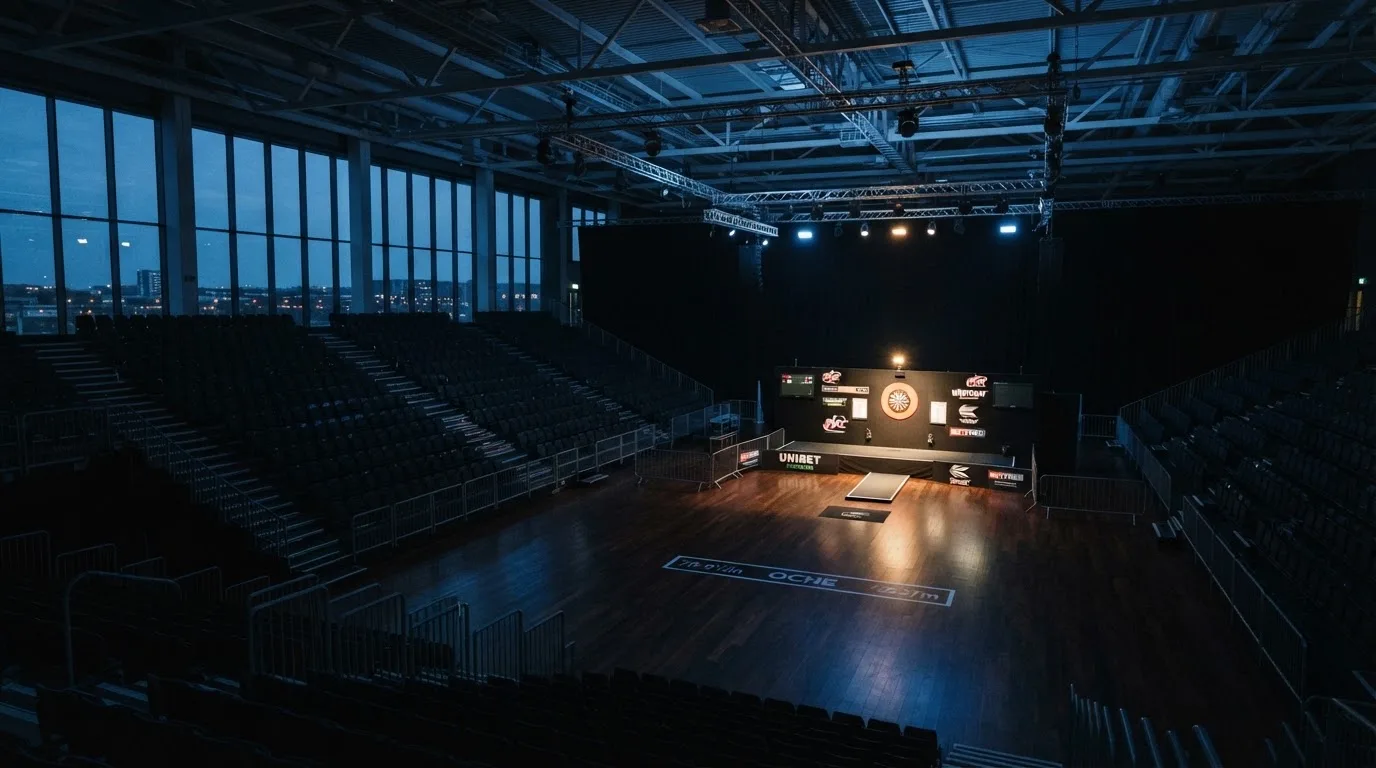
The throw distance is 2.37 m (7 ft 9 in) and the bullseye is 1.73 m above the floor. Both figures matter to a bettor: a stage at a televised event is rarely the regulation 2.37 m and the player’s history on the stage in question is a more reliable guide than the player’s history at a different venue.
In 501, the standard format, players start at 501 and must finish on a double or the bullseye. The rule is the one the betting market does not always reflect: a player can be on a maximum and still need a double, so a price on a checkout line is a price on the player’s history on a specific double, not a price on the player’s general scoring. The Premier League Darts format — the weekly televised tour — runs legs in a first-to format that turns on checkout percentage as much as on scoring, and a player with a 40 % checkout line under the league average will lose legs they were winning on the visit count.
The PDC is the highest governing body in professional darts alongside the World Darts Federation, and the PDC World Championship is the calendar’s anchor event, held over the Christmas and New Year period at Alexandra Palace in London. The 2026 PDC World Darts Championship ran from 11 December 2025 to 3 January 2026 at Alexandra Palace, with 128 players in the draw, an expansion from the 96-player field of earlier years, and a £5,000,000 prize fund with £1,000,000 to the winner. Luke Littler beat Gian van Veen 7–1 in the final. The format ran in tiers: rounds 1 and 2 first to 3 sets, rounds 3 and 4 first to 4, quarter-finals first to 5, semi-finals first to 6 and the final first to 7.
The format detail is the part the headline misses. A first-to-3 format in rounds 1 and 2 is a coin-toss in statistical terms — the shorter the format, the smaller the gap between the seed and the qualifier, and the bigger the upset frequency. The longer the format gets, the more a model’s separation holds, and a quarter-final price on the favourite in a first-to-5 reads differently from a round-1 price in a first-to-3 on the same match structure.
The legal frame in Great Britain
The Gambling Commission licenses the whole commercial market in Great Britain under the Gambling Act 2005. Northern Ireland is outside the Act and has its own older framework, so a Great Britain licence is a Great Britain licence and not a UK-wide one. Since the Gambling (Licensing and Advertising) Act 2014, an operator whose remote facilities are used in Great Britain needs a Commission licence wherever it is based — a Malta, Gibraltar or Curaçao licence is not a substitute, and the operator is the party the offence hits, not the customer.
There is no statutory list of permitted bets or markets, and the cap on licence numbers is none: the Commission issues licences against fit-and-proper tests and the LCCP, and the operator chooses what markets to run under its own category. In-play markets are offered by GB bookmakers and are governed by the operator’s licence conditions, not by a free-standing statute. The Commission’s public register can be searched by business name, trading name, domain or account number and is the whole test of whether a brand holds a licence at the snapshot date.
A few headline rules. Minimum age 18, and the operator must verify name, address and date of birth before a customer can deposit or gamble — including with a free bet. Credit cards are banned for gambling in Great Britain, including credit-card-funded payments through an e-wallet. A financial vulnerability check applies to licensed remote betting when a customer’s deposits minus withdrawals cross £150 in a rolling 30 days, and it is a public-record check (bankruptcy, county court judgments) rather than an income check. Financial risk assessments are announced in a staged plan, with no start date. Deposit limits are the customer’s choice; the state does not set a ceiling.
GAMSTOP is the national multi-operator online self-exclusion scheme and a mandatory licence condition for online operators since 31 March 2020, with periods of six months, one year, five years, or five years with auto-renewal. The minimum period stays in place for a further seven years unless the customer asks GAMSTOP to remove it. GAMSTOP covers online sites and apps; betting shops use a separate service.
The player pays no tax on betting winnings in Great Britain. General Betting Duty is the operator’s tax on gross profits, currently 15%, and from 1 April 2027 a new remote betting rate of 25% applies within it while remote bets on UK horse racing, bets on self-service betting terminals in licensed premises, pool betting and in-person betting stay at 15%. Spread betting has its own rates: 3% financial, 10% other. Whether operators pass the duty through odds is not established, and the customer is not charged duty.
Offshore and the loss of protection
A brand without a Commission licence that takes bets from customers in Great Britain is committing an offence under section 33 of the Gambling Act 2005. The offence is aimed at the operator, not the customer — no offence aimed at the customer who merely bets on an unlicensed site was found in the legal frame.
The honest framing of “unlicensed” is the loss of protection: no GAMSTOP coverage, no Commission complaints route, no approved dispute-resolution body, no British consumer redress if funds are withheld, and not bound by the 10x bonus cap or the £150 vulnerability check. The licensed product carries checks, limits, GAMSTOP and the bonus cap, and the unlicensed product carries none of those, and a customer whose funds are held by an offshore operator has no British route back. Neither is “the safe choice” by default. A reader who chooses the unlicensed route is choosing the price the operator offers in exchange for the protections the licensed route enforces.
Responsible gambling and where to get help
The safer-gambling tools at a licensed operator include deposit limits, time-outs, product restrictions, self-exclusion and reality checks; the specific set is the operator’s own product disclosure, and the Commission’s LCCP is the floor below which no operator may drop. Unibet’s safer-gambling page lists the public set: deposit limits, a Player Profile test, product restrictions and self-exclusion, with live chat support and links to BeGambleAware, GamCare, GAMSTOP, Gambling Therapy and the BGC. The other licensed operators in this comparison carry their own versions of the same toolkit.
The help services a bettor can reach without an account: GamCare runs the National Gambling Helpline, GambleAware funds treatment and education, the NHS runs gambling clinics across the regions, and Gamblers Anonymous runs peer-support meetings. GAMSTOP is the route into self-exclusion across every GB-licensed online operator, and the period — six months, one year, five years, or five years with auto-renewal — is the bettor’s choice and is not reversible in-window.
The bettor who reads the responsible-gambling section first is the bettor who is not the target of the marketing on the rest of the site. The order is not the page’s preference: it is the legal frame’s.
Bonuses and free bets on darts
A welcome offer on a sportsbook is a marketing spend, and the size of the spend is the size of the offer. The cost of the offer to the customer is the wagering requirement, the minimum price for a qualifying bet, the deadline and the cap on what the free bet can return. The numbers below are the figures each operator’s own terms publish; the audit reads the offer as it is written, not as the marketing paragraph describes it.
The Midnite welcome offer: new customers who bet £5 or more on pre-match odds of EVS (2.0) or greater within 14 days of sign-up receive £25 in free bets and 50 free spins, valid for 7 days. The qualifying bet is small, the minimum price is in line with the comparison, the deadline on the free-bet leg is 7 days. The bettor who bets the qualifying leg inside a televised darts night and uses the free bet on a Premier League Darts match the following week is the customer this offer is timed for. The wagering conditions on the free-bet leg are the part of the offer to read before claiming.
The Sporting Index welcome offer: a £10 fixed-odds bet at minimum 1/2 unlocks three £10 fixed-odds free bets, three £5 Total Goals spread bets, three £5 Winning Favourites spread bets and a £1 Race Index spread bet; the qualifying bet cannot be placed in play or cashed out early. The free-bet legs are a bundle, and the bettor who uses only the fixed-odds legs is leaving the spread legs unclaimed; the bettor who uses only the spread legs is not the customer the offer is built for. The fixed-odds free bets are the comparable value to a free-bet welcome at a sportsbook-only book; the spread legs are a different product, with a different return structure and a different risk profile (spread losses can exceed the deposit on the financial-spread side).
The BetGoodwin welcome offer is built around the racing product: Best Odds Guaranteed on all UK and Irish horse and greyhound racing, up to £1,000. The offer is a price promise on the racing side rather than a free-bet welcome, and the darts punter does not get a free-bet leg out of it. The bettor who bets the racing and the darts in the same week is the customer this product is built for; the bettor who only bets the darts does not get the headline offer.
The promotion rules in force at the snapshot date cap wagering requirements on bonuses at 10x: a £10 bonus at 50x needs £500 of bets; under the cap, no more than £100. Mixed-product promotions — an offer that requires gambling on two or more product types — are banned. The cap is a Commission-level rule and binds every GB-licensed operator.
The 10x cap is the part of the rule the marketing page will not print. A £50 free bet with no wagering condition is a different product from a £50 bonus with a 10x turnover; the first is the stake the operator gives back, the second is a bonus the customer has to clear. Read the line that names the leg. The audit reads the offer as it is written.
Live betting and cash out on darts
In-play betting on darts turns on a small set of signals: the checkout percentage across the last three visits, the score on the visit (any 180 in the last two legs is a form marker), and the format of the leg (a first-to-3 leg turns on the visit count in a way a first-to-7 does not). The bookmaker’s in-play product is the operator’s own product, and the depth varies: a book that runs a separate in-play screen for a televised darts match is a different product from a book that runs a thin panel under the live scores. Midnite’s site shows in-play events and price boosts with maximum-stake limits on the slip; the LiveScore Bet in-play product is a panel under the score feed; DAZN Bet’s in-play product is a thin panel. The bettor who wants the full in-play screen on a televised darts match is the customer the bigger shops are built for.
Cash out is a separate feature and not every operator carries it on every market. The cash-out price is the bookmaker’s view of the current state of the bet, and the price will be lower than the fair value of the bet on the same market by the bookmaker’s margin. A punter who cashes out a winning bet is paying the bookmaker’s margin to lock in the profit, and the price is the price the book offers, not the price the bet is worth in the market. A punter who lets the bet run is exposed to the next leg; a punter who cashes out is exposed to the cash-out price. The bet is the bettor’s.
Super Sub, on the Paddy Power app, is a related feature: a bet rolls to the named replacement if a selected player pulls out. The bettor who builds an accumulator with a player-specific leg is the customer this feature is built for, and the alternative — the leg voids and the odds adjust — is the standard rule at most other books.
Predictions, strategy and the value bet
A prediction in darts is a probability statement. The model: start with the player’s three-dart average over the last N visits, adjust for the format (a first-to-3 leg is more volatile than a first-to-7), adjust for the opponent’s three-dart average, and adjust for the venue (the Ally Pally stage is not the Premier League stage and not the Players Championship stage). The output is a probability of winning the match, and a value bet is a bet whose price is higher than the probability implies once the bookmaker’s margin is taken out. The bookmaker’s price is 1 ÷ probability in the decimal world, and the bettor’s edge is the gap between the two.
The bookmaker’s margin is the part of the price that is not the probability. On a two-way market priced at 1.90 / 1.90, the implied probability of each side is 1 ÷ 1.90 = 0.5263, the two probabilities sum to 1.0526, the payout share is 1 ÷ 1.0526 = 0.95, and the margin is 1 − 0.95 = 0.05, or 5%. The arithmetic: a £10 bet at 1.90 returns £19 if it wins, the £19 is 95p of every £1 the book takes across the market, and the 5p in every £1 is the bookmaker’s take. The margin is a band rather than a single figure, because the bookmaker’s price varies by market and by event; the 5% example is a snapshot, not a property of the darts market as a whole, and the actual margin on a televised Premier League Darts match is the bookmaker’s own setting on the night.
A punter’s bankroll is the bankroll, and staking discipline is the only edge the punter controls. A flat stake of 1-2% of the bank on any single bet is the convention the strategy pages repeat; a Kelly stake is the mathematically optimal fraction but is volatile in practice and is the bet the punter does not place. A staking plan that chases losses is a plan that ends the bankroll, and the punter who bets more after a losing run is the punter the bookmaker’s margin was designed for.
No tip is ever certain. The model is the model, the probability is the probability, and a value bet is a bet whose price is higher than the model says it should be — it is not a bet that wins. A reader who acts on a single tip acts on a probability, and a probability is not a promise. The page is a guide, not a tip sheet, and the page does not name who will win.
Bet types and odds
The match-winner market is the entry-level darts bet: pick the player, take the price, settle on the result. The market is a two-way line on a single match, the price reflects the bookmaker’s view, and the punter’s edge — if any — is the gap to the model. A £10 bet at 3.00 returns £30, the profit is £20, the stake is on the bet, and the bet is the bet.
The handicap market is the same match with a leg or set handicap applied to the favourite. A player priced at 1.40 to win a first-to-7 match becomes a player at 1.90 to win a first-to-7 match with a -1.5 set handicap, because the handicap effectively turns the match into a first-to-9. The price is the bookmaker’s view of the handicapped match, and the punter’s edge is the gap to the model’s view of the handicapped match. A handicap line is a tool for the punter who thinks the favourite wins more easily than the price reflects, and the line is the line the book offers.
The correct-score market is the highest-tariff darts bet: pick the exact score of the match (7-4, 7-2, 7-1) and the price reflects the model. The market is harder to beat because the probabilities are smaller, the prices are bigger, and the punter’s edge — if any — is the gap to a model that prices every score line. A punter who builds a model on the correct-score market is a specialist, and the specialist’s edge is a function of the data they have built.
The bet builder is the multi-leg bet on a single match. A bet builder on a televised darts match might combine a match winner, a player to hit a 180, a highest checkout over a set line, and a correct score on the first set. The legs are independent in the punter’s mind but are correlated in the bookmaker’s pricing: a player who wins the match is more likely to hit a 180 than a player who loses, and the bookmaker’s price on the combined bet reflects the correlation. The bet builder is a popular product; the bet builder’s price is the bookmaker’s price, and the punter’s edge is the gap to the bookmaker’s view of the combined probability.
The accumulator is the multi-match bet: a £10 stake on a 4-fold at combined odds of 20.00 returns £200 if all four legs win. The price is the product of the four individual prices, and the margin is the product of the four individual margins — a 4-fold on markets with a 5% margin has a margin north of 20%, and the punter’s edge has to clear that bar. A punter who builds accumulators on short-priced favourites is paying a margin the punter did not price in, and the acca is the product the bookmaker’s marketing is built for. The acca insurance offer — money back as a free bet if one leg loses — is a marketing wrapper around the same arithmetic, and the value of the offer is the value of the free bet the punter can clear.
Cash out, as covered above, is a feature and not a market. Each-way betting is a feature of racing markets and does not apply to darts. Spread betting, in the Sporting Index sense, is a separate product: a bet on a number (Total Goals, Winning Favourites, a Race Index) that settles on the actual number. The bet is a bet; the spread losses can exceed the deposit on the financial-spread side.
The odds format in Great Britain is fractional by tradition and decimal by modern sportsbooks. A price of 5/1 in fractional form is a £6 return on a £1 stake (£5 profit plus the £1 stake), and the same price in decimal is 6.00. A price of 11/4 is a £3.75 return on a £1 stake, and the decimal form is 3.75. The conversion is a/b → a ÷ b + 1.
Tournaments and where the market moves
The PDC World Championship is the calendar’s anchor event, and the field of 128 players and the £5,000,000 prize fund in 2026 are the headline numbers behind the headline coverage. The market on a first-round match is a coin-toss in statistical terms, the market on a quarter-final is a model’s match, and the market on the final is a market on a small number of players. A punter who bets the early rounds is paying a margin on a market where the model and the bookmaker are equally uncertain; a punter who bets the later rounds is paying a margin on a market where the model’s edge is real.
The Premier League Darts is the weekly televised tour, with a smaller field and a season-long points table. The format is shorter than the Worlds (legs in a first-to format) and the market is a weekly product. A punter who bets the Premier League week-by-week is reading the form table and the in-play product every Thursday, and the value is in the player-specific markets (180s, highest checkout, correct score on the leg) rather than the match winner.
The Players Championship and the European Tour events are the floor of the PDC calendar, and the field is wider and the format shorter than the televised events. A bookmaker’s depth on a Players Championship floor event is a test of the bookmaker’s product, and a thin book will show a match-winner line only; a deeper book will show a small set of player props. The televised events are where the comparison is sharpest.
The Champions League of Darts is a separate event, and the field is the top of the rankings. The market is a small-field event with shorter formats, and the upsets are more frequent than at the Worlds. A punter who bets the Champions League is reading a small-field form table and the prices reflect the bookmaker’s view of the small field.
The Grand Slam of Darts, the World Matchplay, the World Grand Prix and the Grand Prix are the second tier of the PDC calendar, each with a different format and a different field. A punter who bets the PDC calendar bets the format, and the format is the part the headline misses.
Frequently asked questions
How do you bet on darts?
Pick a bookmaker from the table at the top of this page, open an account, verify name, address and date of birth (a Commission requirement before the first deposit), deposit by debit card or another non-credit method, and place a bet on a darts market — match winner, handicap, correct score, a bet builder, or an in-play wager. The bet settles when the match settles, the return is stake × decimal odds, and the profit is stake × (odds − 1).
What is darts betting?
Darts betting is wagering on the outcome of a darts match, leg, set or tournament, with prices set by a bookmaker and the bet settled on the official result. The standard formats are 501 (start at 501, finish on a double or the bullseye) and the televised events at the PDC run a first-to format by sets. The most common markets are match winner, handicap, correct score, 180s, highest checkout and the bet builder.
How does darts handicap betting work?
A handicap line applies a leg or set advantage to the underdog, or a disadvantage to the favourite, to make the price closer to evens. A favourite at 1.40 to win a first-to-7 match becomes a favourite at roughly 1.90 with a -1.5 set handicap, because the handicap turns the match into a first-to-9 in the punter’s favour. The bet wins if the handicapped score beats the opponent’s actual score, and the price reflects the bookmaker’s view of the handicapped match.
What is a value bet, and why is no tip ever certain?
A value bet is a bet whose price is higher than the probability implied by the bettor’s model, once the bookmaker’s margin is taken out. The price is the bookmaker’s view, the probability is the punter’s model, and a value bet is the gap between them. No tip is ever certain because the model is a model, the probability is an estimate, and a value bet is a bet the model says is worth taking — it is not a bet that wins.
What is the bookmaker’s margin and how can it be seen in the odds?
The bookmaker’s margin is the share of every unit bet on a market the book keeps on average. On a two-way market priced at 1.90 / 1.90, each side’s implied probability is 1 ÷ 1.90 = 0.5263, the two probabilities sum to 1.0526, the payout share is 1 ÷ 1.0526 = 0.95, and the margin is 1 − 0.95 = 0.05, or 5%. The margin varies by market and by event, and a 5% margin on a darts match is a snapshot, not a property of the sport.
How is the return on a bet worked out from the stake and the odds?
The return is stake × decimal odds, and the profit is stake × (odds − 1). A £10 bet at 3.00 returns £30 and the profit is £20. On a combination bet the odds of the legs multiply into one price: a 4-fold at odds of 2.00, 3.00, 1.50 and 4.00 has combined odds of 36.00, a £10 stake returns £360, and the profit is £350. The arithmetic is the arithmetic; the bet is the bet.
Tennis, darts & cue sports – Free bets
Content created by the «Free bets» team
