
Golf betting tips in 2026: how to read form, price and the bookmaker's margin
 Available in US
A guide to betting on golf, not a tip sheet — how a forecast is built from form and course fit, why a “value bet” is a price above the real chance rather than a hunch, how staking and bankroll discipline protect a punter’s wallet, and where the bookmaker’s own margin sits inside every odds line. The 2026 season has already delivered a major (Ryan Fox won The Open at Royal Birkdale in July, finishing on 270, -10, one ahead of Cameron Young), and the next one on the men’s calendar is the Masters in April, played at Augusta National. The pages below walk through what a bettor needs to handle that market before picking up a price.
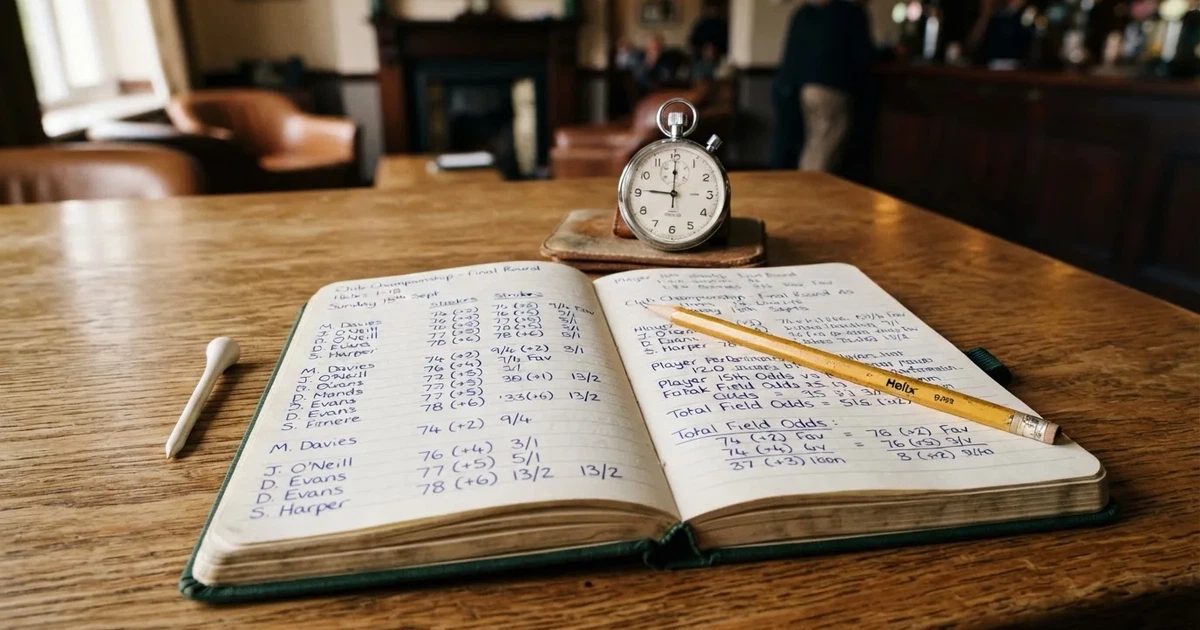
The data below is current as of 27 October 2026 and was checked against the Gambling Commission’s public register of remote operating licences.
How live betting and cash out change the picture on a golf round
Live, or in-play, betting on a golf tournament is unusual in one respect: the event runs for four days, and the leaderboard reshuffles after every hole. A pre-tournament favourite at 12/1 can drift to 33/1 halfway through round one and back to 14/1 by the back nine on Sunday. The bookmaker’s in-play feed sits on top of that volatility, and the price moves every time a player holes a putt, drops a shot or chips in from off the green.

That is also where cash out comes in. Cash out is a feature most major operators carry on outright winner markets, top-five finish, top-ten finish and three-ball or two-ball match-ups — anything with a clear settle point that the book can compute mid-round. The number the book offers is its own estimate of what the bet is worth right now: lower than the full return if the bet is winning comfortably, higher than the lay-to value if it has drifted, but never the full theoretical payout. A cash out at half the back-prest-h value is not a gift — it is the operator paying less than the future expected return to lock in its margin now.
Three rules of thumb follow. First, in-play odds on a tournament outright are best treated as a moving target, not a snapshot — the price the bettor saw at 8am may be gone by the time the first group tees off. Second, cash out on a five-shot lead with twelve holes to play is rarely good value, because the bet has won already and the book knows it. Third, an in-play bet is paid on the result at the end of the tournament, not on the leader at the moment of betting — Tiger Woods withdrawing mid-round does not void a back bet on him if the book had already taken it, but a player who withdraws before the first tee is a non-runner and the bet is voided.
For golf specifically, two markets work well in-play: three-ball and two-ball match-ups, where a single round reshapes the odds every hole, and the outright winner market on the back nine on Sunday, when the field has thinned to the leaders. The bookmaker’s margin is wider in-play than pre-event on most outright markets, partly because the liquidity is lower, partly because the book is pricing uncertainty as well as outcome. A bettor who compares the in-play price with the pre-event price on the same player will often find the in-play number is shorter once a shot or two of momentum has gone in.
Live streaming is part of the same picture on a handful of apps — Sky Sports streams the majors for UK customers, and some operators stream the PGA Tour and DP World Tour events directly inside their in-play console. The combination of live pictures and a moving price is what makes in-play a different discipline to pre-event betting, and it is where the temptation to chase losses with a bigger stake bet on the next group is strongest. That impulse is the one the bankroll rules exist to suppress.
Building predictions and strategy around a tip
A “tip” in golf is shorthand for a forecast that one player will beat the field, a slice of the field or the rest of his three-ball. The forecast rests on three legs of evidence: recent form (last four to six events, cuts made, scoring average, strokes-gained figures), course history (how the player has scored on this layout or one like it, including major championships if it is a major), and current condition (fitness, world ranking momentum, schedule of the last few weeks). None of those legs is a guarantee; they shift the probability by a few percentage points at most.

A forecast only becomes a bet when the price on offer is higher than the chance the bettor assigns. Take a player the bettor judges at a 12% chance of winning. Decimal odds of 10.00 imply a 10% chance (1 ÷ 10.00); that price is too short to back. Decimal odds of 14.00 imply a 7.1% chance; at a 12% real chance, the price is more than fair. That gap is the value bet. It is not a tip that will win — most value bets lose, because the field is wide and the form lines thinner than they look — it is a price at which the bettor expects to profit in the long run if he keeps finding the same gap on other bets.
Staking and bankroll discipline are what keep the value bet from becoming a problem. A flat stake of 1% to 2% of the bank on each bet means a rough patch does not bankrupt the bank, and a record of every bet with the price and the result lets the bettor see whether the edge is real or imagined. Tipsters who publish picks on social media run the same numbers, except they show a tip with a price: a 1-point win at 14/1, a 0.5-point each-way at 33/1. The stake size is the bettor’s choice; the price is the market’s.
Bankroll discipline cuts against the marketing copy that follows every tip — the article-language equivalent of “guaranteed winner”, “lock of the week”, “can’t lose”. None of those phrases survive contact with the sport. The Open Championship at Royal Birkdale in 2026 was won by Ryan Fox of New Zealand, who started the final round two shots off the pace and shot 67 to win on 270 (-10); Cameron Young, the 54-hole leader, finished one behind. Neither result was the favourite at the start of the week. The lesson is not that Fox was a value bet at 100/1 — that is hindsight — it is that golf’s four-day format punishes confident picks in a way that other sports do not.
A staking plan is no better than the record the bettor keeps. A simple spreadsheet — date, event, selection, market, stake, odds, result, profit or loss — is enough; it tells the bettor, after a hundred or so bets, whether the edge is real or whether the model is fooling itself. The first hundred bets are also when most recreational bettors quit the experiment, because the variance of golf’s outright markets is high and the bank swings by 10% on a single weekend.
Three strategies recur on tipster sites, and the bettor should know what each is worth:
- Back-to-back events. A player in form this week is likelier than not to play well next week, but “likelier than not” is a thin edge in a field of 156. The strategy works over a season, not over a fortnight.
- Course-fit specialists. A player who finishes top-20 at Augusta three years running is not a coincidence, and Augusta is the most predictable major in the calendar. Outside Augusta, the edge thins quickly.
- Each-way value. An each-way bet is two bets of equal stake — one on the win, one on the place — at the same price. The place terms vary by book and by event (a quarter the odds for the first four places in a major, a fifth the odds for the first six in a regular PGA Tour event). An each-way value play is one where the place chance is materially higher than the price implies, often because the player is a serial top-20 rather than a winner.
None of those strategies is a system that wins. Each is a filter that narrows the field to a smaller set of bets where the price is more likely to be fair. The bettor who treats them as rules, not as filters, ends up with a portfolio of bets that look clever on the spreadsheet and lose money in the book.
Bet types, odds and how a winning bet pays out
Golf betting has a vocabulary that looks narrower than football’s but runs deeper once a tournament starts. Outright winner, each-way, top-five, top-ten, top-20, three-ball, two-ball, group betting (a player to finish ahead of another named player over the tournament), and a dozen novelty markets — nationality of the winner, first-round leader, hole-in-one on the par-3 contest — make up the bulk of what a UK bookmaker offers on a major.
The starting price on outright winner is set the moment the market opens, often two to three weeks before the first tee. The price on Thursday morning has usually drifted from the opening number on most players, because the book has laid off the early money and the public’s money has settled on a few names. A bettor who prices up the field the night before can sometimes find value on a player the market has not yet noticed, especially in the second or third tier of the odds board.
Each-way betting deserves its own note. An each-way bet is two bets of equal stake at the same odds — one on the player to win, one on the player to place (typically in the first four, five, six or eight depending on the book and the event). The stake doubles, but the win leg pays the full odds and the place leg pays a fraction (usually a quarter or a fifth) of those odds. An each-way bet at 25/1 with a quarter the odds for the first four places pays 25/1 on the win leg and 25/4 (about 6.25/1) on the place leg if the player finishes in the top four. Each-way value is the market where the bettor most often finds an edge on a golfer with a strong top-ten record and a weak win record.
Three-ball and two-ball match-ups are the day’s markets during a tournament round. A three-ball is three players; a two-ball is two. The bet is on the lowest scorer in the group over the round, with the tie handled either by the bookmaker’s dead-heat rule or by the price being offered as a tie-no-bet on some books. Three-ball odds are tight — 5/4, 11/8, 13/8 — and the bookmaker’s margin is wide, often 8% to 12% on this market. Two-ball odds are looser because the field is smaller and the variance lower.
A working example of how a winning bet pays out, on a £10 stake at decimal odds of 6.00 (5/1 fractional):
- Return: £10 × 6.00 = £60 (decimal odds include the stake)
- Profit: £60 − £10 = £50
For an each-way version of the same bet at a quarter the odds for the place:
- Win leg stake: £5 × 6.00 = £30 (return; profit £25)
- Place leg stake: £5 × (6.00 − 1) ÷ 4 + £5 = £5 × 1.25 + £5 = £11.25 (return; profit £6.25)
- Combined return if the player wins: £30 + £11.25 = £41.25 (profit £31.25)
- Combined return if the player places: £11.25 (profit £1.25; the win leg is lost)
Rule 4 is a bookmaker’s rule that applies when a runner is withdrawn from a race (or, in golf, from an each-way or tournament market). The rule reduces the odds on the remaining runners by a factor set by the book. A Rule 4 deduction of 25p in the pound means a 10/1 shot becomes effectively 7.5/1; the deduction depends on the withdrawn runner’s price at withdrawal and is published in the rule book each bookmaker keeps. The bettor does not need to memorise the table, but does need to know the rule exists — otherwise an each-way payout that comes back smaller than expected looks like an error.
A ball coupon is a printed or screen-based list of tournament or group markets the bookmaker packages together. The punter picks one selection from each group, and the odds multiply into one price. A four-leg ball coupon at 5/2, 6/4, 3/1 and 4/1 multiplies into roughly 110/1 — a £1 stake returns £111.99 (decimal: 111.99) if all four legs win. The coupon format is the same shape as a horse-racing accumulator, and the bookmaker’s margin on the combined price is the sum of the margins on each leg minus a small discount. That discount is not a free lunch; it is the bookmaker’s bet that most punters will not pick all four legs.
The bookmaker’s margin is the difference between the true probability of all outcomes and 100%. Take a tournament match-up where the field is reduced to two players (Player A and Player B), with decimal odds of 1.90 on each. The implied probabilities are 1 ÷ 1.90 = 52.63% on each, totalling 105.26%. The bookmaker’s margin is 5.26% — the slice of every unit bet that the book keeps on average. The same match-up at 1.95 on each would give a margin of 2.56%, because the probabilities add to 102.56%. The bettor pays the margin in two ways: by losing it on every bet that does not win, and by accepting that the price on a value bet is the price after the margin, not before. A bookmaker at 5% margin is taking £5 of every £100 bet on the market, on average, before any individual bet settles.
A working example of the margin on an illustrative two-way market at decimal odds of 1.90 / 1.90 — an example, not a quoted price:
- Payout share (the share of every unit bet returned to bettors across all outcomes): 1 ÷ (1/1.90 + 1/1.90) = 1 ÷ (0.5263 + 0.5263) = 1 ÷ 1.0526 = 95.00%
- Margin: 1 − 0.9500 = 5.00%
That is the band a typical golf match-up sits inside: around 5% to 8% margin on the two-ball and three-ball markets, 4% to 6% on the outright winner before the off, and wider on the live in-play price once the round has started. The thinner the margin, the better the long-run deal for the bettor — but only if the bettor’s own probability estimates beat the market’s.
The sport, the courses and the tournament calendar
A regular golf course has 18 holes. Par values split by length for men: par 3 under 250 yards, par 4 from 251 to 450 yards, par 5 over 450 yards, with an 18-hole course typically totalling par 70 to 72. A player may carry no more than 14 clubs in a stipulated round. These are the rules of the game the bettor is pricing — every golf bet pays on the result the player produces under those rules, not on the broadcast version of them.
Stroke play is the format at almost every elite event: the player with the lowest total strokes over the four rounds wins. Match play — where each hole is its own contest — is rarer at the top level, but the Ryder Cup, the Presidents Cup and the WGC-Match Play are the exceptions worth knowing. A bettor who treats a match-play event as if it were stroke play will price the wrong thing.
The four men’s major championships are the Masters (April, Augusta National, Georgia), the PGA Championship (May, rotating venue), the US Open (June, rotating venue) and The Open Championship (July, links courses in the UK). The Masters is the most predictable of the four; its field is smaller and its repeat winners’ list longer than the US Open’s. Jack Nicklaus holds the men’s record of 18 major championships. The women’s majors are the Chevron Championship, the US Women’s Open, the Women’s PGA Championship, the Evian Championship and the AIG Women’s Open.
The 2026 Open Championship at Royal Birkdale, Southport, was won by Ryan Fox of New Zealand from 16 to 19 July 2026. Fox carded 270 (-10) to win by a stroke from Cameron Young, who finished on 271 (-9). The tournament produced the usual crop of in-play swings, the usual three-ball upsets on Saturday and a final leaderboard that did not look like the betting odds board at the start of the week.
The calendar that matters for the bettor, beyond the majors, is the PGA Tour (January through September, with the FedEx Cup playoffs in August), the DP World Tour (the European tour, running in parallel), the LPGA Tour and the LET on the women’s tours, and the LIV Golf schedule (a separate circuit, with a different field structure and a team component). A bookmaker’s coverage of each tour varies; some carry the LPGA outright winner market on every event, others carry it only on the majors.
Top 10 UK-licensed bookmakers for golf betting, compared
A shortlist of ten operators that hold a Gambling Commission remote licence for Great Britain, with their licence numbers, the holder the Commission register names, and a one-line summary of what each operator’s own terms say on the matters that matter for a golf bet. The columns are the licence number and licence holder (from the public register), and the operator’s own published statement on golf markets, live betting, cash out, in-play and the welcome offer that runs at the time of writing.
| Brand | Gambling Commission licence and holder | What the operator’s own terms state on the matters that matter for golf |
|---|---|---|
| Fitzdares | 000400-R-103839-030 — Fitzdares Limited | Cash out, accumulators, Lucky 15s, antepost markets and in-play live odds across horse racing, football, tennis, rugby, cricket, golf and American football |
| Coral | 054743-R-330863-014 — LC International Limited | Sports welcome offer: £40 in free bets on a £20 qualifying sports bet at minimum odds 2.0 (1/1); free bets expire 7 days after issue |
| Bet600 | 044731-R-323941-016 — Tyche Tech Limited | Best Odds Guaranteed on horse racing — bets paid at the bigger of the early price or the starting price |
| Hollywoodbets | 053028-R-330019-013 — Hollywoodbets International UK Limited | Sports welcome offer: stake returned as a free bet of up to £30 on a first qualifying losing accumulator (stake £10+, 3+ legs, odds 4/1+, settled within 7 days) |
| Kwiff | 044448-R-323408-017 — Eaton Gate Gaming Limited | Supercharge feature — odds can be boosted instantly on a bet (for example from 2/1 to 20/1), on single or multi bets across any sport |
| Unibet | 045322-R-324275-019 — Platinum Gaming Limited | Sports welcome offer: £40 in free bets on a £20 qualifying sports bet at minimum odds 2.0 (1/1), paid by debit card or instant bank transfer; free bets expire 7 days after issue |
| DAZN Bet | 048756-R-327274-019 — DZBT Limited | Deposits from £5 by debit card, Apple Pay, Paysafecard, Trustly and Skrill, and from £20 by PayPal, with no processing fees |
| BetUK | 039198-R-319450-029 — LeoVegas Gaming PLC | Free bets exclude virtual sports, esports and non-UK/IE horse racing; minimum odds apply to free bet stakes |
| 10bet | 043173-R-322899-023 — Blue Star Planet Limited | Sportsbook covering football, tennis and horse racing, with cash out, Bet Builder and Live Streaming |
| Octobet | 062545-R-337248-006 — Octopus Game Limited | Best Odds Guaranteed on UK and Irish horse racing, capped at £150 per customer per race |
A note on the table’s first two columns: the licence number is the one the Gambling Commission’s public register shows against the operator’s domain; the licence holder is the company the register names, which may differ from the trading name the bettor sees on the app. Several brands run under one licensee — Ladbrokes and Coral both sit under LC International Limited, for example — and a licence shared across brands is not two separate licences.
A note on the third column: every line quotes what the operator’s own published terms or App Store listing states, in the operator’s own words where the choice is between a paraphrase and a quotation. Where the operator’s terms do not state a matter for golf specifically, the cell carries the general term that the operator does state and the bettor checks the operator’s golf markets directly before betting.
Fitzdares — the boutique book with the long game
Fitzdares is one of the smaller names on the list, founded as a private bookmaker and still trading on that identity. The Commission’s register names Fitzdares Limited as the licence holder under account 400, with remote general betting standard (real events) as the licensed category. The app offers cash out, accumulators, Lucky 15s, antepost markets and in-play live odds across horse racing, football, tennis, rugby, cricket, golf and American football.
For a golf bettor, the relevant question is whether Fitzdares carries outright winner, each-way, three-ball and group markets on the four majors and on the weekly PGA Tour / DP World Tour events. The App Store listing names golf among the sports with live odds; the antepost mention is the giveaway that long-term outright markets sit there. A boutique book that runs antepost is one where the price on next year’s Open Championship is already live in November, which is exactly the market a value-hunting punter wants.
A punter who wants the personal feel of a smaller bookmaker and is happy to trade a thinner in-play feed for an antepost board with depth will find Fitzdares a sensible pick.
Coral — the high-street name with a sportsbook bolted on
Coral is one of the two big high-street names that share a single licensee — LC International Limited also holds the licence for Ladbrokes, and the Commission’s register names the same holder for both. The remote licence is 054743-R-330863-014, and the operator is licensed for remote general betting (standard and intermediary).
The sports welcome offer is a £40 free-bet bundle on a £20 qualifying sports bet at minimum odds 2.0 (1/1), with the free bets issued within 7 days of the qualifying bet settling and expiring 7 days after issue. A punter reading “£40 free bets” needs to know two things the marketing does not foreground: the qualifying odds (2.0 is short, but not prohibitive), and the expiry (7 days is a hard window, not a soft one).
For golf, Coral’s coverage runs the standard set of pre-event and in-play markets on the majors and weekly tours, with the usual each-way terms on the majors. The strong suit is the integration with the rest of the Ladbrokes Coral group’s product, which means a deep antepost board on the Ryder Cup and the Presidents Cup — events the high-street name has always priced hard.
A punter who already has a Ladbrokes or Coral account and likes the high-street pedigree will not lose anything switching to Coral for the welcome offer; a punter starting fresh has the full Coral product to weigh.
Bet600 — a smaller book with BOG on the horse side
Bet600 holds its remote licence under Tyche Tech Limited, with the Commission’s register showing account 44731. The operator’s published terms on its app centre on Best Odds Guaranteed (BOG) for horse racing — bets are paid at the bigger of the early or show price taken and the starting price.
BOG is a horse-racing mechanic. The bettor asks what BOG does for a golf bettor, and the honest answer is: nothing directly. It does tell the bettor that Bet600 prices its markets with a starting price in mind, and that the operator has a tradition of paying out at the better of two numbers. That culture spills over into the golf markets at the margin: a withdrawal in an each-way field might pay under Rule 4 in a way that is generous rather than mean.
A golf bettor weighing Bet600 alongside a bigger brand is weighing depth of markets. Bet600 is unlikely to carry the full LPGA board; it is more likely to focus on the PGA Tour, the DP World Tour and the four majors. The welcome offer, if there is one, is the lever — the bettor reads the terms before claiming.
Hollywoodbets — the South African book with a UK arm
Hollywoodbets’ UK site sits under Hollywoodbets International UK Limited as the licence holder, with the Commission’s register showing account 53028. The site operates under the standard remote general betting licence, and the operator’s UK welcome offer is the safety-net structure: a first qualifying losing accumulator of £10 or more, with 3 or more legs at odds of 4/1 or greater, settled within 7 days, returns the stake as a free bet of up to £30.
The structure tells the bettor two things. First, Hollywoodbets is not chasing the recreational punter with a £40 free-bet bundle — it is selling itself on the safety net for an acca that loses. Second, the safety net is a free bet, not a cash refund, and a free bet stake is not paid back with a win. A £30 free bet at 6/1 returns £180 in profit if it wins, not £210 (the £30 stake would not come back).
For golf, an acca built from outright winner, top-five and three-ball legs is the typical punt, and Hollywoodbets’ acca insurance turns a four-leg acca that loses on the last leg into a free bet that can go again. The bettor who likes accumulators and is comfortable with a free bet as the fallback will find Hollywoodbets’ structure a reasonable match for the way they already bet.
Kwiff — the surprise-boost book
Kwiff’s licence is held by Eaton Gate Gaming Limited, with the Commission’s register naming account 44448. The licence covers remote betting, and the operator’s signature feature is the Supercharge — an instant boost to the odds on a bet, from 2/1 to 20/1 in the example the App Store listing uses, on single or multi bets across any sport.
The Supercharge is a surprise mechanic: the bettor does not know in advance which bets are boosted or by how much. That randomness is the marketing hook, and the gambling-control hook is the bettor’s stake on a bet that may turn out to have been worth more than the price shown at placement. A boosted bet that wins pays at the boosted price; a boosted bet that loses loses at the boosted price (the stake is unchanged).
For golf, a Supercharge on a three-ball or outright winner market turns a 9/2 shot into a 20/1 shot in the bettor’s favour — if the Supercharge lands. The bettor who likes the upsell mechanic, who values the surprise boost and is comfortable with the variance, will find Kwiff a different bookmaker from the rest of the list. The bettor who wants a transparent price on every bet should look elsewhere.
Unibet — the long-standing European book with a UK front door
Unibet’s UK site is run by Platinum Gaming Limited, Gibraltar, with the Commission’s register showing account 45322. The operator states it has traded since 1999 and holds the standard remote general betting licence.
The sports welcome offer matches Coral’s: £40 in free bets on a £20 qualifying sports bet at minimum odds 2.0 (1/1), with the free bets expiring within 7 days of issue. The payment method restriction is the giveaway — Unibet’s qualifying bet must be funded by debit card or instant bank transfer, which excludes deposits by e-wallet.
For golf, Unibet’s strengths are its depth of market (it has covered the European tour since the late 1990s) and its safer-gambling tools — deposit limits, a Player Profile test, product restrictions and self-exclusion, with live chat support and links to BeGambleAware, GamCare, GAMSTOP, Gambling Therapy and the BGC.
A punter who wants a bookmaker with a longer track record on the European tours, a transparent safer-gambling suite and a welcome offer that pays in free bets (with the usual expiry caveat) will find Unibet a clean fit.
DAZN Bet — the broadcaster’s book with a low deposit floor
DAZN Bet’s licence is held by DZBT Limited, with the Commission’s register showing account 48756. The licence covers remote betting, and the operator’s deposit terms are the unusually low floor: deposits start at £5 by debit card, Apple Pay, Paysafecard, Trustly and Skrill, and at £20 by PayPal, with no processing fees.
The £5 floor is the giveaway. Most UK-licensed books set the minimum deposit at £10; DAZN Bet’s £5 is half that, and the range of payment methods is broad enough that a punter without a debit card (or with a Paysafecard voucher to hand) can still get money on. The PayPal minimum of £20 is the e-wallet floor and matches the industry.
For golf, the question is the depth of the in-play and outright board. DAZN Bet’s marketing is the broadcast angle (DAZN is a sports broadcaster), and the in-play console on golf events tends to be solid for the majors and patchy on the weekly tours. A punter who bets small and often, and wants the lowest deposit floor in the list, will find DAZN Bet a sensible pick.
BetUK — the LeoVegas-owned book with restricted free bets
BetUK’s licence is held by LeoVegas Gaming PLC, with the Commission’s register showing account 39198. The licence covers remote betting, and the operator’s free-bet terms exclude virtual sports, esports and non-UK/IE horse racing, with minimum odds applying to the qualifying bet.
The exclusions tell the bettor what BetUK is for. It is a real-event book, not a virtual or esports shop, and the horse-racing coverage is UK and Ireland only. For a golf bettor, those restrictions do not bite — golf is a real event, and the markets the bettor cares about (outright, each-way, top-five, three-ball) are exactly the markets BetUK carries.
A punter who wants a free bet as part of the welcome offer, and who bets on football, tennis or golf rather than on virtuals or esports, will find BetUK’s exclusions a clean match for their betting menu.
10bet — the mid-market book with bet builder and live streaming
10bet’s licence is held by Blue Star Planet Limited, with the Commission’s register showing account 43173. The licence covers remote betting, and the App Store listing names football, tennis and horse racing as the sportsbook’s headline sports, with cash out, Bet Builder and Live Streaming as the live features.
The Bet Builder mention is the giveaway. A Bet Builder (also called a same-game multi on some books) is a feature that lets the bettor combine multiple selections from one event into one bet — for golf, that means a three-ball winner combined with the winning score or the number of birdies in the round, settled as one accumulator. Live Streaming on the operator’s app is a smaller subset of events than the broadcast bet, but the majors and some PGA Tour events sit on it.
For a golf bettor, 10bet’s appeal is the in-play console rather than the outright board. A punter who bets in-running on three-balls and the outright market, and wants a single app to handle the bet builder, the cash out and the live pictures, will find 10bet a reasonable fit.
Octobet — the new-entrant book with capped BOG
Octobet’s licence is held by Octopus Game Limited, with the Commission’s register showing account 62545. The licensed category is remote general betting standard (real events), and the operator’s signature term on its app is Best Odds Guaranteed on UK and Irish horse racing, capped at £150 per customer per race.
The cap is the giveaway. A £150-per-customer-per-race ceiling is a sensible control for a bookmaker that wants to offer BOG without leaving the door open to a single customer arbitraging against the SP on a £40,000 wager. For the recreational horse punter, £150 is well above the average stake. For the golf bettor, BOG is not a relevant mechanic anyway — the horse-racing market is its own product.
A punter who bets across both horse racing and golf, and wants a single welcome offer that covers both, will find Octobet’s BOG cap a footnote rather than a reason to switch. The reason to switch is the depth of the golf board on a new-entrant book, which is the variable the bettor checks on the app before claiming the offer.
What golf betting looks like across the UK market
The bookmaker’s spread across the UK is wider than any one operator’s coverage. A major championship pulls fifty-plus outright winner prices, each-way terms on the top eight, three-ball odds on every group on Thursday and Friday, top-five, top-ten, top-20 and group betting on the headline pairings, plus a slew of novelty markets — nationality of the winner, first-round leader, hole-in-one on the par-3 contest at Augusta. That is the buffet; the bettor picks the courses with the right price-to-probability ratio.
A weekly PGA Tour event pulls a smaller board: outright winner, each-way, top-five, top-ten, three-ball and two-ball. The DP World Tour pulls a similar shape, with the European venue bias in the antepost markets. The LPGA Tour is covered by most UK books on the majors and on a handful of weekly events. LIV Golf is covered on some books as an outright winner market and on others not at all — the field structure (54 players, 14 events, a team element) does not fit the standard 156-player, four-day model, and some books price the event differently as a result.
The exchange, for the bettor who wants to lay as well as back, sits at Betfair and Smarkets in the UK market. Both run on a betting intermediary licence from the Commission, and both carry golf outright markets on the majors and on the bigger weekly events. A back-to-lay trade at 25.0 on the outright winner, scaled back to 6.0 after a good third round, is the standard pattern on a major; the bettor locks in a profit on the position if the trade closes before the final round. The exchange’s margin on a major outright is tighter than any bookmaker’s — typically 2% to 4% — because the exchange is a venue, not a counterparty, and the back and lay prices are set by the punters.
The spread of bookmakers across the UK is not the only thing that matters. The spread of markets on a single tournament matters more for a bettor who has narrowed down the field. A book with the outright winner and the each-way, but not the three-ball, is half a book for the in-running specialist. A book with the three-ball and the top-five, but not the group betting, is half a book for the form specialist. The bettor who wants depth on every market ends up with three or four books open at once — one for the outright, one for the in-play, one for the exchange lay.
Legality, regulation and the Gambling Commission register
The Gambling Act 2005 covers Great Britain — England, Scotland and Wales. Northern Ireland has its own older law and is outside the Act, so a “GB-licensed” book is licensed to take bets from customers in those three countries only. The Commission is a non-departmental public body sponsored by the Department for Culture, Media and Sport, and is the regulator of the commercial market.
Since the Gambling (Licensing and Advertising) Act 2014 an operator whose remote facilities are used in Great Britain needs a Commission licence wherever the operator is based. Sections 33 and 36 of the 2005 Act, as amended, are the relevant provisions. A Curaçao, Maltese or Gibraltar licence is not a substitute for a Commission licence at the point of consumption. The Commission’s public register is the whole test of who holds a licence: it can be searched by business name, trading name, domain or account number, and it lists every licence category the operator holds.
There is no state monopoly on betting and no cap on the number of licences. The licence categories are remote general betting standard (real events), remote general betting standard (virtual events), remote general betting limited, remote pool betting and remote betting intermediary (the category for betting exchanges). A bookmaker’s category is on the register; the bettor checks the register to see what the operator is licensed to do.
Minimum age is 18. Identity verification — name, address and date of birth — is required before a customer can deposit or gamble at a licensed site, including with a free bet or bonus. The verification has been in force since 7 May 2019. Verification means no anonymous play at a licensed bookmaker, and a bookmaker that does not ask for ID at sign-up is a bookmaker not licensed for Great Britain.
Financial spread betting is regulated by the Financial Conduct Authority, not the Commission. A bookmaker that offers both fixed-odds betting and spread betting on the same platform is regulated by both bodies for the two products — Spreadex is the example named on its own homepage, where the FCA regulates the spread-betting side and the Commission regulates the fixed-odds side. A punter looking at a spread bet needs to know that losses on spread bets can exceed the deposit, which is not the case for fixed-odds betting.
What may be bet on in Great Britain is set by the operator’s licence and its own house rules, not by statute. The Commission publishes no list of permitted bets or markets; the LCCP sets the conditions, the operator’s licence category sets the scope. In-play betting is offered by GB bookmakers under their licence conditions and customer-protection duties; the legal status is “permitted”, not “unrestricted”. Esports are treated like any other event on a remote general betting standard (real events) licence. Virtual events are a separate licence category. Bets on politics, TV shows and novelty markets are offered by GB bookmakers; no statutory prohibition was found.
Tax on winnings: the player pays no tax on betting winnings in Great Britain. That is general information, not tax advice, and a professional gambler should ask HMRC or an adviser. The General Betting Duty is the operator’s tax on gross profits — currently 15% — and a new remote betting rate of 25% applies from 1 April 2027 within that duty, while remote bets on UK horse racing, self-service betting terminal bets, pool betting and in-person betting stay at 15%. The duty is the operator’s liability; whether operators pass it through to the punter in the odds is not established, and the page does not state that the duty is passed on. Until 1 April 2027 the remote rate stays at 15%.
The Commission’s statutory levy is a separate charge on operators, not a tax on the punter. Advertising is not licensed by the Commission; it is regulated by the ASA under the CAP Code (non-broadcast) and BCAP Code (broadcast), alongside the LCCP’s marketing conditions. CAP Code section 16 sets the rule that no one who is or seems to be under 25 may be featured gambling in marketing (with an exception for in-venue advertising where a bet can be placed directly); the rule is about who appears in the advertisement, not who may bet. The Premier League clubs’ voluntary withdrawal of gambling sponsorship from the front of matchday shirts, from 2026/27, is a club-level decision, not statute.
A GB-licensed bookmaker is not the only choice available to a UK punter. Offshore books — Curaçao, Malta, Gibraltar — operate without a Commission licence and accept UK customers through their UK-facing sites. The legal position is that the operator is committing an offence under section 33 of the Gambling Act 2005 (on summary conviction up to 51 weeks’ imprisonment, a fine up to level 5, or both; six months in Scotland); the offence is aimed at the operator. The punter who bets on an unlicensed site does not commit an offence under the Act, and the page does not write that betting on an unlicensed site is illegal.
What the punter does lose is the British consumer protection: no GAMSTOP coverage, no Commission complaints route, no approved dispute-resolution body, no British consumer redress if funds are withheld. The 10x bonus cap and the £150 financial vulnerability check do not apply at an unlicensed book. Enforcement against an unlicensed operator is disruption, not blocking: cease-and-desist notices, search-engine referrals, work with registrars, hosts and payment providers. The Commission has been given, or is about to receive, court-order DNS blocking powers, but the page does not write that ISP blocking is in operation.
The honest framing: a GB-licensed book means verification before the first bet, the bonus cap, the vulnerability check, GAMSTOP coverage, dispute resolution and consumer redress. An offshore book means none of those protections and a real risk that funds are withheld. Neither is “the safe choice” by default, and neither is “the unsafe choice” — the bettor chooses with the information the Commission publishes, not a slogan.
Safer gambling, GAMSTOP and the help that is available
GAMSTOP is the national multi-operator online self-exclusion scheme and has been a mandatory licence condition for online operators since 31 March 2020. The exclusion periods are six months, one year, five years, or five years with auto-renewal. After the minimum period the exclusion stays in place for a further seven years unless the customer asks GAMSTOP to remove it. GAMSTOP covers online sites and apps; betting shops use a separate service (the multi-operator self-exclusion scheme for the high street, which is run by the same organisation).
A financial vulnerability check (LCCP condition 3.4.4, in force since 30 August 2024) applies to licensed remote betting when a customer’s deposits minus withdrawals exceed £150 in a rolling 30 days (since 28 February 2025). The check is a public-record check — bankruptcy or county court judgments, for example — and is not an income check, not a credit reference check, and not a soft search. The check is run by the operator using a third-party provider; the customer’s data is shared only for the purpose of the check.
Financial risk assessments — the affordability checks that have been the subject of public debate — have been announced in a staged plan (Commission article of 7 July 2026), with no start date. The page does not write that the assessments are in force; the position is “announced, staged, no start date”.
Deposit limits (RTS 12): operators must offer a gross deposit limit on a fixed time frame. The first changes have applied since 31 October 2025; a second phase was postponed to 30 September 2026, and whether the second phase is live is not established. The limits are the customer’s choice; there is no state-set deposit or loss ceiling for betting. A punter who wants a £50-a-week ceiling sets that ceiling with the operator; a punter who wants no ceiling sets no ceiling.
Help is available whether or not the punter has self-excluded. GamCare runs the National Gambling Helpline; GambleAware publishes information and routes to local services; the NHS runs gambling clinics; Gamblers Anonymous runs peer-support meetings. The Commission’s register lists the operators licensed for remote betting in Great Britain; the GAMSTOP site lists the operators covered by the exclusion scheme.
A safer-gambling practice the punter can run themselves is the spreadsheet mentioned earlier: date, event, selection, market, stake, odds, result, profit or loss. After a hundred bets the spreadsheet tells the punter whether the edge is real. Before the hundredth bet, the spreadsheet is a discipline — a record that stops the impulse to chase a loss on the next group. The discipline is the cheapest safer-gambling tool the punter can buy.
Crypto and anonymity at the betting counter
Identity verification at a GB-licensed bookmaker is in force before the first deposit, since 7 May 2019. That means no anonymous play at a licensed site — every customer has had name, address and date of birth checked, and a £150-rolling-30-days spend triggers a financial vulnerability check. An offshore book that does not ask for ID at sign-up is operating outside the GB licence regime, and the punter who uses one has accepted the loss of British consumer protection.
Crypto deposits at a GB-licensed bookmaker are not established. The Commission’s public register names the payment methods the operator accepts, but the framework does not require the operator to list them, and a British named-account rule or a state list of permitted payment methods is not established. The page describes payments qualitatively and from each operator’s own terms, not from a general rule.
An offshore book that takes Bitcoin (BTC), Ethereum (ETH) or stablecoins settles deposits on the blockchain and at the speed of the blockchain — typically minutes rather than hours. The benefit is speed and a pseudonymity the bank-based system does not offer. The cost is the loss of the Commission’s protection regime: no GAMSTOP, no dispute resolution, no redress if funds are withheld. A punter who wants crypto deposits reads the offshore book’s terms on withdrawals, on KYC at the cash-out stage (most offshore books ask for ID when the punter tries to withdraw, not when they deposit) and on the source-of-funds check the book runs under its own anti-money-laundering policy.
The honest framing for a punter weighing a crypto deposit against a debit-card deposit: the crypto deposit is faster and pseudonymous; the debit-card deposit is slower and identified. Both have a place. Neither is a free choice at a GB-licensed book — the licensed book verifies before the first deposit, and the offshore book verifies at withdrawal. The punter chooses the trade-off, not the page.
Bonuses, free bets and what an offer actually costs
The sports welcome offers on the UK market in 2026 cluster around three shapes:
- Free bet bundle. A £20 qualifying bet at minimum odds 2.0 (1/1) returns £40 in free bets, issued within 7 days of the qualifying bet settling and expiring 7 days after issue. Coral and Unibet run this shape.
- Safety-net accumulator. A first qualifying losing accumulator (stake £10+, 3+ legs, odds 4/1+, settled within 7 days) returns the stake as a free bet of up to £30. Hollywoodbets runs this shape.
- Enhanced odds or Supercharge. A one-off price boost on a named event (the Champions League final, the Grand National) or a random boost on any bet. Kwiff runs the random Supercharge; other books run the one-off enhanced odds.
A free bet’s stake is not paid back with a win. A £30 free bet at 6/1 returns £180 in profit on a win, not £210. The marketing copy that follows every welcome offer calls the £40 a “bonus”; the page calls it what it is — a free bet whose stake is not returned.
A free bet’s value is the expected return over a large number of uses, at a given price. The formula for a free bet whose stake is not paid back, on a market at decimal odds O and a payout share P (the share of every unit bet returned to bettors across all outcomes, so 1 − margin):
- Free-bet value: free-bet amount × (O − 1) ÷ O × P
A £30 free bet at 6/1 (decimal 7.00) on a market with a 95% payout share (5% margin) is worth 30 × (7.00 − 1) ÷ 7.00 × 0.95 = 30 × 0.857 × 0.95 ≈ £24.43. That is the average worth of the free bet across many uses, not what any single free bet returns. The bettor who uses a free bet at longer odds (each-way at 25/1, for example) gets more of the value; the bettor who uses it at shorter odds gets less.
The promotion rules in force since 19 January 2026 cap wagering requirements on bonuses at 10x. A £10 bonus at 50x wagering needed £500 of bets before the bonus could be withdrawn; under the cap no more than £100 of bets is needed. The cap applies to bonuses, not to free bets with no wagering condition; whether the cap applies to a free bet with a wagering condition is not established.
Mixed-product promotions — an offer that requires gambling on two or more product types, such as “bet on football to get free spins” — are banned. A free bet issued on a sportsbook with no casino tie-in is unaffected; a “bet £20 on football, get £10 of casino bonus” type offer is.
A punter reading a welcome offer needs three numbers: the qualifying bet (stake, minimum odds, payment method), the free bet (amount, expiry, return-on-win rule), and the wagering requirement (if any, including the minimum odds on the wagering bets and the expiry on the wagering). Three numbers is the cost of reading an offer properly; less than that, and the punter claims an offer whose shape they do not know.
A worked example of bonus turnover, on a hypothetical £30 bonus with a 5x wagering requirement (the cap allows up to 10x; this is illustrative) and a £10 stake per bet at minimum odds 2.0:
- Required turnover: £30 × 5 = £150
- Bets needed at £10 each: 15
- Expected cost of clearing: £150 × 5% margin on the market = £7.50 (the expected loss across the £150 of qualifying bets, at a 5% margin)
The £7.50 is the average cost of clearing the offer. A punter who clears the offer and ends up with the bonus + the profit on the wagering walks away ahead; one who ends up with the bonus − the cost of clearing walks away behind. The arithmetic does not pick a side; the punter does.
Mobile, app and the screen the bet lives on
Golf betting on a phone is the default. The outright winner market at 11pm the night before the first round, the three-ball at 9am on Thursday, the in-play price with the leaderboard on the same screen — all of it lives on the app or the mobile site. A bookmaker without a working mobile product is a bookmaker the modern punter does not use.
The app stores carry the iOS apps for Coral, Bet600, Hollywoodbets, Kwiff, Unibet, DAZN Bet, BetUK, 10bet, Octobet, Fitzdares, BetWright, London Bet and others. The Android equivalents sit on Google Play under the same brand names. Each app offers the four majors and the weekly PGA Tour / DP World Tour events, with the depth varying by book — the bigger books run 50-plus outright prices on a major; the smaller books run a top ten. In-play consoles run the same shape, with the live pictures from Sky Sports, DAZN or the bookmaker’s own stream where available.
A mobile product is more than the app itself. The login (fingerprint, PIN, Face ID), the deposit (Apple Pay, Google Pay, debit card, the e-wallets the book accepts), the bet builder (combining selections on one event into one bet), the cash out (settling a bet mid-round at the operator’s number), the safer-gambling tools (deposit limit, reality check, self-exclusion) — those are the features the punter actually uses. A book that scores well on the headline sports count and badly on the in-play console is a downgrade on golf, where the in-running product is half the value.
A punter with two or three apps open on a tournament weekend is a punter who has compared the prices across books before the first tee. The bettor who bets only on one app has accepted that book’s price as the market’s; that is the punter’s choice, but it is a choice with a cost — the 1% to 3% difference between one book’s price and another’s, compounded over a hundred tournaments.
Frequently asked questions
How do you bet on golf in the UK?
Pick a UK-licensed bookmaker from the Commission’s public register, open an account, complete the identity verification (name, address and date of birth), deposit by debit card or bank transfer, and pick a market — outright winner, each-way, top-five, top-ten, three-ball or group betting. Place the bet at the price shown, settle the bet at the tournament’s conclusion (in-play bets settle at the end of the round, not at the moment of betting). Withdraw winnings to the same payment method used to deposit.
What is Rule 4 in golf betting?
Rule 4 is a bookmaker’s rule applied when a runner in a race or a player in a tournament is withdrawn after the bet is taken. The book reduces the odds on the remaining runners by a factor set by the book, published in the rule book each operator keeps. A Rule 4 deduction of 25p in the pound means a 10/1 shot becomes effectively 7.5/1. Rule 4 deductions are most often applied in horse racing and in golf each-way markets when a player withdraws before the first tee.
What are ball coupons in golf betting?
A ball coupon is a bookmaker’s list of tournament or group markets packaged together — a format borrowed from horse racing. The punter picks one selection from each group on the coupon, and the odds multiply into one combined price. A four-leg coupon at 5/2, 6/4, 3/1 and 4/1 multiplies into roughly 110/1 — a £1 stake returns £111.99 if all four legs win. The combined price carries the bookmaker’s margin, which is the sum of the margins on each leg minus a small discount.
What is a value bet, and why is no tip ever certain?
A value bet is a price the market offers that is higher than the probability the bettor assigns to the outcome. A player at 14/1 (decimal 15.00) on a tournament where the bettor’s model gives a 10% chance is a value bet, because 15/1 implies a 6.25% chance. No tip is ever certain because golf is a four-day event against a field of 156, with weather, course conditions, fitness and a hundred small moments of chance shaping the outcome. Even the best forecast leaves 80% to 95% of outcomes undecided; the price reflects that uncertainty.
What is the bookmaker’s margin, and how is it visible in the odds?
The bookmaker’s margin is the slice of every unit bet the book keeps on average. It is the difference between the true probability of all outcomes (100%) and the sum of the implied probabilities from the odds. A two-way market at 1.90 / 1.90 has implied probabilities of 52.63% on each, totalling 105.26% — the margin is 5.0%, and the payout share (the share of every unit bet returned to bettors across all outcomes) is 94.74%. The same market at 1.95 / 1.95 has a margin of 2.56%. The margin sits inside every odds line, and the thinner the margin, the better the long-run deal for the bettor.
How is the return on a bet worked out from the stake and the odds?
For decimal odds, the return is the stake multiplied by the odds (the decimal odds include the stake), and the profit is the return minus the stake. A £10 stake at decimal odds of 6.00 returns £60 and returns £50 in profit. For fractional odds, the return is the stake multiplied by the fraction, plus the stake. A £10 stake at 5/1 returns £60 in total (£50 profit plus the £10 stake). An each-way bet is two bets of equal stake at the same odds — one on the win, one on the place — so the stake doubles.
Tennis, darts & cue sports – Free bets
Content created by the «Free bets» team
