
How to think about snooker betting tips in 2026
 Available in US
Snooker is a small sport, and that is part of its attraction to bettors. A cue and a table, twenty-two balls, a referee, two players, and a frame that runs to a finish line the bookmaker quotes in numbers. The market around it mirrors that simplicity at first glance: a head-to-head price for the match, a frame handicap, an outright on the tournament, a price on who pots the next hundred, an in-play line that moves ball by ball. Underneath, the same price machinery as every other sport is doing its work. “Snooker betting tips” in 2026 is mostly the question of how to read those numbers, what makes one a value call and the rest an overpay, and why no tip is ever a promise.
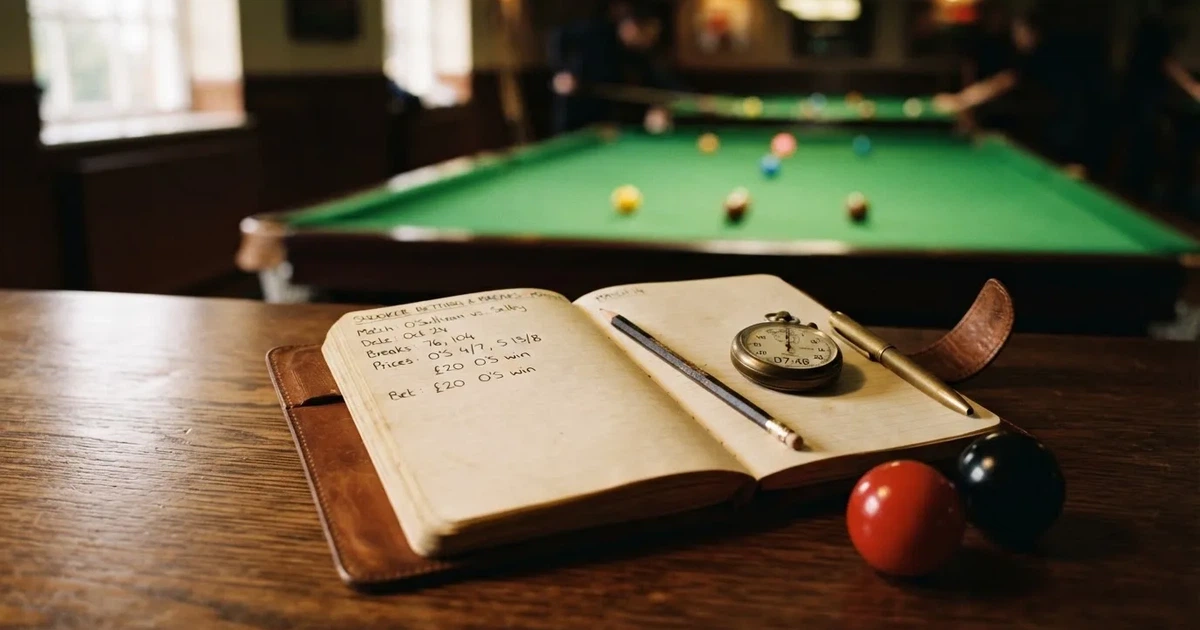
Current data: verified against the register on 27 October 2026.
Reading prices on a snooker match
The first number a bookmaker prints on a snooker match is the head-to-head price. Two players, two outcomes. Pick one and the price you see — 1.90, 2.20, 1.36, anything — is the decimal version of what the bet returns for every pound staked. Fractional odds sit in the same slot on a British site: 9/10 reads as 1.90 in decimal, evens is 2.00, 6/4 reads as 2.50, 5/2 reads as 3.50. A £10 stake at 1.90 returns £19; the £9 profit sits inside that return, alongside the £10 stake a winning bet gets back. A losing bet returns nothing, and the stake stays with the bookmaker.
That is the surface of the market. The texture underneath is the bookmaker’s margin — the slice of every pound that does not belong to the bettors. Take a head-to-head market priced 1.90 against 1.90, an arbitrary pair chosen for the math rather than any quoted tie. The implied probabilities (1 ÷ 1.90 and 1 ÷ 1.90) sum to about 105.3%. That 5.3% over 100 is the overround. State it as a band: for a balanced two-way snooker head-to-head at this kind of price the margin lands somewhere between roughly 2.5% on a sharp main-tournament match and 7% or more on a smaller event with thin liquidity. A market below 2% on a first-round Crucible tie is unusual and worth a second look; a market north of 8% on an early-round qualifier is normal and the reason value on a long-priced outsider looks so easy to find on paper.
The margin is the first thing to read on any snooker market. Frame handicaps, total frames, first-to-N frames, century counts, highest break bands and outrights each carry their own. Outrights have the fattest margins of the lot because the bookmaker has to balance a 64, 96 or 128-player field against the bets taken on a handful of favourites; a tournament winner is a thin product and prices it like one. Match head-to-heads on the televised stages, where liquidity is heaviest, are the leanest products the snooker market offers.
A second number sits one click deeper. The bookmaker’s price implies a probability; the bettor’s own probability for the same event is something else. Where the bettor’s number is bigger than the bookmaker’s, with the margin removed, the bet has value. Where the bookmaker’s number is bigger, the bet is an overpay dressed up as a tip. The arithmetic of value is unforgiving: a 1.90 price implies 52.6% before margin, and a bet only has value if you believe the player wins more often than the implied line.
That last sentence is the whole of betting on snooker, and the rest of this guide is what sits around it.
Markets that move through a snooker event
Bet types across a snooker event cluster into four families, each with its own price profile and its own way of being read.

Match outright. Two players, one winner, one price per side. This is the lowest-margin product on the televised rounds and the highest-margin product on the early qualifiers. Outright odds are also the ones that move most during a session, because each frame updates the bookmaker’s model in plain view — a 1.80 favourite after a fluked opening frame can drift to 2.10 in two visits.
Frame markets. A specific frame the player wins, a handicap on the frame score, the colour the frame finishes on, whether there is a century in the frame, total points, total frames in the match. Frame markets are the snooker equivalent of “next point” markets in tennis and they shift ball by ball when the match is in-play. A 50-point lead at the mid-session interval is not a 50-point lead once a player sits down after the interval.
Tournament markets. Outright winner, each-way places, top-four finish, group betting, name-the-finalist. The margin on these is the sport’s widest, the time between bet and settlement the longest, and the value search the most competitive — every other bettor on the event has had the same months to weigh up the same form lines.
In-play. Every market above is also offered live, with the same logic but refreshed prices. In-play is where snooker punters with a feel for momentum — who knows that a 5-1 lead is not “five frames to one” when the better player is the one behind — find their edge. It is also where reckless in-running bets quietly drain a bankroll. The cash out button on the bet slip does not change the price; it locks in the bookmaker’s mid-market quote at that second and removes the tail.
Same-game combinations — a player to win and to make a century, a player to win and the match to go over a frame line — multiply across legs and price up to a far larger number. The bookmaker’s margin multiplies across the legs as well; a four-leg same-game multi carries four slices of margin in one coupon.
Tournaments the snooker betting market follows
The professional tour runs from late spring qualifying rounds through the televised Crucible weeks in April and May, then into the invitationals through to the UK Championship at York in late November and December, then the Masters at Alexandra Palace in January. The calendar is built around five or six tournaments that the snooker betting market actually prices: the World Championship, the UK Championship, the Masters, the Champion of Champions, the Players Championship, and the occasional Grand Slam event.
The World Championship at the Crucible Theatre is the centre of gravity. It has been held in Sheffield since 1977 and its first-round frame count sits at best of 19, the final at best of 35. The winner in 2026, Wu Yize, beat Shaun Murphy 18-17 in a final that went the distance, with a £500,000 winner’s share from a total prize fund of £2,395,000. The same 2018-2026 era of the modern game has Stephen Hendry and Ronnie O’Sullivan holding seven world titles each; the 15 consecutive titles Joe Davis took between 1927 and 1946 sits in a different era entirely, and looks unbeatable from any modern distance.
Frame counts after that first round at the Crucible are the most settled on the calendar: most professional matches sit at best of 7, 9 or 11. Best-of-N is part of how to read an over/under market on total frames — a best-of-9 fixture cannot go past 9, so the upper band on a total-frames line is fixed by the format and not by anything the players do.
Behind the televised tier sits the Q School pathway, the EBSA amateur routes and the IBSF-governed international circuit. The amateur side is where in-the-know bettors find a price edge, because the market is thinner, the form less public, and the bookmaker’s margin wider. The professional game itself is run by the WPBSA, which sets the rules and sanctions the World Snooker Tour; the IBSF runs the amateur side. The distinction matters when a player is suspended or when an amateur event is being priced for the first time on the site.
What a snooker betting site actually offers
Ten UK-licensed bookmakers cover snooker in some form. Coverage varies more than in football or horse racing. Every site on the shortlist offers match outrights on the televised tournaments; not every one offers frame handicaps, century-band markets or in-play pricing on early-round matches. The shape of the offer is a real decision point for the punter, because it determines what strategy is even available on any given week.
The features that decide a snooker site are: the depth of the outright market (winner, each-way places, top-four finish, group betting at the bigger events), whether in-play is offered match by match or only at the televised rounds, the availability of cash out on outrights (which settles only at the end of a long tournament), and the price of a bet builder on snooker (some sites still exclude snooker from a same-game multi even when they offer it on other sports). A bettor who wants match outrights and a few frame lines on a Saturday morning needs a different site from a bettor who wants in-play on a Wednesday afternoon World Championship qualifier.
The page that follows the operators in the next section on this site walks through each of them on the same axes — licensing position, snooker-specific product depth, safer-gambling tools — and ends with a verdict aimed at a particular kind of punter. The shape of a snooker punter matters: a once-a-year World Championship back-the-favourite reader is choosing a different site from a weekly match-markets reader.
Snooker betting in the British licence frame
A bookmaker serving customers in Great Britain needs a Gambling Commission licence, and a Commission licence is the only test of who holds one. The Commission’s public register is the source — searchable by business name, trading name, account number or domain. A site with a .com extension is no less licensed than one with .co.uk; the domain proves nothing. A Curaçao, Malta or Gibraltar licence is not a substitute for a Great Britain licence, because the Gambling (Licensing and Advertising) Act 2014 closes the geographic loophole: remote facilities used in Great Britain have to be authorised at the point of consumption, wherever the operator is based. The Act itself is the Gambling Act 2005; Northern Ireland sits outside it under older law, and “GB-licensed” is the accurate phrase, not “UK-licensed”.
Identity is the first consequence for the bettor. British-licensed sites verify name, address and date of birth before the first deposit (a rule in force since 7 May 2019), so even a free-bet offer cannot be claimed anonymously. There is no anonymous play on a Commission-licensed site; that is the structural answer to any search for “betting without identity” — the rule is not optional, and any operator offering it is operating outside the GB frame.
Age 18 is the floor. Credit cards have been banned for gambling in Great Britain since 14 April 2020 (a Gambling Commission licence condition), including credit-card-funded payments through an e-wallet; debit cards and bank-based payments are not covered by the ban. There is no statutory cap on the maximum stake a bookmaker will accept, so the stake ceiling on a snooker match is the operator’s own line on each account, and most operators will cut that down sharply once they spot sharper play.
Bonuses, where the operator offers them, sit under a Commission-published cap on wagering requirements that took effect on 19 January 2026: a 10x ceiling on the bonus base (so a £10 bonus cannot be asked to clear more than £100 of qualifying bets). A “free £10 with a 50x turnover” deal — the kind of headline that used to lead many a promotion page — does not pass the new cap and is not the same offer as one that does. Mixed-product promotions, where the offer conditions require play across two or more product types (betting and casino, betting and bingo, betting and lottery), are also banned under the same rule. The Commission does not list a money-value cap on a free bet; what it does set is the wagering ceiling where the free bet has one.
Spread betting is the part of the market that sits outside the Commission’s licence. Financial spread betting is regulated by the Financial Conduct Authority, with separate pricing and a worse worst-case for the customer: losses on a spread bet can exceed the deposit. Spread bets on sporting indices that are not financial products come under General Betting Duty and a different licence. Snooker punters mostly operate in fixed-odds betting, but the distinction matters when a site offers both — Spreadex is the example here, regulated by the FCA for spread betting and by the Commission for its fixed-odds book, and its own terms state that spread betting losses can exceed the deposit.
On the offshore side, providing gambling facilities in Great Britain without the licence the Act requires is an offence aimed at the operator under section 33 of the Gambling Act 2005. There is no offence aimed at the customer who merely bets on an unlicensed site; the honest framing for a reader who might be tempted is that an unlicensed site means no GAMSTOP coverage, no Commission complaints route, no approved dispute-resolution service, and no recourse under British consumer law if funds are withheld. The new bonus cap and the financial vulnerability check do not reach that punt either. “Available” is not the same as “well regulated”, and the better word for an unlicensed snooker site that might show in a search is “uncovered”.
Responsible gambling as the day job
The Commission’s safer-gambling frame sits at the centre of every GB-licensed snooker site and is the practical difference between a regulated market and an offshore one. GAMSTOP is the closest thing to a single off-switch: a free, multi-operator self-exclusion scheme that any licensed online betting operator has been required to be a member of since 31 March 2020. A GAMSTOP block is set for six months, one year, five years, or five years with auto-renewal; after the minimum period it stays in place for another seven years unless the customer asks GAMSTOP to remove it. A GAMSTOP block covers sites and apps; betting shops run their own separate self-exclusion service.
The newer layer is the financial vulnerability check, in force from 30 August 2024 for licensed remote betting: when a customer’s deposits minus withdrawals cross £150 in any rolling 30 days (the threshold took effect on 28 February 2025), the operator runs a public-record check for markers such as county court judgments or bankruptcy. It is not an income check, and it is not a credit-reference check. The more intrusive “financial risk assessment”, the affordability check of the press headlines, was announced on 7 July 2026 in a staged plan with no start date, and the accurate phrasing today is “announced, staged, no start date” — not “in force”.
Deposit limits run the other way. The Commission’s Remote Technical Standards require a gross deposit limit on a fixed time frame, with first changes in force since 31 October 2025 and a second phase that was rescheduled to 30 September 2026; whether that second phase is live as the page is read is not established, and any operator-facing limit reader sees is at least partly their own product settings. There is no state-set ceiling on deposits or losses: any limit is the customer’s choice, and the operator has to offer one.
The help lines, separate from any operator, are also part of the frame. GamCare runs the National Gambling Helpline (24 hours, free, confidential), GambleAware funds treatment and education, the NHS gambling clinics take clinical referrals, and Gamblers Anonymous runs peer-support meetings. A reader who recognises the pattern in their own betting — chasing losses, hiding stakes, betting more to feel the same hit — does not need a betting tip next; the next call is GamCare.
The British licensing frame sidesteps none of this. The operator frame is half the picture: GAMSTOP, the £150 vulnerability check, the bonus cap, the safer-gambling tools at the operator’s site itself (deposit limits, time-outs, product restrictions on the operator’s own platform, self-exclusion at one site only). The other half is the British self-help and treatment sector, which is funded partly by the industry through GambleAware and partly through the NHS and GamCare. The two halves together are what “responsible gambling” means in a snooker market regulated by the Commission.
Crypto, anonymity and snooker
Snooker can be bet on with crypto, but not on a Great Britain-licensed site. The same identity-before-deposit rule that closes off anonymous play closes off the typical crypto flow into a GB bookmaker — a Commission-licensed operator runs a “know your customer” check before the first deposit, which is the opposite of a crypto-native wallet. An operator that accepts bitcoin or ethereum directly and skips identity verification is operating outside the GB frame, and the sections above on what that costs the punter apply in full. A “snooker betting with bitcoin” search delivers, by and large, sites that are not licensed for Great Britain.
A small number of GB-licensed sites accept crypto via a regulated e-wallet or third-party processor that runs the same customer due diligence as a debit card. Where that exists, it is the operator’s own terms page that says so, and the terms are what bind the punter, not the marketing. A reader who wants to fund a snooker bet with crypto on a licensed site has to read the payment-methods page and check.
The wider question — whether a British named-account rule, a state list of permitted payment methods or any rule against cryptocurrency deposits at licensed operators exists — is not established by the Commission’s published framework. The honest description is “operator-specific, not statute-specific, at GB-licensed sites; common at unlicensed sites that meet the crypto user where they already are”. An unlicensed crypto snooker site is also, by definition, an unlicensed snooker site, and every protection that comes from the licence — GAMSTOP, the Commission complaints route, the bonus cap, the dispute-resolution service — is absent.
Bonuses and free bets on snooker
The shape of a snooker promotion has been narrowed considerably by the Commission’s 19 January 2026 rule. A welcome offer on a GB-licensed site now sits inside a 10x wagering ceiling on the bonus base and excludes mixed-product promotions that ask for play across product types. A “free £10 free bet” with no wagering requirement still exists; the cap governs the cases where there is a turnover condition on the bonus.
The mechanism to read on any snooker promotion, free bet or welcome offer is the same regardless of sport. A free bet is one stake’s worth of price, not one stake’s worth of stake back; only the profit on a winning free bet returns to the customer, and the stake is taken as payment for the bet itself. A £10 free bet at 1.90 that wins returns £10 × (1.90 − 1) = £9 in cash, not the £19 a cash bet of the same price would return. After the bookmaker’s margin on the chosen market is applied, the value of the free bet is the free-bet amount × (odds − 1) ÷ odds × the market’s payout share — an estimate that depends on which market the free bet is spent on. A free bet used at long prices and on low-margin markets is worth more than one used at short prices on a high-margin market; the difference is small in pound terms but adds up over an account’s lifetime.
Acca insurance adds another shape. An “acca” is the short British term for accumulator, the multi-leg bet where each leg has to win for the bet to pay. Acca insurance refunds the stake as a free bet, not as cash, when one leg lets the bet down. The refund is bounded — a typical BoyleSports structure asks the customer to opt in, stake at least £5, hold each leg at minimum odds of 1/2, and accepts refunds up to £20 as a free bet that expires in 7 days, with all selections required to settle on the same day. The refund-as-free-bet form is the whole point: the cover is on the bet, not on the cash. A wagering-free refund would be a different product.
Price boosts at the snooker end are mostly a televised-tournament feature, where the bookmaker’s marketing leads the market and the boost is the headline grabber. The boosted price has a margin too, and that margin may be wider than the underlying price. A boost to “Ronnie O’Sullivan to win and make a century in the final” looks like value against the unboosted single bets; spread across the legs of the price, the margin is rarely tighter than the singles.
Best Odds Guaranteed (BOG) is a horse-racing feature and does not transfer across sports, including snooker. BOG pays out at the higher of the bookmaker’s early price and the starting price (SP), where SP is the on-course price set by the market at the off. On a snooker match there is no SP — the price is the price, the match starts, and that is the price settled at. A reader who sees BOG on a horse race and BOG-style language on a snooker price has misread the product.
The reader’s question on any snooker promotion is the same five-clause check, in this order: what is being granted (free bet, bonus cash, stake refund, price boost), what the wagering requirement is, what the minimum odds per leg are, when the offer expires, and what the maximum payout is. The arithmetic on the wagering requirement is the audible bit: turnover = bonus base × wagering factor (where the base is the bonus alone, or the deposit plus bonus, depending on the operator’s wording), and the number of bets needed is that turnover divided by the stake per bet. A £20 bonus with a 10x turnover (the maximum the Commission now allows) means £200 of qualifying bets, which at £5 a leg is 40 bets at minimum qualifying odds. The expected cost of clearing the bonus is roughly turnover × market margin, and on a snooker head-to-head at a 5% margin, that is £10 of expected cost on the £200 turnover. The offer pays £20 of nominal value and costs £10 in margin to clear, leaving £10 of net value on a generous read; on a tougher read, with shorter expiry or a higher minimum odds rule, the same offer leaves less.
That last arithmetic is the heart of every bonus, and it is the bit the marketing never does. A free bet that pays £9 on a 1.90 win is not worth £10. An acca insurance that refunds £20 as a free bet on a £20 qualifying acca is not a £20 refund. A 100% deposit match with a 10x turnover is a £100 bonus with a £1,000 clearing bill, on a market whose expected cost on the bookmaker’s margin is roughly £50 — a £50 profit on a £100 deposit, before the time and the variance. The honest number on a promotion is the final number, not the headline.
In-play snooker betting and cash out
In-play snooker pricing is a slower animal than in-play pricing on football or tennis. A frame is four points to start, a long safety exchange, a clinical break of 70 or so, a missed red, another safety. The clock between price updates is minutes, not seconds, and the bookmaker’s algorithm does not move on every shot the way an in-running football book does. The sharper the bettor, the smaller the edge on in-play pricing on a snooker match in the early frames; the bigger the edge as the match settles into a lead and one player plays for safety with the game already won.
Cash out is the tool the bookmaker gives the punter to lock in a price mid-event. The bettor’s choice to cash out a frame-win bet at 1.80 when their player leads 4-1 in a best-of-9 is a bet on what 4-1 means in the remaining frames: it almost certainly means the match, and the cash-out button is offering the punter roughly the bet’s mid-market value less a margin that goes to the bookmaker. The cash-out price is the bookmaker’s mid-price, not the punter’s value; on a snooker match where the favourite is one frame from a 5-3 lead, the cash-out offer is closer to “what I am willing to lock in” than “what your bet is currently worth on the open market”. Outright cash out on tournament markets is the same principle across a much longer scale; a snooker outright cash-out is the punter betting against themselves over weeks.
In-play bets that are settled during a mid-session interval are not the same product as in-play bets settled at the end of a frame. Frame markets that the bookmaker offers mid-session are settled on the official result; in-running bets on the colour of the final shot of a frame are settled on the referee and the marker, and the in-running book offers the tighter margin because the variance is high and the uncertainty is real.
A bettor who treats in-play snooker as a separate skill from pre-match snooker is right: the data set is different, the timing is different, and the discipline is different. A weekly pre-match snooker punter does not automatically have an in-play edge; an in-play punter does not automatically have a pre-match edge.
Building a forecast, and why no tip is ever certain
A snooker forecast is built out of form, statistics, line-ups and the bookmaker’s own price. Form is recent match wins and losses, the surface of the player’s run; statistics are breaks per frame, frames won while ahead, centuries, tournament average; line-ups are the qualifier path and the seed number; the bookmaker’s price is the implied probability that closes each factor.
Form on its own is half a story. The bookmaker watches the same form; the margin in the price already accounts for what the bookmaker’s model sees. The bettor’s edge is the part of the form the bookmaker has not priced. That part is small and it shifts, week to week, player to player.
Statistics on the televised tournaments are public. CueTracker is the usual source for century counts, frames won while behind, and average break building. The amateur side is thinner, and the public data set is much smaller. A punt on a Q School match is betting against a bookmaker whose own pricing is rough.
Line-ups in the early rounds of a televised tournament can produce value bets: a seeded player priced at 1.20 in the first round against a qualifier priced at 4.50. That is a match where the seed wins, but the price gap does not always match the gap in playing level. A 4.50 qualifier with a strong season on the tour is not the same price as a 4.50 qualifier who qualified by default.
The bookmaker’s price is the closing argument. After all of the above, the bet only has value if the price implies less of a chance than the bettor believes. A “tip” that calls the favourite is not a tip; the favourite is also the bookmaker’s favourite, and a tip that names the favourite without a price reading is no more than the market already gives.
The system that wins on a row of snooker bets is the system the bookmaker’s margin does not eat. Bankroll discipline is the system; staking plans (level stakes, percentage of bank, Kelly fractions in different versions) are the way the discipline is operated; value is the criterion on which the bet is selected in the first place. None of the three is a tip and none of them is a tipster. A tipster is a person who sells predictions, and the predictions are sold because the edge they claim is the edge that does not survive the transaction costs of paying for it. A reader who buys a “tip sheet” for the World Championship is paying for the same information as the bookmaker and ending the day with the same numbers, less the price of the sheet.
A forecast that goes out as “Player X to win at 1.90” is honest if and only if the writer’s probability for the player is greater than 52.6%, with the margin taken out. A forecast that goes out as “Player X to win for sure” is a marketing line, not a forecast. The honest forecast admits the unknown on every match, because the honest forecast is the one that ends up being correct often enough to pay for its own margin.
The ten UK-licensed sites for snooker betting
The pages that follow review ten operators on the same axes: Gambling Commission licence position, snooker-specific product depth, and the safer-gambling tools the operator’s own terms publish. The order below is not a ranking. Most of the sites also offer football, horse racing and casino products; this section only takes them on their snooker offer.
Fafabet
Fafabet’s snooker cover sits on a Gambling Commission remote licence (account 57385) under Taichi Tech Limited, the same frame as the operator’s horse-racing and football lines. The site’s signature product on the racing side is Best Odds Guaranteed on UK and Irish racing from 9am on race days; snooker punters working across sports will meet that feature even when the snooker coupon is the day’s interest. The licensed frame means deposit limits, GAMSTOP coverage and the standard British identity check on first deposit. Fafabet suits the punter who treats snooker as one sport in a wider racing-led account and wants the same operator across each product.
Tote
Tote’s pool-betting heritage shapes a different shape of snooker product. Tote is also a Commission-licensed site (account 54779) under TDCO Limited, with the categories a standard GB general betting licence carries. The pool-betting frame is the place to look for place terms that vary by event, including some snooker markets, alongside the fixed-odds head-to-head. Tote suits a bettor who is comfortable with a stake divided across a pool and willing to take the place terms as they read.
Swifty Sports
Swifty Sports is the more recently licensed bookmaker on the list (Commission account 58957 under Swifty Global (UK) Ltd), and its app-stack pitches snooker bettors a Cash Out option alongside a Best Odds Guaranteed offering on the racing side and a daily price-boost programme on a wider sports card. A Bet Builder is on the product roadmap, listed as coming soon. The licensed frame gives GAMSTOP membership and standard British safer-gambling tools. Swifty suits a newer-account punter who wants the cash-out button on outrights and the price-boost deals on the bigger televised snooker weeks.
BoyleSports
BoyleSports comes with the most detailed safer-snooker product detail on the list. The standard fixed-odds licence (Commission account 39469 under BoyleSports Enterprise) backs a sportsbook with a named acca-insurance structure, an opt-in feature where a single losing leg on a pre-match multi returns the stake as a free bet, with a minimum stake of £5, minimum leg odds of 1/2 and a cap on the maximum refund of £20 that expires after 7 days and has to be settled on the day the bet was placed. BoyleSports suits the snooker multi-bettor who wants the stake cover on a Saturday acca and accepts the £20 ceiling.
Smarkets
Smarkets sits in a different licence category (Commission account 39173 under Smarkets (Malta) Limited) as a remote betting intermediary, the category used by exchanges. The snooker product is laid out as an order book with back and lay prices and live charts, with two-factor authentication on the account side and a quick-trade-out button for traders who want to close before the close. A standard snooker backer’s experience of Smarkets is different from a sportsbook user; the price is on the order book, not in a coupon, and the stake size is set against the unmatched liquidity at each side. Smarkets suits the snooker bettor who wants to lay as well as back, or who has an exchange habit and prefers the order-book frame to a sportsbook coupon.
VBet
VBet covers snooker from a wider product perspective. The Vbet app is published by SCGO Limited (Commission account 44662), with a Bet Builder covering the same-game multi space, pre-match and in-play sections across the sportsbook, a live calendar with results and statistics, and live streaming on selected events. The wider product stack is the appeal: a snooker punter who also wants the live calendar and the streaming lives inside the same account. VBet suits a bettor who wants a snooker bet inside a wider in-play product and is comfortable that the live calendar work still has to be done by hand for some events.
QuinnBet
QuinnBet’s snooker offer sits inside a fixed-odds licence (Commission account 61011 under QuinnBet (Gibraltar) Limited) with a free-bet structure that is unusually specific on the conditions: free bets are valid for 7 days from credit, can be used on any market at odds of 1/2 or greater, and have maximum odds of 50/1, with straight accumulators allowed and combination bets such as Trixies, Patents and Yankees excluded. The terms page on the free bet is the place to read on any QuinnBet offer before claiming. QuinnBet suits a snooker punter who reads the offer terms and stays on the straight-accumulator frame.
Geoff Banks
Geoff Banks is the small-stake bookmaker in the ten. The Geoff Banks app is published by GB Sports Advisors Limited (Commission account 54095), with a snooker offer weighted toward live in-play prices and ante-post outrights on future events. Geoff Banks suits the dedicated snooker punter who wants in-play on a televised match and on the long-run tour events, with a smaller site and a smaller marketing footprint than the global sportsbooks.
Midnite
Midnite’s snooker offer is wrapped around the new-account product. Midnite is licensed by the Commission (account 101839) with a sportsbook that shows in-play events, an acca builder, popular accas and a price-boost programme with maximum-stake limits on the boosted lines. The licensed frame brings GAMSTOP, deposit limits and the financial-vulnerability check at the £150 rolling-30-days threshold. Midnite suits a snooker punter who wants the price-boost product on the bigger snooker weeks and the in-play coverage on a televised round.
BetMGM
BetMGM rounds out the list on a wider Casino and Sports Betting licence (account 101839). The relevant operations on the UK side cover snooker inside a standard fixed-odds licence under Commission account 39198 (LeoVegas Gaming PLC) with a sportsbook that includes a bet-builder on snooker where the operator offers it. The 7-day validity and minimum-odds terms on the welcome free bets are typical of the cohort. BetMGM suits a snooker punter who has an existing account on the wider BetMGM Casino product and wants the snooker product inside the same frame, accepting the shorter validity and the typical bonus-cap rules.
Picked bookmakers — a focused comparison
The table that follows takes the same ten brands and lines them up on the points that decide a snooker bettor: the Gambling Commission licence and the licence holder, and what the operator’s own terms say about the subject of the page — snooker market depth, in-play, cash out, bet builder, safer-gambling tools. The no-data marker (—) marks the cells the inputs do not cover; it is an honest gap, not a verdict on the brand.
| Brand | Commission licence (account · licence holder) | What the operator’s own terms state on snooker and the page’s subject |
|---|---|---|
| Fafabet | 57385 · Taichi Tech Limited | BOG on UK/Irish racing from 9am; snooker covered as part of the wider sportsbook with standard safer-gambling tools |
| Tote | 54779 · TDCO Limited | Pool-betting heritage, Tote place terms vary by event; fixed-odds snooker head-to-heads alongside the pool |
| Swifty Sports | 58957 · Swifty Global (UK) Ltd | Cash Out on selected markets, daily price boosts, live streaming; Bet Builder listed as coming soon |
| BoyleSports | 39469 · BoyleSports Enterprise | Acca Insurance for snooker: £5 min stake, 1/2 min odds, £20 max refund as free bet, 7-day expiry, same-day settlement |
| Smarkets | 39173 · Smarkets (Malta) Limited | Order book with back/lay, two-factor authentication, quick trade-out — a betting exchange, not a sportsbook |
| VBet | 44662 · SCGO Limited | Bet Builder on snooker where available, pre-match and in-play, live calendar and live streaming on selected events |
| QuinnBet | 61011 · QuinnBet (Gibraltar) Limited | Free bets valid 7 days, 1/2 min odds, 50/1 max odds; straight accumulators only (Trixies, Patents, Yankees excluded) |
| Geoff Banks | 54095 · GB Sports Advisors Limited | Live in-play prices on televised snooker, ante-post outrights on the wider tour |
| Midnite | 101839 · Midnite Limited | In-play, acca builder, popular accas, price boosts with maximum-stake limits |
| BetMGM | 39198 · LeoVegas Gaming PLC | Standard fixed-odds sportsbook on snooker under a wider casino and sports product |
The pace of change on the British-licensed snooker market is the table’s real point. The same ten brands this week may not be the same ten in six months: smaller brands are taken over (Boylesports Enterprise operates a number of trading names), brand priorities shift (Swifty’s Bet Builder is “coming soon” on the day the inputs are written, “live” six months later), licence holders reorganise. A reader who uses the Commission’s register as the source of the current licence holder, rather than the brand name, has the most stable frame.
For snooker specifically the comparison also divides the cohort along two lines the table does not show. The first is coverage depth: most of the list offers at least the head-to-head match outright on the televised rounds; only a subset offers the full frame-handicap and over/under frame marke on the same week. The second is in-play: in-play snooker is offered by most of the list on the televised rounds, where liquidity is heaviest, and absent on the early-round qualifiers for most of them. A snooker punter who wants in-play on every round has a smaller subset of the list to choose from — Swifty, VBet, Geoff Banks, Midnite, BoyleSports on a televised week, with thinner coverage on the rest of the season.
Working out a return on a snooker bet
The arithmetic of a snooker bet is the same as any other fixed-odds bet, and the formulas are short enough to be useful even without a calculator. Pick a price, pick a stake, multiply. Return = stake × odds. Profit on a win = stake × (odds − 1). A £10 stake at 1.90 returns £19, with £9 of profit inside; the £10 stake is returned alongside the winnings, not separately. A losing bet returns nothing, and that is the end of the bet.
A combination bet, where each leg has to win, prices each leg up and multiplies: two legs at 2.00 each is a 4.00 price; three legs at 1.80 each is 5.832, which the bookmaker rounds to a displayed price (typically rounded down to 5.83, occasionally up). The bookmaker’s margin multiplies across the legs as well. A four-leg snooker multi at 1.80 each line carries four slices of margin; on each leg at a roughly 5% margin the multi carries something close to a 20% margin in total, which is why the long shots on a Saturday morning acca pay so much and lose so often.
The other formula that pays to know is the one that reverses the price. The implied probability of a 1.90 price is 1 ÷ 1.90, or about 52.6% before margin. The implied probability of a 2.50 price is 40%; of a 1.36 price is 73.5%; of a 4.00 price is 25%; and of a 7.00 price is about 14.3%. The conversion of fractional to decimal is the same as it is on horse racing: 5/1 reads as 6.00, 11/4 as 3.75, evens as 2.00. The shape of the price book in front of the punter is the same shape as the probabilities; the punter’s job is to spot where the punter’s own probability is higher than the implied line, with the margin taken out, and place the bet there.
A worked example on a snooker match: a £10 stake on Player A at 1.90 to win a head-to-head. Return on a win = £10 × 1.90 = £19. Profit on a win = £19 − £10 = £9. Implied probability before margin = 52.6%. The punter believes Player A wins at probability p; the bet has value when p > 52.6%, with margin taken out. The punter who genuinely believes p is around 60% has a £9 expected return against a £10 stake; the punter who believes p is 50% has no value, however confident they feel.
A second worked example on a four-leg snooker accumulator at 1.80 each leg, stake £5. Total price = 1.8⁴ = 10.4976, displayed at 10.50. Return on a win = £5 × 10.50 = £52.50. Profit on a win = £47.50. Implied probability of the acca = 1 ÷ 10.50 = 9.5%; combined margin of the four singles sits at roughly 20% of stake when each leg carries a 5% margin. The bet is a long shot; the punter who treats it as a daily play pays for it in margin.
Worked margin calculation on a balanced two-way market
The page’s arithmetic uses a balanced two-way snooker market priced 1.90 against 1.90 as an example, not a quoted tie. Implied probability from one side: 1 ÷ 1.90 ≈ 52.63%. The two sides together imply 105.26%. The overround is the part over 100% — about 5.26% here. The payout share is 1 ÷ 1.0526, or about 95%. The margin is 1 minus the payout share, or about 5% of stake on a market this lean. State it as a band with its condition rather than as a single figure: on a balanced head-to-head snooker match, the margin lands between roughly 2.5% on a sharp main-tournament match and 7% or more on a smaller event with thin liquidity; a 1.90/1.90 example with a 5.26% overround sits inside that band.
The same formula applies to any other two-way snooker market priced by the bookmaker — frame handicaps at 1.90/1.90, totals at 1.90/1.90. A market at 1.85/1.85 carries a higher implied probability on each side (54.05%) and a higher overround (8.11%). A market at 2.00/2.00 carries a 100% implied probability on each side (exactly 100%), no overround, no margin — a market without a margin is a market without a bookmaker. Anywhere else on the market the overround is positive.
The implication for the value-bet search is direct. The lower the margin on a market, the closer the bookmaker’s price is to the true probability, and the harder the punter has to work for an edge. The biggest edges are on the markets with the fat margins: small-event outrights, exotic bets, tour-props with limited liquidity. The punter who lives on those markets is paying the bookmaker a higher fee per bet and finding more home wins on paper; the punter who lives on the leaner markets pays less per bet and earns less per edge.
The reader behind the question
Searches for “snooker betting tips” in 2026 split into three rough reader shapes, and the page they need is not the same.
The once-a-year reader is a horse-racing-and-World-Championship punter. They will place one or two pre-match bets on the Crucible weeks and a small handful of bets on the UK Championship at York in late November. The product they need is a Commission-licensed sportsbook with a BOG-style product on the racing side and a clear snooker outright on the televised weeks. BOG does not apply to snooker; the racing product is the reason to keep the same account. Fafabet, BetMGM and Midnite are the pick of the list for this reader.
The weekly match-markets reader wants match head-to-head and frame markets on the live tour, week in, week out. The product they need is a snooker sportsbook with deep coverage of every televised round and the early-round qualifiers. Smarkets (as a betting exchange), VBet and Swifty Sports are the pick of the list for this reader.
The in-play reader wants frame markets and outrights live, with cash out on the outrights and live streaming on a couple of the televised rounds. The product they need is in-play snooker pricing across the season and a Cash Out option on longer-running markets. Swifty Sports, VBet, Geoff Banks and BoyleSports on a televised week are the pick of the list for this reader.
The reader who falls between the three has a smaller cohort of brands where each axis lines up with the others. The honest answer for a reader who wants in-play snooker, deep outrights and a longer-running welcome offer is that they will be choosing between two or three of the ten brands and not finding the perfect fit on a single site. The pragmatic reader splits their action across two licensed accounts and reads both sets of terms before placing the bet.
Frequently asked questions
How do you bet on snooker?
A snooker bet is a fixed-odds bet like any other on a Commission-licensed site. The punter picks the player, the frame or the tournament, picks a stake, takes the price on the bet slip, places the bet, and waits for the result. The same product is offered pre-match and in-play; the in-play book is a different, usually smaller, market with the same arithmetic.
What is a value bet and why is no tip ever certain?
A value bet is a price that implies less of a chance than the punter’s own probability. If the bookmaker’s 1.90 implies a 52.6% chance and the punter believes the player wins more often than 52.6%, the bet is value. A tip is a prediction of the result; a value tip is the same prediction with the punter’s probability higher than the book’s. The certainty is missing because every match has unknowns — a fluked frame, a missed ball at a crucial moment, an unseeded player in fine form. The tip that is “certain” is the one with the lowest margin for surprise.
What is the bookmaker’s margin and how can it be seen in the odds?
The bookmaker’s margin is the slice of every pound staked that does not return as winnings. On a balanced two-way market priced 1.90/1.90 the implied probabilities add to 105.3% (about 5.3% over 100%, that is the overround); the payout share is 1 ÷ 105.3% = about 95%, and the margin is 1 minus that, or about 5% of stake. Anywhere the implied probabilities add to more than 100% there is margin; the bigger the over-round, the bigger the margin, the lower the long-run payout to the bettors.
How is the return on a bet worked out from stake and odds?
Return = stake × odds. A £10 stake at 1.90 returns £19 (£10 back plus £9 of profit). A £5 stake at 3.50 returns £17.50 (£5 back plus £12.50 of profit). A losing bet returns nothing. A combination bet multiplies the odds: a four-leg multi at 1.80 each has odds 1.8⁴ = 10.4976, displayed as 10.50, and a £5 stake returns £52.50 on a win.
How can it be checked that a bookmaker holds a Gambling Commission licence?
The Commission’s public register is the source. It can be searched by business name, trading name, account number or domain, and the register carries the licence categories and the licence holder, not just the trading brand. A reader who wants to verify a snooker bookmaker’s licence types the brand name into the register; the entry shows the licence account, the holder, the categories and the issue date.
Tennis, darts & cue sports – Free bets
Content created by the «Free bets» team
