
How UFC Betting Actually Works in Great Britain
 Available in US
Last checked against the Gambling Commission’s public register on 27 October 2026.

The UFC is a fight-night sport, not a Saturday-afternoon one. Cards drop midweek, the main event is on Saturday or Sunday, and the betting window opens days before. Online UFC betting in Great Britain runs on a straightforward rule: a bookmaker serving customers here needs a Gambling Commission remote licence, full stop. Gibraltar or Malta paperwork is not a substitute. The licence is the consumer protection layer: it brings GAMSTOP, the 10× bonus wagering cap, deposit limits, source-of-funds checks and the Commission’s complaints route. No licence, no cover.
This page closes the practical gaps. It runs through how UFC bouts settle, what markets a licensed bookmaker prices, where the margin hides, which brands hold a current remote licence, how live betting and cash out behave, and what the welcome offers really cost once turnover and minimum prices are counted. Numbers and licence details come from each operator’s own terms and the Commission’s public register, checked on the date above.
How UFC Bouts Actually Settle
UFC rounds are five minutes long with one minute’s rest. Title fights and main events go five rounds, everything else three. A bout ends by submission, knockout, technical knockout, judges’ decision (unanimous, majority, split or technical) or disqualification; a no-contest call is also possible. When judges are needed, three of them score each round under the ten-point must system: the round winner gets 10, the loser 9 or fewer, with 10-8 reserved for dominant rounds. A draw on the cards is rare and handled by a single rule: if a title fight is scored a draw, the defending champion keeps the belt.
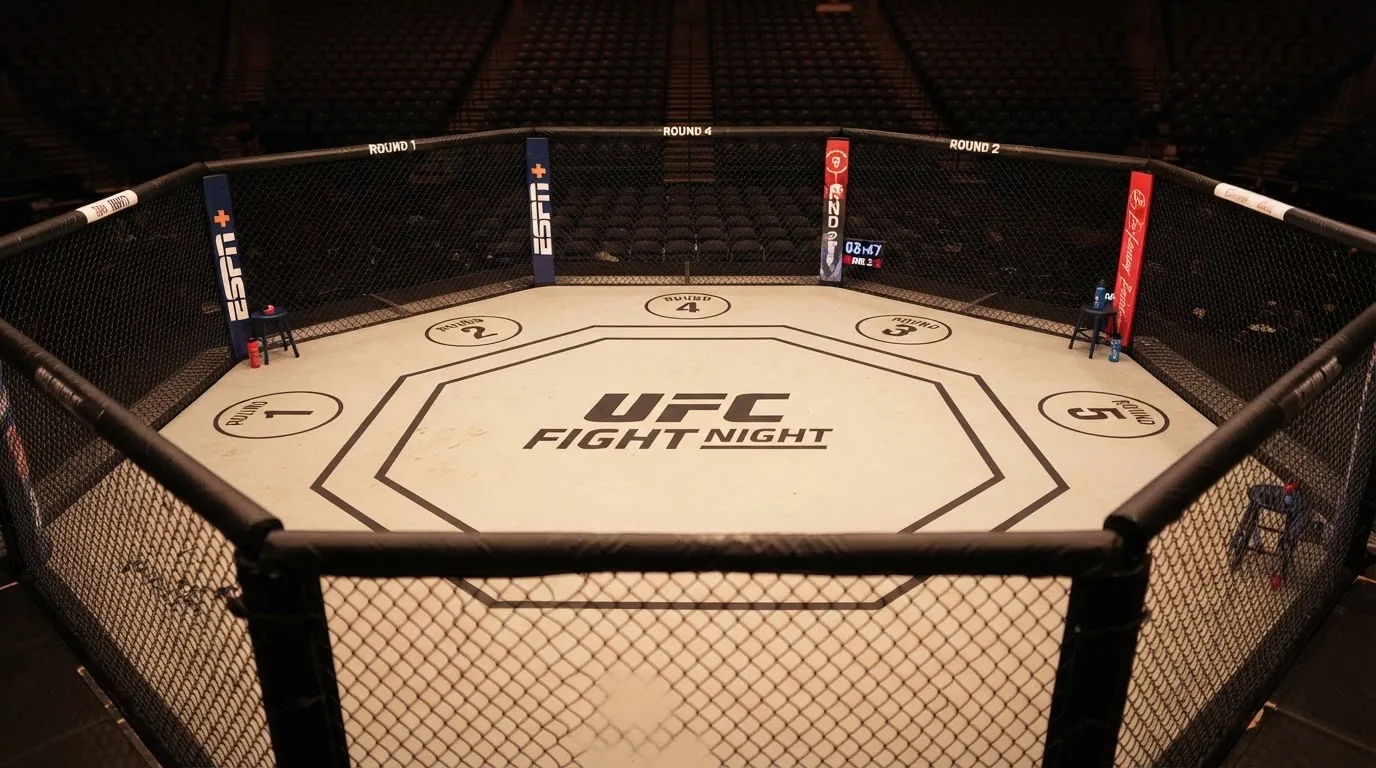
The settlement list matters because the bookmaker’s market is the same list, sliced differently. The “method of victory” market is the most obvious cut: knockout, TKO, submission, decision. A bet on a fighter to win at any price is settled on whichever of those legal endings applies. Live in-play pricing leans on what is in front of the judges at that moment: a cut opened, a takedown defended, a gas-tank visibly emptying. That is where round-grouping markets come in, with “fight ends inside the distance” the most common two-way price.
The promotion has run over 750 events since its first card in Denver on 12 November 1993. Eight men’s and three women’s weight classes sit on the active roster, and Dana White has run the operation since 2001. The card density is what shapes the betting calendar: a numbered event roughly every other weekend, Fight Night cards filling the gap, and a pay-per-view block four or five times a year.
Two upcoming events show how the calendar lands in practice. UFC 334 (Gane vs. Hokit) is scheduled for 14 November 2026 at Madison Square Garden, and UFC 335 (Oliveira vs. Lopes) for 12 December 2026 at T-Mobile Arena. Numbered events with two well-known names on top draw the deepest market coverage and the sharpest prices; Fight Night undercards often have only the moneyline, total rounds and method of victory priced, with the rest of the markets appearing the day before.
Live UFC Betting and How Cash Out Behaves
UFC is one of the better live-betting sports because the market is small and the events are long. A three-round bout runs roughly 18 minutes of clock time and stretches to 35 minutes from walkout to last score; a five-round title fight is closer to an hour. That gives a licensed bookmaker room to reprice through every round, and gives a punter a window to react.

In-play prices update round by round at the mainstream UK brands, with the most granular offering on the method-of-victory market, the over/under on total rounds, and the moneyline. Where the bookmaker’s own product includes it, cash out lets the punter close a position before the final bell, accepting the price on screen at that instant. The price on screen is the bookmaker’s, not the market’s, and the gap between the two widens sharply the moment a fighter is hurt, because the algorithm reprices a one-punch knockout probability at a value it is rarely accurate to the cent on.
A few patterns repeat across the live product at GB-licensed firms. The first is that the overround (margin) on in-play prices is wider than on pre-fight prices, sometimes by a couple of percentage points. The second is that markets “suspend” rather than disappear: a takedown in progress freezes the moneyline for the seconds the referee is separating, then resumes. The third is that the cash-out button is more useful on a multi-leg acca (where a couple of legs have already won) than on a single pre-fight line, where the pre-fight price was the better number. Spread betting brands operate in-play in a different mode: Sporting Index’s product lets the punter switch between fixed-odds and spread modes, with auto cash-out on the fixed-odds side. Spreadex’s financial spread book is FCA-regulated, not Commission-regulated, and the operator states that spread losses can exceed the deposit.
The licensed bookmaker’s in-play pricing is not “unrestricted” as a legal matter; the controls sit inside the licence conditions, the LCCP social responsibility code, and the Remote Technical Standards. Markets close when the operator closes them, not on a regulator’s schedule.
Picking a Path: How to Approach UFC Cards
The honest framing of “UFC betting tips” is the least marketable part of the subject. Nobody knows the outcome of a fight. Tipsters sell forecasts; markets price probabilities; sharp bettors look for edges, which are real but small, and they shrink as the market matures. What the punter can control is the cost of being in the market: the margin baked into the price, the size of the accumulator, the number of bonuses cleared per year, and the time spent on a card that will end in a finish more often than the public pricing assumes.
Three rules of thumb hold across the GB-licensed market on UFC. First, the moneyline is the most efficient market: it is the most priced, the easiest to compare across bookmakers, and the one with the thinnest margin. Method of victory, total rounds and “go the distance” are wider. Second, the closer to fight night, the more accurate the price, because the betting public has weighed in and the bookmaker’s algorithm has had a full week of data. Lines released four days out are softer and easier to beat in theory; they are also more likely to be cut. Third, the undercard is where the value hides, because fewer customers means fewer recreational dollars pulling the line around.
Bankroll management matters more in MMA than in most team sports, because the variance is brutal. A favourite at 1.30 wins eight or nine times out of ten in a 12-fight sample and the punter still loses. A 2.00 price means a 50% chance, which is a worse bet than it sounds once the margin is taken out. A straight unit-stake approach — same size on every pick, no doubling after a loss — is the boring answer, and the boring answer is the one that survives the variance.
Predictions are entertainment, not edge. A punter who pays for a tipster is paying for someone else’s reasoning; the reasoning is sometimes useful, the picks are never reliably right, and the price the tipster does not know about is the one the bookmaker already took out.
UFC Markets and How the Odds Are Built
The standard UFC menu at a GB-licensed firm has six or seven markets, with the deepest cards running closer to fifteen. The moneyline, or “to win the fight”, is universal. The over/under on total rounds is universal too, usually at 0.5, 1.5, 2.5 and 3.5 on three-round bouts and an extra 4.5 line on five-round fights. Method of victory, “fight ends inside the distance”, and “to win by knockout” or “to win by submission” are standard at the bigger brands. Round-grouping, “in round 1/2/3” and “to win in rounds 4 or 5” are common on title fights. The bet builder covers method, total rounds and the moneyline on the same fight.
A useful sanity check on any UFC price: take a look at the overround. The two-way moneyline rarely prices to a true 50/50; the favourite is at 1.55, the underdog at 2.60, and the bookmaker’s take is the difference between 100% and what the two prices together return. The 5% margin called out in the next section is the better case, not the average.
A worked example on a two-way market. The bookmaker prices fighter A at 1.90 and fighter B at 1.90 (decimal). The implied probabilities are 1 ÷ 1.90 = 0.526, or 52.6%, for each fighter. Add them: 52.6% + 52.6% = 105.3%. The extra 5.3% is the bookmaker’s margin. A punter playing the 1.90 market loses, on average, 5.3 pence per pound staked across a long enough run, before any qualifying offer is layered on top. A three-way market (fighter A, fighter B, draw) typically prices with a margin closer to 7% on the same card.
Bet builders are different. The same-fight builder stacks method of victory, total rounds and round grouping, and the margin on the combined price is rarely below 8% because the bookmaker is pricing correlated outcomes without a public line to anchor against. A punter who can build the same bet at a different firm — and many licensed firms now allow it — should check the prices against each other.
The UFC Calendar and What Each Card Carries
The UFC runs a year-round schedule. Numbered events, the ones with the Roman numerals or three-digit numbers (UFC 304, 305, 334), draw the biggest names and the deepest market coverage. Fight Night cards, usually on Wednesday or Saturday, run in between, with regional content and a couple of ranked fighters. The Contender Series runs in summer. The schedule is denser than any other major combat sport, and a GB punter who bets every card is betting on roughly 40 events a year.
A typical numbered card has 12-14 bouts, of which the last five to seven are reasonably priced. A Fight Night has 10-12 bouts, of which three or four are sharp. The main event is priced 7-10 days out; the co-main and the rest of the main card open about 4-5 days out; the undercard sometimes does not get lines until the day before, because the bookmaker does not have the data.
The market margin on a numbered event’s main event tends to be lower than on a Fight Night’s main event, because the larger public interest brings more bookmakers in and tightens the price. The market margin on the undercard is higher, sometimes visibly so: a 9% margin is not unusual on a 6-fighter prelim with limited liquidity.
How the Ten Licensed Brands Compare
The ten brands below are all on the Gambling Commission’s public register with a current remote general betting licence. They are not the only licensed firms; many others (bet365, Betway, Ladbrokes, Coral, Paddy Power, BetVictor, BoyleSports, Sky Bet, BetUK, and dozens more) hold a Commission licence. None of these is “the only” licensed brand. What changes between them is the product they wrap around the licence: market depth, live pricing, bet builder capability, app quality, payment methods and the size and conditions of the welcome offer.
The table below holds the licence number and what the operator’s own terms state on UFC-facing features. Where the operator’s own documentation names a feature, that is what the cell says; where the operator’s terms do not name it, the cell is left as the no-data marker. The check date is in the lead above.
| Bookmaker | Licence | Holder | What the operator’s terms say on UFC-relevant features |
|---|---|---|---|
| LiveScore Bet | 056859-R-332720-005 | LiveScore Betting and Gaming (Gibraltar) Limited | Bet Builder up to 10 selections, covering match result, both teams to score, corners, total goals, player scoring and card markets |
| BetGoodwin | 002927-R-327985-008 | Goodwin Racing Limited | Sports welcome offer of £15 in free bets for a £10 qualifying bet, split across a £5 sports bet, a £5 acca and a £5 Sub-Cover bet |
| Bet600 | 044731-R-323941-016 | Tyche Tech Limited | Best Odds Guaranteed on horse racing, paying the starting price if it exceeds the price taken |
| William Hill | 039225-R-319373-015 | WHG (International) Limited | Best Odds Guaranteed on UK and Irish horse racing from 8 AM on race day, on single and multiple bets; not ante-post, tote or pari-mutuel |
| Hollywoodbets | 053028-R-330019-013 | Hollywoodbets International UK Limited | Sports welcome offer: stake back as a free bet of up to £30 on a first losing acca, with stake £10+, 3+ legs, odds of 4/1 or greater, settled within 7 days |
| Fitzdares | 000400-R-103839-030 | Fitzdares Limited | Cash out, accumulators, Lucky 15s, specials and ante-post markets on horse racing, football, tennis, rugby, cricket, golf and American football, with in-play live odds |
| Betfair | 039439-R-319330-013 | PPB Counterparty Services Limited | In-play betting, Bet Builder, free live streaming on UK and Irish horse racing and football inside the app, and a 90 Minute Payout market |
| DAZN Bet | 048756-R-327274-019 | DZBT Limited | Deposits start at £5 by debit card, Apple Pay, Paysafecard, Trustly and Skrill, and at £20 by PayPal, with no processing fees |
| NetBet | 039170-R-319343-032 | Netbet Enterprises Limited | Daily Boosts, Profit Boosts and free bet offers, a Bet Builder with instant dynamic odds, and sports stats for major leagues |
| Sporting Index | 027343-R-308898-011 | Sporting Index Limited | Switch between fixed odds and spread betting, with in-play betting, Bet Builder for football, auto cash-out and Multi-Markets |
The table tells the licensing story; it does not say which brand is the best for a given punter. That is what the write-ups underneath cover. The product on UFC specifically — the depth of the method-of-victory market, the over/under rounds lines, the live in-play speed, the bet builder coverage — is not always spelled out in the operator’s public terms, and where it is not, the cell is left blank. The punter who cares about a specific feature should check the operator’s own betting slip on a current card before staking.
LiveScore Bet
LiveScore Bet runs on the same engine that powers the LiveScore app, so the live scores and the betting slip sit in the same place. The Bet Builder allows up to 10 selections and covers match result, both teams to score, corners, total goals, player scoring and card markets; the same product handles UFC when a card is priced, which is more often on numbered events than on Fight Nights. LiveScore Bet is licensed under Commission account 56859 through LiveScore Betting and Gaming (Gibraltar) Limited.
For the punter, the deciding question is whether the app’s strength — fast in-running scores and a tight integration with match data — translates to useful in-running UFC pricing. The live data feed on UFC is good; the in-play book depth is decent on main events and thinner on the undercard, in line with the wider GB market.
BetGoodwin
BetGoodwin’s product is a tighter list than the bigger brands, with horse racing at the centre and UFC added on numbered events. The sports welcome offer of £15 in free bets for a £10 qualifying bet, split across a £5 sports bet, a £5 acca and a £5 Sub-Cover bet, is one of the smaller cash-equivalent packages on the market; what it gives up in headline size it pays back in the £10 minimum, which is lighter than the £20-£50 floors elsewhere. BetGoodwin is licensed under Commission account 2927 through Goodwin Racing Limited.
The free-bet stake is not returned with a winning free bet, which is the standard GB-licensed pattern. A punter who plans to bet small and often, on a few UFC events a year, gets a clean product here. A punter who wants every Fight Night priced should look at a brand with the wider schedule.
Bet600
Bet600’s named feature is Best Odds Guaranteed on horse racing, paying the starting price if it exceeds the early or show price taken. The horse-racing BOG is the headline; UFC pricing is offered on numbered events without a documented edge. The operator is licensed under Commission account 44731 through Tyche Tech Limited.
The honest read is that Bet600 is a horse-racing-first bookmaker that prices UFC when the schedule makes it worthwhile. A punter shopping for BOG on the racing side and willing to use a different firm for UFC is the natural fit.
William Hill
William Hill is one of the largest GB-licensed firms, with Best Odds Guaranteed on UK and Irish horse racing from 8 AM on race day, applied to single and multiple bets but not to ante-post, tote or pari-mutuel pools. The UFC product is broad: full moneyline, method of victory, total rounds, and a bet builder on numbered events, with the brand’s standard in-play interface. William Hill is licensed under Commission account 39225 through WHG (International) Limited.
For a punter who already has a William Hill account and is comfortable with the app, the brand is a one-stop shop for UFC. The product on offer is not the cheapest in the market; the breadth and the licence standing are the trade-off.
Hollywoodbets
Hollywoodbets’ sports welcome offer is a stake-back as a free bet on the first losing acca: stake £10 or more on an accumulator of three or more legs at odds of 4/1 or greater, settled within seven days, with the free bet capped at £30 and one per customer. The free bet is what most GB-licensed firms offer, with the cap and the odds floor setting the practical ceiling. Hollywoodbets is licensed under Commission account 53028 through Hollywoodbets International UK Limited.
The offer is well-defined and the rules are spelled out in the App Store listing. A punter who already plans an acca on a UFC card — say, a three-leg card builder across the main event, the co-main and one Fight Night feature — gets most of the offer’s value without a forced bet.
Fitzdares
Fitzdares’ app offers cash out, accumulators, Lucky 15s, specials and antepost markets on horse racing, football, tennis, rugby, cricket, golf and American football, with in-play live odds. UFC is part of the standard menu on numbered events. The app is premium-positioned; the brand sits in a different market from the larger firms. Fitzdares is licensed under Commission account 400 through Fitzdares Limited.
The product is a curated one. A punter who likes a smaller, well-organised app and wants fewer in-house promotions will be at home; a punter chasing a deep market of bonus offers will not.
Betfair
Betfair Sportsbook is the fixed-odds product; the Exchange is the betting intermediary arm, which is the same licence holder but a different product. The Sportsbook offers in-play betting, Bet Builder, free live streaming on UK and Irish horse racing and football within the app, and a 90 Minute Payout market on football. UFC is priced on the Sportsbook side, and the Exchange is a separate venue for punters who want to lay bets as well as back them. Betfair is licensed under Commission account 39439 through PPB Counterparty Services Limited.
The 90 Minute Payout is a football product, not a UFC one. The relevant UFC offer is the breadth of the Sportsbook and the presence of the Exchange as a price-discovery venue. A punter who wants to back a fighter on the Sportsbook and lay the same fighter on the Exchange, locking in a position, can do so within one licence holder.
DAZN Bet
DAZN Bet’s deposit methods are the part of the offer most relevant to a new customer: deposits start at £5 by debit card, Apple Pay, Paysafecard, Trustly and Skrill, and at £20 by PayPal, with no processing fees. The minimum is lower than most GB-licensed firms and the method list is broader. DAZN Bet is licensed under Commission account 48756 through DZBT Limited.
UFC pricing on DAZN Bet is offered on numbered events. The product edge is the low deposit minimum and the broad method set, which makes the brand a natural fit for a punter who wants to stake small.
NetBet
NetBet’s product is promotion-led: Daily Boosts, Profit Boosts and free bet offers, a Bet Builder with instant dynamic odds, and sports stats for major leagues. The bet builder price updates as legs are added, which is a useful feature for a UFC card builder. NetBet is licensed under Commission account 39170 through Netbet Enterprises Limited.
The promotions rotate. A punter who reads the NetBet promotions page on a Wednesday before a Saturday card gets the most out of the offer; a punter who only checks once a month misses more than at a brand with a steadier, less promotional product.
Sporting Index
Sporting Index is the outlier of the ten: a spread-betting book that lets the punter switch between fixed odds and spread betting, with in-play betting, Bet Builder for football, auto cash-out and Multi-Markets. Spread betting on UFC is a different product from fixed-odds betting and has its own tax treatment under financial spread duty. Sporting Index is licensed under Commission account 27343 through Sporting Index Limited.
The bet is against the bookmaker on a range — fighter A finishes inside the distance at a number, fighter B goes the distance at a different number — and the punter wins or loses the stake multiplied by the difference. Losses can exceed the stake on the spread side, the same as Spreadex’s financial book. A punter who knows what spread betting is and wants that product is the natural fit; a punter who has only placed fixed-odds singles should not start with Sporting Index on UFC.
The Legal Framework in Great Britain
The Gambling Commission licences every operator that takes remote bets from customers in Great Britain, and the test is the public register, not a brochure claim. The Gambling (Licensing and Advertising) Act 2014 closed the previous loophole: from 1 November 2014, an operator whose remote facilities are used in Great Britain needs a Commission licence wherever it is based. A Gibraltar, Malta or Curaçao licence is not a substitute. A GB licence is the consumer protection layer. With it come GAMSTOP membership, the 10× bonus wagering cap, the £150 rolling-30-days vulnerability check, the credit-card ban, the deposit-limit requirement, the source-of-funds duty, the LCCP social responsibility code, and the Commission’s complaints and ADR routes. Without it, none of those protections apply.
There is no statutory list of permitted sports or markets. A bookmaker holds a licence for a category — remote general betting standard (real events), remote general betting standard (virtual events), remote general betting limited, remote pool betting or remote betting intermediary (the exchange licence) — and offers markets under its own rules. UFC is a real event; it is offered under the general betting standard licence by every firm on the register that covers the sport.
Spread betting splits two ways. Financial spread betting is regulated by the Financial Conduct Authority, not the Commission, and Spreadex’s site is explicit on this. Sports spread betting — points, rounds, method-of-victory ranges — is regulated by the Commission under the general betting standard licence, with Sporting Index the best-known example on the UFC side. The two are different products, different tax treatments, and the operator’s terms say so.
Northern Ireland is outside the Gambling Act 2005. A GB-licensed operator is licensed to take bets in Great Britain (England, Scotland and Wales). The same operator can take bets from Northern Ireland customers only under the older Northern Ireland regime, and not all of them do. The register entry states the licence category; whether the brand takes Northern Ireland bets is a separate question. Write “GB-licensed” and not “UK-licensed” when the licence is a Commission one.
How the Operator’s Own Protections Stack Up
GB-licensed operators share a set of consumer protection layers that are not optional. The minimum age is 18. Identity is verified before a customer can deposit or place a bet, with name, address and date of birth checked, and the check applies even when the first bet is a free bet or bonus. Credit cards have been banned for gambling in Great Britain since 14 April 2020, including credit-card-funded e-wallet deposits. Debit cards and bank-based payments are not covered by the ban.
GAMSTOP is mandatory for online operators since 31 March 2020. Self-exclusion periods are six months, one year, five years, or five years with auto-renewal. After the minimum period, the exclusion stays in place for a further seven years unless the customer asks GAMSTOP to remove it. GAMSTOP covers online sites and apps; betting shops use a separate scheme. There is no Commission ban on a customer signing up to multiple brands; the self-exclusion is multi-operator by design.
Deposit limits became a licence condition under RTS 12, with the first changes applied since 31 October 2025. A second phase, postponed to 30 September 2026, is the question of when further limits are live. The Commission has not set a state deposit ceiling: limits are the customer’s choice, and the operator is required to offer them. A punter who has registered with a self-set limit cannot raise it without a cooling-off period, and cannot remove it without one either.
The financial vulnerability check is a public-record check (bankruptcy and county court judgments, for example) on a rolling 30-day deposits-minus-withdrawals figure that exceeds £150, in force since 28 February 2025. It is not an income check and not a credit reference check. The financial risk assessments announced in the Commission’s article of 7 July 2026 are a separate, staged plan with no start date; write “announced, staged, no start date”, not “in force”. Customer-affordability rules are tightening over the next two years, and the punter who keeps deposits low and stake sizes small will see fewer of these interruptions.
What “Offshore” Means in Practice
An unlicensed brand is not illegal for the punter to use; the offence in section 33 of the Gambling Act 2005 is aimed at the operator. The honest framing of an offshore book is what the punter loses by being on one: no GAMSTOP, no Commission complaints route, no approved ADR body, no British consumer redress if funds are withheld, no 10× bonus cap, no £150 vulnerability check, no credit-card ban at the source, no Commission-led source-of-funds check. The book runs on its own house rules, and the house rules are whatever the operator chooses to publish.
Enforcement against unlicensed brands is disruption, not blocking. The Commission issues cease-and-desist notices, refers to search engines, works with registrars, hosts and payment providers, and has been given, or is about to receive, court-order DNS blocking powers. Write the position as it stands, not as the press shorthand “blocked in the UK”. The punter on an unlicensed site has no automatic consumer protection, and that is the relevant fact.
Cryptocurrency and UFC Betting in Great Britain
A GB-licensed bookmaker is not permitted to run an anonymous crypto-funded product. The identity check is the entry point: name, address, date of birth, all verified before the first deposit. A book that takes Bitcoin and pays out in Bitcoin is, in the GB market, almost always an unlicensed one, and the consumer protections above do not apply. The crypto-friendly books some research points at are operating from Curaçao or Anjouan, on licences that the Gambling Commission does not recognise for the GB consumer.
A punter who wants to bet with crypto and stay inside the GB framework is in a narrow channel: buy crypto on a GB-registered exchange, sell to sterling, deposit by debit card, bet in sterling, withdraw to the same source. The crypto exposure is the FX and on-chain side, not the betting side. The betting side stays inside the Commission’s perimeter and the punter keeps GAMSTOP, the bonus cap and the complaints route.
A punter on an unlicensed crypto book has none of those, plus the exchange-rate risk of a payout in BTC, plus the operator-custody risk that the licensed books do not carry. The choice is the licensed book with sterling, the offshore book with crypto, or a punt on neither.
How UFC Bonuses and Free Bets Work in Great Britain
The headline number on a welcome offer is rarely the number the punter takes home. Three mechanics matter: the wagering requirement, the minimum price on the qualifying bet, and the stake treatment on the free bet itself.
The 10× bonus wagering cap (in force since 19 January 2026) means a £10 bonus can be cleared with no more than £100 of qualifying bets. Older offers, signed up to under grandfathering, may carry a higher multiple and are still in circulation. A punter should check the current terms on the offer page before staking. Mixed-product promotions (an offer that requires betting on two or more product types, like a free bet contingent on placing a casino stake) have been banned since the same date. Welcome offers on UFC at GB-licensed firms now sit inside that frame.
The free bet stake is not returned with a winning free bet, in nearly every case. A £10 free bet at 2.50 returns £25 (£10 × 2.50 = £25, stake not returned), not £35. The effective price of the bet is the odds minus 1, scaled by the probability of winning, which gives the free bet an average value below its face. The bonus turnover rule multiplies the cost: a £10 bonus with a 5× wagering requirement needs £50 of qualifying bets at the minimum price, which is often 1.50 or 1.80. The bettor clears the bonus by running that £50 through, taking the margin hit on the qualifying bets, and ending up with the bonus amount in cash if the wagering is met.
The minimum qualifying price is the line the punter must clear. A bet at 1.20 does not count, and a bet at 1.50 does. The most common minimum on a sports welcome at a GB-licensed firm is 1.50 (½ in fractional), with some offers at 1.80 (4/5). The punter who backs a heavy favourite at 1.10 to clear the bonus has wasted the bet: it does not count. The punter who backs a 1.70 shot clears the bonus with one bet and keeps a positive expected value, in theory.
The capped-stake welcome (Hollywoodbets’ up-to-£30 stake-back on a losing acca, BetGoodwin’s £15 in free bets for a £10 qualifying bet) is the practical shape of the current GB market. The days of a 100% deposit match with a 10× wagering requirement are gone. What is on offer is closer to a “bet £10, get £15-£30 in free bets” structure with a defined minimum price and a defined expiry. A punter who accepts the offer under those rules is taking a real but modest promotion; a punter who treats it as a free £100 is reading a brochure that no longer exists.
Mobile Apps and How They Compare
The five most-downloaded sports betting apps in the UK on the App Store are the same five brands a punter names first: bet365, William Hill, Betfair, Betvictor and Paddy Power. Of the ten on the Commission’s register that are routed to this page, all ten have an iOS app and an Android app, the Android app distributed from the operator’s own site in most cases (Google Play’s policy on real-money gambling apps varies by country and is the reason for the sideload). The app feature set is broadly the same: live in-play, bet builder, cash out, acca, partial cash out, price boost, free-bet balance, deposit and withdrawal.
What differs is the polish. LiveScore Bet’s app benefits from the LiveScore data feed, so live scores and the betting slip are in the same view. Betfair’s app hosts the Sportsbook and the Exchange in the same login. DAZN Bet’s app has a clean deposit flow with the £5 minimum and a broad method list. The rest of the ten sit in the middle: solid, well-maintained, none of them noticeably worse on a UFC card.
A punter who bets on the bus to work needs an app that loads in two seconds, holds a stable connection, and refreshes the in-play price without a full reload. The mainstream GB apps do this; the smaller brands sometimes do not. A free install and a £5 deposit on a low-card Saturday is the cheapest test.
Where to Get Help
GamCare runs the National Gambling Helpline and is the front door for problem gambling support in Great Britain. The service is free, confidential and 24/7. GambleAware funds treatment and education. The NHS runs specialist gambling clinics across the country. Gamblers Anonymous runs peer-support meetings. GAMSTOP is the self-exclusion tool, online, at the multi-operator level.
A punter who has decided to take a break can register with GAMSTOP in minutes, and the exclusion applies to every GB-licensed online operator in one go. A punter who wants a single-operator exclusion can use the responsible-gambling tools on the operator’s app (deposit limits, timeouts, reality checks, full self-exclusion). A punter who is in crisis should call GamCare.
The Commission’s own page lists approved alternative dispute resolution (ADR) bodies. A punter with an unresolved complaint against a licensed operator can complain to the Commission after going through the operator’s process and the ADR route.
Margin and the Numbers Behind the Odds
The single number every punter should know is the margin. The bookmaker does not need to beat the punter at 50% on the bets; it only needs the price to be wrong in its favour by a few percent on every bet, and the long run does the rest. The margin is the measure of how wrong the prices are, on average, against the “true” probability.
The math on a two-way market. The bookmaker prices fighter A at 1.90 and fighter B at 1.90. The implied probability of each is 1 ÷ 1.90 = 0.526, or 52.6%. A perfectly priced market with no margin would have the two probabilities sum to 1.000 (100%). The sum here is 1.053, or 105.3%. The extra 5.3 percentage points is the bookmaker’s margin, sometimes called the overround, the vig, or the juice. The punter’s expected loss on the 1.90/1.90 market is 5.3% of every pound staked, before any promotion is layered on top.
The same calculation on a 1.55 / 2.60 market: 1 ÷ 1.55 = 0.645 (64.5%), 1 ÷ 2.60 = 0.385 (38.5%). The sum is 1.030, or 103.0%, so the margin is 3.0% — a tighter price on a more one-sided fight, which is what the market looks like when the public has piled in. The same calculation on a 1.30 / 3.60 market: 0.769 + 0.278 = 1.047, or a 4.7% margin. Heavy favourites price tighter because the public interest is heavier; long-shot underdogs price looser.
The three-way method-of-victory market on the same fight is wider. If the method is priced knockout 3.00, submission 4.50, decision 2.40: 1 ÷ 3.00 + 1 ÷ 4.50 + 1 ÷ 2.40 = 0.333 + 0.222 + 0.417 = 0.972, or 97.2% summed, giving a 2.8% margin. That is a tight three-way line, by the standards of the market. A 1.50 / 3.50 / 7.00 method of victory market on a different card would be 0.667 + 0.286 + 0.143 = 1.096, or a 9.6% margin, which is loose. The punter who does this calculation on every method of victory market they intend to bet will find the tight line.
The margin on a UFC bet builder is higher. A 6-leg builder at 8% margin has an expected loss of 8% on the stake. A 3-leg builder at 6% margin has an expected loss of 6%. The cost of the feature is the margin and the temptation to over-build; the cost of the alternative (three singles at 4% margin each) is the loss of the convenience and the correlation across legs. The punter who builds the same bet at two different bookmakers and takes the lower combined price is doing the work the algorithm does on the main market.
A margin of 5% on a card with £1,000 of qualifying bets at the minimum price (to clear a £50 bonus at 5× wagering, say) is £50 in expected cost on the clearing itself. The bonus pays out at most £50 in cash, so the cost and the value are matched. The punter who takes the bonus and clears it at a margin of 8%, on bets that did not need to be that large, has paid £80 to clear £50. The offer’s “value” is in the offer’s structure, not in the brochure.
A general rule that holds across the GB-licensed market: the tighter the main market, the better the punter’s expected position. A 3% moneyline margin is a sharp book. A 6% margin is a typical book. A 10% margin on a niche market is a soft book, and the soft book is where the edge is most often claimed and least often realised.
How the Calculation Lands on a Real Bet
The math on a single bet is simpler. A £10 stake at 2.50 returns £25 if the bet wins. The punter’s profit is £15. The bookmaker’s expected margin is baked into the 2.50: a “true” 40% chance would price at 2.50 with no margin, but the price on a real fight at 2.50 is the 2.50 less the bookmaker’s cut.
A worked example. A punter places £20 on a 4/5 (1.80 decimal) shot. The return on a win is £20 × 1.80 = £36. Profit is £16. The bookmaker’s margin on the 4/5 line is whatever the underdog’s price implies; on a 1.80 / 2.10 fight, the margin is 1 ÷ 1.80 + 1 ÷ 2.10 = 0.556 + 0.476 = 1.032, or 3.2%. The punter’s expected cost on the line is 3.2% of the £20 stake, or 64 pence, before any promotion. A punter who bets the same £20 at the same line across a 20-bet sample pays an expected £12.80 in margin; the same sample at a 6% margin on a niche market pays £24. The line is the difference.
A £10 accumulator (acca) with four legs at 1.80, 2.10, 1.65, 2.40: the combined price is 1.80 × 2.10 × 1.65 × 2.40 = 14.97. The £10 stake returns £149.70 if all four win. The implied probability of the acca is 1 ÷ 14.97 = 0.067, or 6.7%. The “true” probability of the four legs all winning is the product of the four implied probabilities less the margins on each: 0.556 × 0.476 × 0.606 × 0.417 = 0.067, adjusted for the margin on each leg, which works out close to 0.06 (6.0%) for a typical GB card. The acca’s implied edge over the product of the four singles is small, sometimes negative, depending on the line. The punter who has priced the four legs as singles at 1.80, 2.10, 1.65, 2.40 and built the acca from the same prices has built the same bet; the punter who has built the acca inside the bet builder and accepted the combined price has built a slightly worse bet at the same logic.
The cash-out on a winning acca, mid-event, is a separate calculation. The cash-out price is the bookmaker’s price on the remaining legs, and the bookmaker’s price is wider than the market on a live event. A punter who cashes out a four-leg acca at 14.97 after the second leg wins, with two legs to run, is taking the bookmaker’s live price on those two legs. The price will be below the “true” 2.10 × 1.65 = 3.465 product, because the bookmaker is taking a wider margin in-running and because the bookmaker is hedging the position on the exchange. The punter who has the option to let the bet ride to the end, on a 14.97 price with two legs to run, should usually let it ride. The punter who is using the cash-out to lock in a return on a heavy favourite on the third leg has a different reason to take it.
A Note on the Calendar and the Gaps Between Cards
The UFC runs 40-ish numbered and Fight Night events a year. The punter who bets every card is betting 12-15 bouts per card, which is 500+ bets a year, on a sport with high variance. The cost of the activity, in expected loss to margin alone, is 3-6% of the stake, or £300-£600 on a £10,000 annual bankroll. The cost of bonuses cleared inside that activity adds another layer, on the order of the bonus’s face value if the wagering is matched. The cost of chasing losses on a 0-3 night is the unrecovered stake.
A punter who bets 2-3 cards a year, on numbered events with two or three singles each, is in a different cost bracket. The margin is still there, but the volume is lower, and the time spent pricing the card is higher per bet. The expected loss on £300 of singles across a year at 4% margin is £12. The expected loss on £3,000 at the same margin is £120. The punter who treats the bet as a small entertainment cost is paying £12 a year for the experience; the punter who treats it as a sideline income is paying £120 for the same experience and not getting the income.
The honest read of the sport, the market and the bookmaker’s product is the same: betting is paid for in margin, the margin is in the price, the price is the product. A punter who can read the margin on a market has the only edge the bookmaker cannot take away.
A Note on Promotions, Codes and Affiliate Links
This page does not list a working bonus code, a promo code or an affiliate link, by design. The promotion terms change on a calendar the operator sets, the welcome offer at a GB-licensed book is a one-per-customer product, and the offer that pays a punter £15 in free bets is not the same offer that pays the next punter £30. A punter looking for the current offer should land on the operator’s promotion page directly, where the offer’s headline, terms, expiry and qualifying bets are spelled out for the date the page is read. Codes and affiliate links have no place in a comparison that aims to describe the product, not market it.
Closing the Case
The path through online UFC betting in Great Britain is straightforward. A GB-licensed bookmaker, identified on the Commission’s public register, with a product that covers the card, a payment method that suits the punter, and a welcome offer whose terms the punter has read. The punter who reads the margin on the market they intend to bet is reading the only number the bookmaker cannot fudge; the punter who reads the wagering requirement on the bonus they intend to claim is reading the only number the offer can be made cheap on. The rest is the sport, which does what it does on a Saturday night, and the price, which is what the market says it is.
The brands above are not the only licensed firms. They are the ten the Commission’s register routes to this page, and they sit alongside a longer list. A punter who is not on one of them yet is on the wrong side of a comparison that costs nothing to fix. A punter who is on one of them and dissatisfied is, with a five-minute read of the register, a few clicks from one of the others.
Frequently Asked Questions
Where to bet on UFC fights?
At a bookmaker that holds a Gambling Commission remote licence and is on the Commission’s public register. The licence is the entry condition; the Commission’s register is the only place to confirm it. Among the brands routed to this page, all ten are on the register; the punter can confirm by searching the operator’s business name, trading name or Commission account number on the register’s search page.
Where to bet on UFC?
The same answer as above. A GB-licensed bookmaker is the only UK-facing brand that carries the consumer protection layer: GAMSTOP, the 10× bonus wagering cap, the £150 vulnerability check, the credit-card ban, deposit limits, source-of-funds checks and the Commission’s complaints route. An offshore book offers none of those.
Where can I bet on UFC fights?
At any of the ten brands on the Commission’s register routed to this page, or at any of the other GB-licensed firms that price the sport. The punter who already has an account with a GB-licensed book can use that book. The punter who does not should pick one from the register, deposit by debit card, complete the identity check, and price a current card before staking.
How can it be checked that a bookmaker holds a Gambling Commission licence?
The Commission’s public register is the only authoritative source. Search by business name, trading name, domain or account number. The register entry states the licence type (remote general betting standard, real events, in the case of the brands on this page), the licence holder’s legal name and the current status. A brand that does not appear on the register is not licensed for the GB consumer; a brand that appears is.
How is the return on a bet worked out from the stake and the odds?
Multiply the stake by the decimal odds. A £10 stake at 2.50 returns £25 if the bet wins. The profit is the return less the stake: £15 on a £10 stake at 2.50. The fractional equivalent of 2.50 is 6/4 (3/2 in some books); the conversion is (a ÷ b) + 1, where a/b is the fractional form.
What is the bookmaker’s margin and how can it be seen in the odds?
The margin is the difference between the sum of the implied probabilities on a market and 100%. On a two-way market priced 1.90 / 1.90, the implied probabilities are 52.6% and 52.6%, summing to 105.3%, and the overround is 5.3%, while the margin is 5.0%. The margin is the bookmaker’s expected long-run take on the market, in percentage terms of the stake. A tighter market (1.55 / 2.60, summing to 103.0%) is a lower margin. A looser market (1.30 / 3.60, summing to 104.7%) is a higher margin. The punter’s expected loss on a market, before any promotion, is the margin.
Combat & motorsport – Free bets
Content created by the «Free bets» team
