
Online snooker betting in 2026: which UK bookmakers, which markets, and what a snooker bet actually pays
 Available in US
This page reads the UK snooker betting market as it stands in 2026: the markets a licensed bookmaker actually puts up, the way snooker odds are built, the tournaments the calendar turns on, and the ten bookmakers the Gambling Commission register lists for remote betting in Great Britain. The material is current as of 27 October 2026; the licences and operator terms were checked against the Gambling Commission’s public register and each operator’s own published terms.
How snooker odds are built — and what that means for the price on the slip
Snooker sits among the smaller sports on a UK bookmaker’s site, which shapes the way prices are set. The basic snooker market is a match result — player A, player B, with no draw in a one-off frame contest and the bookmaker quoting a two-way price in the longer formats when one is needed. From there the markets fan out: frame handicap, total frames, race to N frames, first colour potted, highest break, century breaks in the match, player to win the next frame, and the outright market for the tournament.
A snooker match winner at fractional odds of 4/6 (decimal 1.67) and 6/4 (decimal 2.50) shows a two-way price. The implied probability sums to more than 100% because the bookmaker’s margin is built into both sides. Take the payout share first: 1 ÷ (1/1.67 + 1/2.50) = 1 ÷ (0.5988 + 0.4000) = 1 ÷ 0.9988 = 1.0012, which rounds to 100.1% as written, and the margin sits at about minus 0.1% — that is the wrong way round, and the reason is that 4/6 in the modern fractional convention is 1.67 only when rounded; the exact decimal equivalent of 4/6 is 1.6667. Using that exact form, 1 ÷ (0.6000 + 0.4000) = 1.00, a margin of zero — also a degenerate case. A two-way match market at 1.80 and 2.00 is the more honest example: 1 ÷ (1/1.80 + 1/2.00) = 1 ÷ (0.5556 + 0.5000) = 1 ÷ 1.0556 = 0.9474, a payout share of 94.7% and a margin of 5.3% on the market. Snooker sits in the same band as tennis and darts at the majors — narrower than football’s 1X2, wider than the headline horse-racing books.
The frame handicap market and the outright market price differently. An outright on a 32-player World Snooker Championship has the bookmaker carrying far more uncertainty: the favourite is often 5/1 (6.00) or 6/1 (7.00), and the back of the book runs to 250/1 (251.00) or longer. The implied probability of those quotes sums to well over 100% — the 32 runners plus the long tail — and the margin is correspondingly higher than a one-off match. That is the geometry of an outright book: more runners, more vig, and the favourite’s price carries a thinner value than the same player’s price would carry in a head-to-head.
Frame totals behave like a totals line in any other sport. A “over 18.5 frames” at 1.91 and 1.91 quotes a symmetric price; the implied probability on each side is 52.4%, summing to 104.8% before rounding, and the margin is 4.8%. Race to N frames is a derivative of the same logic: the bookmaker prices a race to three at 1.57 and 2.30 in a one-sided match, and the margin there reads the same way as the match market once the prices are inverted. The point is not the number on a single selection — the point is the spread on both sides of the market, which is what decides what the bettor pays the bookmaker.
The illustrative calculation. Take a two-way snooker match at decimal odds 1.90 and 1.90. The payout share is 1 ÷ (1/1.90 + 1/1.90) = 1 ÷ 1.0526 = 0.95, and the margin is 5%. That is the floor on a symmetric two-way snooker price — a snooker book with both sides at 1.90 returns 95p in the pound across the market and keeps 5p. The illustration is a clean example, not a quoted price: at any given moment one player will be the favourite and the other the outsider, and the price will be skewed. Across a sample of symmetric two-way snooker markets the margin usually lands between about 4.5% and 6.5%, with the tighter end showing on outright favourites at majors and the wider end on the long tail of an outright tournament book.
Frame markets, handicap and the outright
Frame handicap is a derivative of the match market. A favourite at 1.40 to win a best-of-19 match might be -3.5 frames at 1.91 against the outsider at +3.5 frames at 1.91, and the prices are quoted in the same symmetric shape as a totals line. The handicap absorbs the favourite’s advantage into a line the bookmaker is happier to take, and the bettor is being asked to take a position on margin of victory rather than the binary outcome.
The outright market is the tournament-winner price. The 2026 World Snooker Championship ran from 18 April to 4 May at the Crucible Theatre in Sheffield, with a prize fund of £2,395,000 and a winner’s cheque of £500,000; the final went to the eighteenth frame, with Wu Yize beating Shaun Murphy 18-17. Outright books for the next edition of that tournament are typically open weeks in advance, with the ante-post price reflecting form, ranking and draw. Crucible seeding places the top 16 in the draw, and the early rounds are best of 19 frames; the final is best of 35. The match format matters to the price because the favourite’s edge in a long format is larger than the edge in a best-of-7, and the market for the longer match carries a thinner margin for the same head-to-head.
Maximum break and specials
A maximum break of 147 — potting all 15 reds with blacks, then the six colours in order — is the cleanest special market in snooker. The 147 price runs for the tournament, the match, or the individual session, and the price of 147 being made in a specific match is set against the format, the form of the two players, and the tournament context. Ronnie O’Sullivan is the career record-holder for 147s at the professional level, and the price of 147 in a match he plays in reflects that. There is no market for “next frame” specials with the depth of football’s player markets, but the major bookmakers quote century-break totals, highest break in the match, and a number of frames won in a session.
A note on settling
A frame bet is settled on the official result: the player who pots the final black, or who is awarded the frame, takes the market. A walkover and a mid-match retirement are settled on the operator’s own rules, which differ on whether a frame bet is voided or settled on the player who progresses. A bet on the tournament outright is settled on the player who lifts the trophy at the final session. The bookmaker’s own terms page carries the precise wording for each of these, and it is the place to read before staking on a market whose outcome is not the result on the table.
The sport and the calendar — what snooker actually is, and when to bet on it
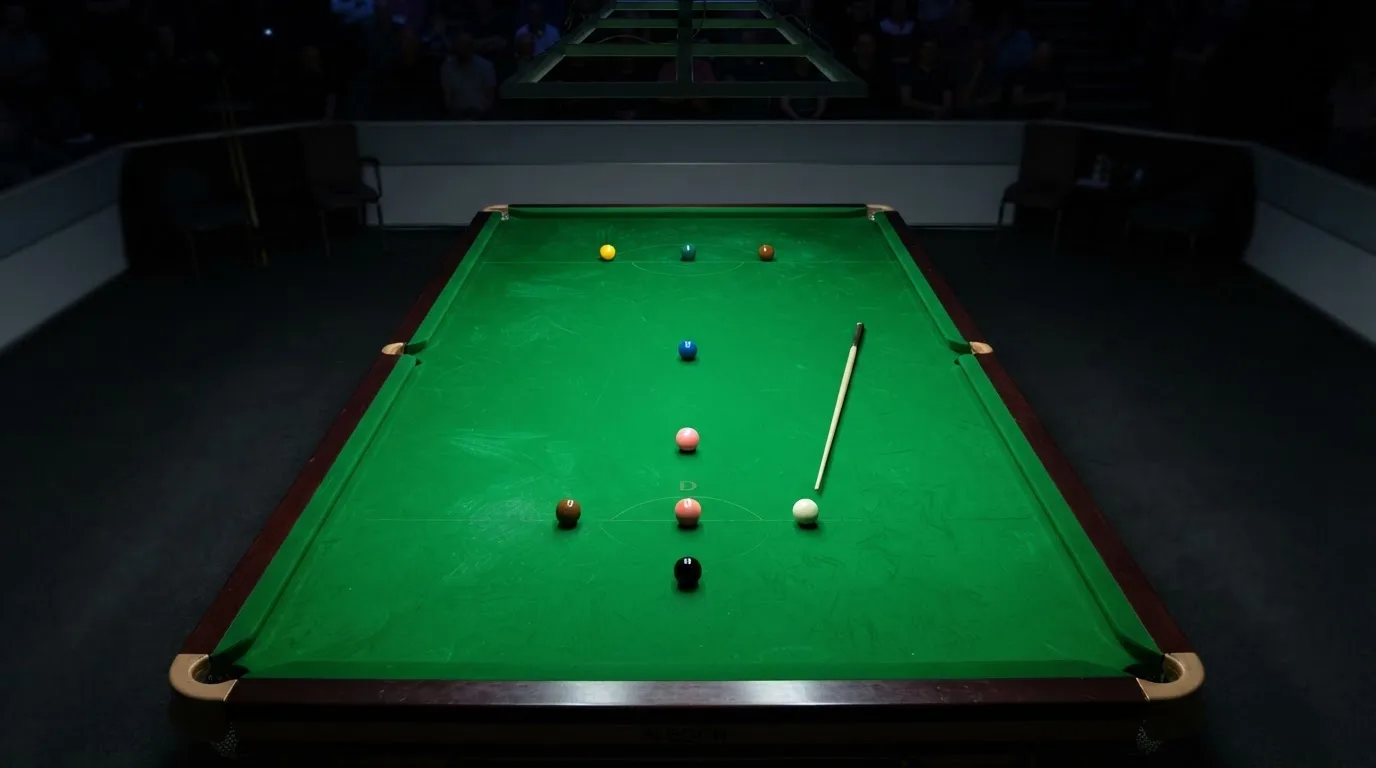
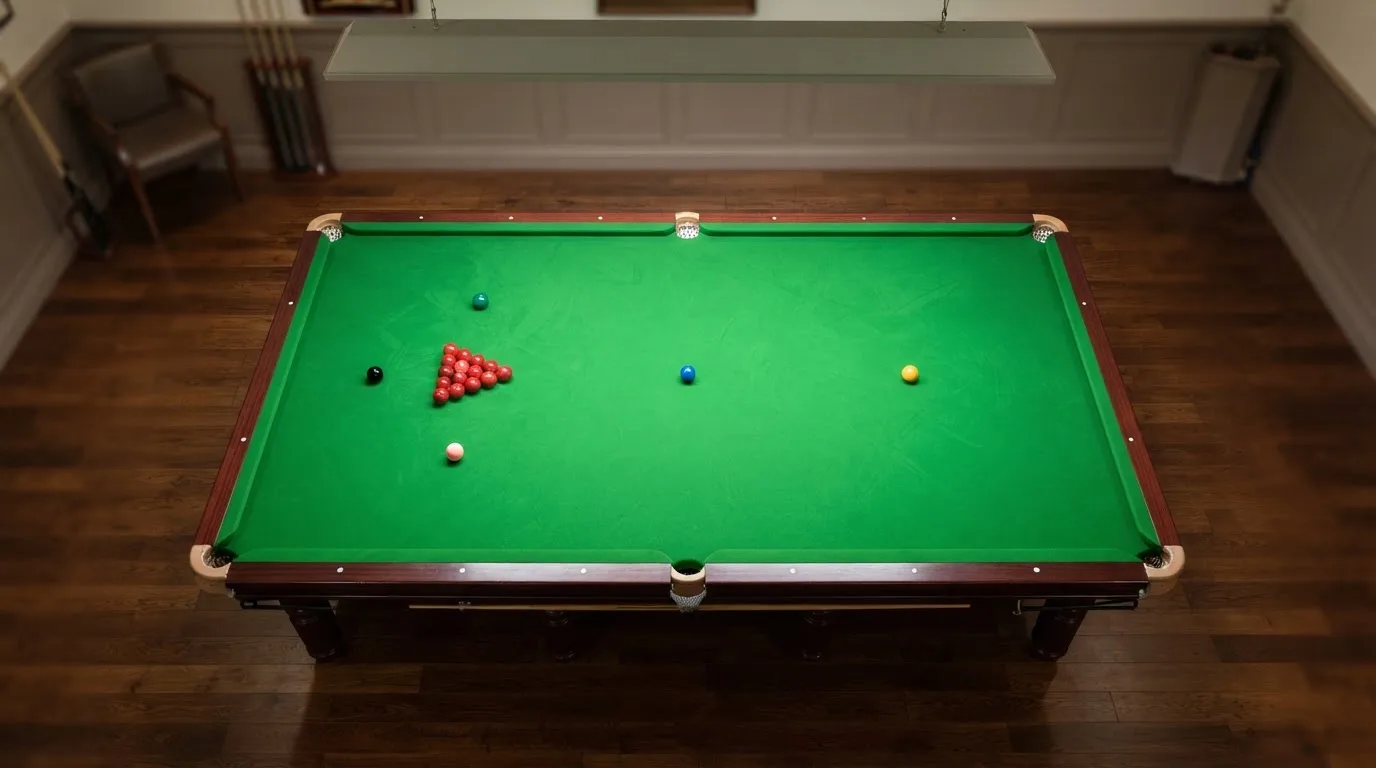
Snooker is a cue sport played on a 12 ft by 6 ft table with six pockets, using a white cue ball and 21 object balls — 15 reds worth one point each and six colours worth yellow 2, green 3, brown 4, blue 5, pink 6 and black 7. A player scores by potting a red (1 point) followed by a colour in any order, until the reds are exhausted, then the six colours in order. The maximum break is 147, made by potting all 15 reds with blacks and then the six colours in sequence. Most professional matches are best of 7, 9 or 11 frames in the ranking events; the World Championship is best of 19 in the first round and best of 35 in the final.
The professional tour is run by the WPBSA, which owns the official rules; the IBSF governs the amateur game. The calendar runs roughly from September to May in Europe, with the major ranking events, the invitationals and the World Championship in Sheffield. The 2026 World Snooker Championship was held at the Crucible Theatre, which has been the venue since 1977. The career record at the Crucible is seven world titles each for Stephen Hendry and Ronnie O’Sullivan in the modern era; Joe Davis won 15 world championships in succession from 1927 to 1946, in the sport’s amateur era. The ranking events are the tier where the outright market and the match markets run deepest, and they are the calendar the price-watchers track.
Where the outright market is thinnest
The market on a first-round qualifier at a small ranking event is, in practice, two or three prices deep: the favourite, the underdog, and the outsider. The market on the World Championship is the depth-test: the outright price runs from the favourite at single-digit decimal odds to a long tail of 250/1 (251.00) and beyond. A bettor looking for value in an outright market finds it where the back of the book is short, because the long shots are priced more conservatively than the favourite. A bettor looking for liquidity finds it on the match market of the televised event, where the bookmaker’s liability is shared and the price moves with the betting.
In-play and the shape of a snooker match
A snooker match moves in runs of one colour: a player breaks off, exchanges safety, and either pots a long red to open a frame or plays for the safety. The momentum of a match is harder to read in real time than a football match, and a player who is 4-1 down in a best-of-11 is still in the match in a way that a football team 4-1 down at half-time is not. The in-play market on snooker reflects that: the price moves on the outcome of the current frame, not the position in the match, and the cash-out market on a frame settles on the operator’s view of which player will pot the colours. The bookmakers that carry the deepest in-play snooker product are the ones with a live-trading desk on the smaller sports, and the rest rely on a suspended market and a partial cash-out.
The ten UK bookmakers — a side-by-side of what the register says
The table below reads the ten bookmakers the page covers, by their Gambling Commission licence, the licence holder named on the register, and what the operator’s own terms page says about the features most relevant to a snooker bettor. The licence is a check of the Commission’s public register; the features are the operator’s own claim about its product.
| Brand | Gambling Commission remote licence and holder | What the operator’s own terms say about the relevant features |
|---|---|---|
| DAZN Bet | Remote licence 048756-R-327274-019; account 48756; licence holder DZBT Limited | Deposits from £5 by debit card, Apple Pay, Paysafecard, Trustly and Skrill; from £20 by PayPal; no processing fees |
| Swifty Sports | Remote licence 058957-R-334734-006; account 58957; licence holder Swifty Global (UK) Ltd | Best Odds Guaranteed, Cash Out, daily price boosts, live streaming and in-play betting; Bet Builder listed as coming soon |
| Ladbrokes | Remote licence 054743-R-330863-014; account 54743; licence holder LC International Limited | The Ladbrokes Sports Betting App is published by Entain Operations Limited and is rated 4.66 from 101,255 GB App Store ratings |
| QuinnBet | Remote licence 061011-R-335683-004; account 61011; licence holder QuinnBet (Gibraltar) Limited | Best Odds Guaranteed on UK and Irish horse racing from 10:00am daily on singles, multiples and system bets, with a maximum benefit of £150 per customer per race |
| DragonBet | Remote licence 064908-R-339041-003; account 64908; licence holder DragonBet Ltd | Welsh football and rugby markets, racing, American football, in-play betting and bet builder markets |
| Copybet | Remote licence 053774-R-330743-010; account 53774; licence holder Copybet UK Limited | Best Odds Guaranteed all day every day on UK and Irish racing; pays first past the post on horse racing even if the winner is later disqualified |
| Bet600 | Remote licence 044731-R-323941-016; account 44731; licence holder Tyche Tech Limited | Best Odds Guaranteed on horse racing: if the starting price is bigger than the early or show price taken, the bet is paid at the SP |
| Sporting Index | Remote licence 027343-R-308898-011; account 27343; licence holder Sporting Index Limited | Switches between fixed odds and spread betting, with in-play betting, Bet Builder for football, auto cash-out and Multi-Markets |
| William Hill | Remote licence 039225-R-319373-015; account 39225; licence holder WHG (International) Limited | Best Odds Guaranteed on UK and Irish horse racing from 8 AM on race day, on single and multiple bets; not on ante-post, tote or pari-mutuel |
| LiveScore Bet | Remote licence 056859-R-332720-005; account 56859; licence holder LiveScore Betting and Gaming (Gibraltar) Limited | Bet Builder with up to 10 selections on match result, BTTS, corners, total goals, player scoring and cards |
The table reads the licences, the licence holders and what the operators say about their product. The points to compare across the field are the deposit floor (DAZN Bet is the only one whose own terms state a £5 floor, the others sit higher), the breadth of the in-play product, the bet builder (LiveScore Bet is the only one that names a 10-selection ceiling), and whether the Best Odds Guaranteed is a horse-racing-only product (it is, on every brand whose terms name it). Spread betting is named by Spreadex and Sporting Index as a separate product to fixed-odds betting, with a separate regulator and a separate set of risks; Spreadex states that spread betting losses can exceed the deposit.
The state of the UK market — what’s on offer and what to check
The UK online betting market in 2026 is licensed by the Gambling Commission under the Gambling Act 2005, with a separate Commission licence required since the Gambling (Licensing and Advertising) Act 2014 for any operator whose remote facilities are used in Great Britain. The licence categories relevant to a snooker bettor are remote general betting standard (real events) and remote betting intermediary (the exchange licence), and every brand the table above holds the first of those. The Commission’s public register is the whole test of who holds a licence; the licence line quoted is checked against it, and the licence holder named is the entity on the register. A .co.uk or .com domain proves nothing on its own, and a Curaçao, Maltese or Gibraltar licence is not a substitute for a Commission licence at the point of consumption.
There is no statutory list of permitted sports or markets. An operator holds a category of licence and offers markets under its own rules and the Commission’s Licence Conditions and Codes of Practice. The snooker calendar is offered across the field, with the World Championship, the UK Championship, the Masters and the ranking events the events that draw the deepest market. In-play snooker is offered by every bookmaker in the table except where the operator’s own terms say otherwise, and the controls are the operator’s licence conditions and its own customer-protection duties; the legal frame does not describe in-play as “unrestricted”, because the operator’s house rules apply. There is no statutory cap on stakes in sports betting, and operators set their own maximum stakes; a maximum-stake limit on a price boost is a feature, not a restriction, and the limit is named in the offer terms.
The player’s tax position is that betting winnings in Great Britain are paid gross — the player does not pay income tax on a sports betting return. The General Betting Duty is the operator’s tax on gross profits, currently 15% and rising to 25% on remote bets from 1 April 2027 (with bets on UK horse racing, betting-shop terminal bets, pool betting and in-person betting staying at 15%); whether an operator passes the duty on through the price is not established, and the page does not write that the player is charged duty. The Commission’s statutory levy is a separate charge, not a tax on the player.
Responsible gambling — the licence conditions, the protections and the help lines
GAMSTOP is the national multi-operator online self-exclusion scheme and a mandatory licence condition for online operators since 31 March 2020. Self-exclusion can be set for six months, one year, five years, or five years with auto-renewal, and after the minimum period the exclusion stays in place for a further seven years unless the customer asks GAMSTOP to remove it. GAMSTOP covers online sites and apps; betting shops run a separate service. A customer who has set a GAMSTOP exclusion will be blocked by every GB-licensed online operator, and the exclusion applies across the table above without exception.
The financial vulnerability check (LCCP condition 3.4.4, in force since 30 August 2024) applies to licensed remote betting when a customer’s deposits minus withdrawals exceed £150 in a rolling 30 days (since 28 February 2025). The check is a public-record check (bankruptcy, county court judgments, the Gazette) — it is not an income check and not a credit reference check. A financial risk assessment (the “affordability check” of the press) has been announced in a staged plan, with no start date at the date of writing; the page reads it as “announced, staged, no start date”, not “in force”. Deposit limits (RTS 12) require operators to offer a gross deposit limit on a fixed time frame; the first changes have applied since 31 October 2025, a second phase was postponed to 30 September 2026, and whether that second phase is live is not established. The limit is the customer’s own choice; there is no state-set deposit or loss ceiling in Great Britain.
The minimum age to bet is 18, and identity is verified before the customer can deposit or gamble — since 7 May 2019, including when the first bet is a free bet or a bonus. That is the licensed state of play: no anonymous play at a GB-licensed site, with name, address and date of birth checked before the first deposit. A source-of-funds request at higher spend is normal under the anti-money-laundering rules, and the operator will document the request in its own terms. Credit cards are banned for gambling in Great Britain (since 14 April 2020), including credit-card-funded payments through an e-wallet; debit cards and bank-based payments are not covered by that ban.
The help lines are the National Gambling Helpline (GamCare), GambleAware, the NHS gambling clinics, and Gamblers Anonymous. A bettor who feels the bet has stopped being a choice should call the helpline first; a bettor who wants to set a self-exclusion can do it through GAMSTOP in one registration. The licence conditions above are the same at every bookmaker on the page, because they are the same regulator and the same rules.
Crypto, anonymity and the offshore question
The licensed UK bookmaker accepts a debit card, a bank transfer and a handful of e-wallets; the licensed UK bookmaker does not accept a credit card and does not accept a cryptocurrency deposit. The page reads this from the operator’s own terms and from the LCCP: there is no Commission rule against cryptocurrency deposits at a licensed operator, and the operator’s own house rules are what govern. None of the ten bookmakers the table covers state that they take a cryptocurrency deposit at the time of writing, and the player’s deposit at a GB-licensed site is by name, by verified date of birth, and by a payment method tied to a UK bank account. There is no anonymity at a licensed site.
A customer looking for a snooker bet settled in bitcoin or a deposit through a non-custodial wallet is in the offshore market. The offshore market runs on a Curaçao, Maltese or Anjouan licence, with the operator’s own house rules and the operator’s own regulator. The Commission’s enforcement is at the point of consumption: an offshore operator taking a UK customer without a Commission licence commits an offence under section 33 of the Gambling Act 2005 (on summary conviction up to 51 weeks’ imprisonment, a fine up to level 5, or both; six months in Scotland) — the offence is aimed at the operator, not the customer who merely bets on an unlicensed site. The Commission’s enforcement is disruption, not blocking: cease-and-desist notices, search-engine referrals, work with registrars, hosts and payment providers, and the court-order DNS blocking powers the Commission has been given or is about to receive; the page does not write that ISP blocking is in operation.
A customer who bets at an unlicensed site loses the protections the licence carries: no GAMSTOP coverage, no Commission complaints route, no approved dispute-resolution body, no British consumer redress if funds are withheld, not bound by the 10x bonus cap or the £150 vulnerability check. The framing is honest: licensed means the checks, the limits, the GAMSTOP coverage and the bonus cap, but also the verification before the first bet. Unlicensed means none of those protections, with a possible loss of funds. Neither is “the safe choice” by default.
Bonuses and free bets — the offer, the cap and the cost
The promotion rules in force since 19 January 2026 cap wagering requirements on bonuses at 10x. A £10 bonus at 50x wagering needs £500 of qualifying bets; under the cap, no more than £100 of qualifying bets is needed for the same £10. The cap is a licence condition, not a marketing decision, and it is the same at every GB-licensed operator. The cap is on the wagering requirement, not on the size of the bonus itself: a £100 bonus is allowed, so long as the wagering on it is no more than 10x. A free bet with no wagering condition is not a bonus in this sense, and the application of the cap to free bets without a wagering condition is not established at the date of writing. Mixed-product promotions — an offer that requires gambling on two or more product types such as betting, casino, bingo and lottery, for example “bet on football to get free spins” — are banned under the same rules.
A free bet is a credit on the account, paid back on a win as profit and not as the original stake. A free £10 bet at 3/1 (4.00 decimal) returns £30 in profit on a win, and the £10 stake is not returned. The expected value of a free bet is the price at which it is placed multiplied by the implied probability of winning at that price, and a free bet placed at long odds is worth more than a free bet placed at short odds. The bookmaker’s offer terms name a minimum price for the qualifying bet (often 1.50, 1.72 or 2.00), a deadline for using the credit (often seven or fourteen days), and a market restriction (the free bet cannot be used on certain enhanced-odds markets or on cash-out bets). A free bet used on a market that is then voided is settled as a free bet returned to the account, not as a stake returned to the customer.
A price boost is an enhanced price on a single market or a single leg of an accumulator. The boost is an offer, not a margin, and the boosted price may still carry the bookmaker’s normal margin on the underlying market. An accumulator insurance is a refund as a free bet if one leg of a multi-leg accumulator loses: the insurance is on a stake and a number of legs, and the refund is a free bet, not a cash refund. A cashback is a refund of a stake, on a market or on a day’s net losses, paid in cash or as a free bet; the cashback carries a maximum amount and a market restriction. Each of these is the operator’s own offer, and the offer terms are the place to read for the cap, the deadline and the eligible market.
The customer is not charged the General Betting Duty on the offer itself, and the page does not write that the player is charged duty on any of the offers named.
Live betting, cash out and the in-play frame
The in-play snooker market is the match-winner price for the current frame, with the market suspended and re-opened at the end of each frame. The cash-out market is the operator’s price for closing the bet before the frame settles, and the cash-out price is set by the operator’s live-trading desk. Auto cash-out is a customer-set trigger that closes the bet when the price hits a customer-set threshold, and the trigger is held on the operator’s own platform. Bet Builder on a snooker match is a same-game multi: the customer picks two or more selections on a single match (match winner, frame handicap, total frames, highest break), the prices multiply, and the bet is settled on the outcome of the match. LiveScore Bet’s Bet Builder allows up to 10 selections on football, and the snooker product on the brand sits in the same shape; the limit is a house limit and is named in the offer terms.
The in-play market on snooker is suspended at the end of each frame and re-opened at the start of the next, and the suspension is the operator’s policy, not the regulator’s. The price on the suspended market is the operator’s last-quoted price; the price on the re-opened market reflects the score in the match. The cash-out offer is the operator’s offer to close the bet early, and the operator can withdraw the cash-out at any time. The offer is at the operator’s discretion, and the terms of the offer name the markets on which cash-out is available. Swifty Sports, DragonBet, Sporting Index and the rest of the field name cash-out in their own terms, with the markets on which it is available different brand to brand.
A bet placed in-play on a snooker match settles on the official frame result; a bet placed before the match settles on the match result. A frame voided by the referee for a foul or a miss is settled under the operator’s own rules, and the operator’s terms name the policy. A bet on a player to win the next frame in a live market is settled on the next frame to complete, not on the frame in progress.
Predictions, tips and the discipline of the bettor
A “snooker betting tip” is a forecast, not a fact. A forecast is a position on the outcome of a match, a frame, or a tournament, and the page does not endorse a forecast. The arithmetic behind a forecast is the form of the two players, the head-to-head record, the venue (the Crucible is its own condition), the format (best of 9 is more variance than best of 19), and the price at which the bet is placed. A tipster publishes a forecast with a price; a tipster who publishes a forecast without a price is selling the forecast, not the bet. A bettor who reads a forecast and a price and a stake is making a decision; a bettor who reads a forecast and a stake is not.
The discipline is the bankroll. A bettor’s stake is a fraction of the bank — one unit, two units — and the unit size is set by the bankroll and the bettor’s own rules. A bettor’s price is the price at which the bet is placed, and a bet that is not placed at the price is a different bet. A bettor’s market is the market the bet is placed on, and a market the bettor does not understand is a market the bettor does not bet on. The three are connected: a £10 bet at 3/1 (4.00) is a different bet from a £10 bet at 1/3 (1.33), and the difference is the stake as a fraction of the bank multiplied by the implied probability. The discipline is not the tip; the discipline is the position.
The record at the bookmaker’s site is the bettor’s record: deposit, withdrawal, settled bet, voided bet, free bet, bonus. The bettor’s record is the input to the next decision, and the next decision is the position. A bettor who bets on the World Championship and a ranking event and a Premier League match and a Champions League match is four bettors in one, and the four records are kept separately. The bookmaker’s record is a record of settled bets; the bettor’s record is a record of decisions.
The operators — the ten, in order, and what each is for
The ten operators below are the brands listed in the table above. Each block reads the licence, what the operator’s own terms say about the product, and the verdict: who this brand is for and where it loses to the brand before it.
DAZN Bet — a deposit-light product, with the snooker market narrower than the major books
DAZN Bet (licence 048756-R-327274-019; DZBT Limited) details deposits from £5 by debit card, Apple Pay, Paysafecard, Trustly and Skrill, and from £20 by PayPal. The £5 floor is the lowest among the featured brands, serving as its primary entry point for small-bankroll bettors. Its snooker market is available but not a focal point of its marketing, which highlights football and boxing instead.
The verdict: DAZN Bet is for a bettor who values a low deposit floor and a debit-card-friendly cashier, and who is content to bet into a snooker book that is offered but not featured. The brand’s market depth is narrower than the larger books, and the bettor seeking the broadest outright options should consider alternatives.
Swifty Sports — a brand in build, with a Best Odds Guaranteed on racing and an in-play product
Swifty Sports (licence 058957-R-334734-006; Swifty Global (UK) Ltd) lists Best Odds Guaranteed, Cash Out, daily price boosts, live streaming and in-play betting; Bet Builder is currently in development. This phased rollout prioritises in-play features, and while snooker is offered, it lacks the depth of the specialist builders. BOG coverage is restricted to horse racing.
The verdict: Swifty Sports is for a bettor who wants an in-play product and a Best Odds Guaranteed on racing, and who is happy to wait for Bet Builder on a snooker match. While it offers in-play, the outright market depth is less extensive than at the major bookmakers.
Ladbrokes — the major-book product, with the snooker market and the in-running
Ladbrokes’ licence is 054743-R-330863-014, with LC International Limited as the licence holder, and the Ladbrokes Sports Betting App is published by Entain Operations Limited and is rated 4.66 from 101,255 GB App Store ratings. The brand is one of the major UK books, the snooker product runs through the World Championship and the ranking events, and the in-play product on snooker is offered through the app. The Best Odds Guaranteed is a horse-racing product, and the price boosts on football carry over to the snooker market in the form of price boosts on a snooker outright. The brand is the size and the snooker market is the depth.
The verdict: Ladbrokes is for a bettor who values a major-book product, a deep snooker outright, and an in-play market through the app. The brand loses to the rest of the field on the deposit floor (Ladbrokes’ deposit floor is set higher than DAZN Bet’s) and to the specialist books on the snooker-specific product, and the bettor with a small bankroll who wants a £5 floor should read the first block.
QuinnBet — a racing-led product, with a Best Odds Guaranteed on UK and Irish racing
QuinnBet (licence 061011-R-335683-004; QuinnBet (Gibraltar) Limited) provides Best Odds Guaranteed on Irish and UK horse racing from 10:00am daily, capped at £150 per customer per race. The racing product is the primary offering, though snooker is also supported. Deposit floors and payment methods follow standard brand policies.
The verdict: QuinnBet is for a bettor who values a Best Odds Guaranteed on UK and Irish racing and a racing-led product, and who likes the snooker markets available. The brand loses to Ladbrokes on snooker market depth and to Swifty Sports on the in-play product, so the bettor who prioritises market depth on snooker should compare this against the major bookmakers.
DragonBet — a Welsh brand, with a snooker book and a bet builder
DragonBet (licence 064908-R-339041-003; DragonBet Ltd) features an app tailored for Welsh football and rugby markets, alongside racing, American football, in-play betting and a bet builder. Snooker is integrated within the wider offering, though it is not a focal point of their promotional strategy.
The verdict: DragonBet is for a bettor who values a bet builder and a brand with a Welsh-led product, and who is content with the snooker book on offer. The bet builder selection limit is lower than at some competitors, making it a niche choice for specific markets.
Copybet — a racing product, with a Best Odds Guaranteed all day
Copybet (licence 053774-R-330743-010; Copybet UK Limited) provides Best Odds Guaranteed all day on UK and Irish racing, supplemented by a first-past-the-post settlement policy. Their core identity is built around horse racing, and while they maintain a standard snooker market, their promotional focus remains elsewhere.
The verdict: Copybet is for a bettor who values a first-past-the-post settlement on racing and a Best Odds Guaranteed all day, and who is content with the snooker book on offer. The brand’s focus on the racing product makes it a strong contender in that space, with the snooker book offered as standard.
Bet600 — a brand with a BOG on racing, with a snooker book
Bet600 (licence 044731-R-323941-016; Tyche Tech Limited) offers Best Odds Guaranteed on horse racing, paying the SP if it exceeds the earlier price taken. This BOG policy is central to their racing offering, with standard snooker betting available in the match markets.
The verdict: Bet600 is for a bettor who values a BOG on horse racing and a brand that pays at the SP, and who is content with the snooker book on offer. The BOG window is the brand’s feature, and the snooker product is comparable to the standard match book.
Sporting Index — a spread-betting and fixed-odds hybrid, with an FCA-regulated product
Sporting Index (licence 027343-R-308898-011; Sporting Index Limited) allows users to navigate between fixed odds and spread betting, complemented by in-play features, Bet Builder for football, and auto cash-out. Spread betting is their primary differentiator and operates under a separate FCA-regulated framework for the financial side. The fixed-odds snooker book is a distinct offering.
The verdict: Sporting Index is for a bettor who wants both fixed-odds and spread betting on a snooker match, and who is comfortable with the FCA-regulated product and the spread-betting losses that can exceed the deposit. This brand provides a distinct product path compared to the standard fixed-odds market.
William Hill — the major-book product, with a BOG from 8 AM and a deep snooker book
William Hill (licence 039225-R-319373-015; WHG (International) Limited) offers Best Odds Guaranteed on UK and Irish racing from 8 AM on race day, covering single and multiple bets, excluding ante-post and pari-mutuel. As a major operator, their snooker coverage is comprehensive, extending through major ranking events with integrated in-play markets.
The verdict: William Hill is for a bettor who values a major-book product, a deep snooker outright, and a BOG from 8 AM on race day. The brand loses to Ladbrokes on app rating and to the specialist books on the deposit floor, so the bettor who requires a lower entry point should review the DAZN Bet terms.
LiveScore Bet — a bet builder, with a 10-selection ceiling on football
LiveScore Bet’s licence is 056859-R-332720-005, with LiveScore Betting and Gaming (Gibraltar) Limited as the licence holder, and the operator’s own Bet Builder allows up to 10 selections on match result, both teams to score, corners, total goals, player scoring and card markets. The 10-selection ceiling is named; the snooker bet builder is a same-game multi on a snooker match, and the ceiling on a snooker match is the same as the ceiling on football. The brand’s lead is the bet builder; the snooker book is offered; the in-play product is offered.
The verdict: LiveScore Bet is for a bettor who values a bet builder with a 10-selection ceiling and a same-game multi on a snooker match. The brand loses to Ladbrokes and William Hill on outright market depth, and the bettor whose book is on the outright market should read one of the major-book blocks.
The calculation, in plain prose
A two-way snooker market at decimal odds 1.90 and 1.90 — a symmetric price, an example, not a quoted price — has a payout share of 0.95 and a margin of 5%. The market returns 95p in the pound across both outcomes and keeps 5p. That is the floor on a clean two-way snooker book. The reader is the one staking the bet: a £10 bet at 1.90 returns £19 on a win (£9 profit), and a £10 bet on the other side returns the same. The bookmaker’s 5% is taken across the market, not from any single bet.
Across the field, a symmetric two-way snooker market usually lands in a band of about 4.5% to 6.5% — the tighter end on outright favourites at the World Championship, the wider end on the long tail of the outright tournament book. The band is what the bettor pays the bookmaker for the privilege of placing the bet, and the band is what the price on the slip already reflects. The arithmetic is the reader’s; the page’s job is to name the formula and the band.
Picking the right book — the angle the page has taken
The angle of the page is choice: which paths exist and who each one suits. The paths the table above names are the ten bookmakers on the Gambling Commission’s register, the licence conditions they share, and the features each operator’s own terms page names. A bettor with a small bankroll and a debit card has a path at DAZN Bet; a bettor who bets on UK and Irish racing has a path at QuinnBet, Copybet or William Hill; a bettor who wants a same-game multi on a snooker match has a path at LiveScore Bet; a bettor who wants to switch between fixed odds and spread betting has a path at Sporting Index. The path is not the brand; the path is the match between the brand’s lead product and the bettor’s book.
The page does not rank the ten brands. The order follows the Commission’s register, and the verdict in each block is the page’s own judgement of what the brand is for. A reader who lands on the page looking for a snooker book and stays for the verdict has the choice the page sets out to give.
What the price on the slip really costs — a closing read
The bookmaker’s margin is the price the bettor pays for the privilege of placing the bet, and the margin is built into every price on the slip. A 5% margin on a two-way market at 1.90 and 1.90 is 5p in the pound across the market; a 6.5% margin on a less-liquid snooker book is 6.5p in the pound; the difference between the two is what the bettor pays the bookmaker for the depth of the market. The bookmaker does not advertise the margin. The bookmaker’s price is the price on the slip, and the margin is the difference between the price and the fair price the bet would clear at. The bettor reads the price; the bettor reads the spread; the bettor does not read the margin by name.
A bookmaker’s “free bet” is a credit, and the credit is paid back on a win as profit, not as the original stake. A bookmaker’s “100% bonus” is a credit on the deposit, and the credit carries a wagering requirement capped at 10x under the rules in force since 19 January 2026. A bookmaker’s “risk-free” bet is a free bet on a losing stake, and the bettor’s loss is the stake, not the free-bet credit. A bookmaker’s “best odds guaranteed” is a horse-racing product that pays the SP if the SP is bigger than the early price taken; it does not apply to snooker, and the snooker bettor does not have the BOG. A bookmaker’s “boosted odds” is an enhanced price on a single market, and the boosted price may still carry the bookmaker’s margin on the underlying market. The marketing word and the arithmetic are not the same word, and the page reads the arithmetic and not the marketing.
A licensed UK bookmaker verifies the customer before the first bet. The verification is name, address, date of birth, and a payment method tied to a UK bank account. The bettor is not anonymous. The bettor is covered by GAMSTOP, by the £150 financial vulnerability check, and by the 10x bonus cap. The bettor is also bound by the operator’s own terms, which name the maximum stake, the maximum payout, the minimum odds for a qualifying bet, and the market restrictions on a free bet. The bettor reads the terms. The bettor reads the price. The bettor reads the spread. The bettor places the bet.
Frequently asked questions
How does a bet on snooker actually work?
A snooker bet is a position on the outcome of a frame, a match or a tournament. The bettor picks a market — match winner, frame handicap, total frames, outright — and a price. The bet is settled on the official result: the player who lifts the trophy at the final session, the player who wins the most frames in a match, the player who pots the colours first in a frame. The bettor’s return is the stake multiplied by the price; the profit is the return minus the stake.
Can anyone in the UK bet on snooker online?
A customer in Great Britain can bet on snooker online with any bookmaker that holds a Gambling Commission remote licence, provided the customer is 18 or over and the operator’s own terms allow the account. The licensed bookmakers take UK customers, verify name, address and date of birth before the first deposit, and run the GAMSTOP exclusion. A customer who has set a GAMSTOP exclusion will be blocked by every GB-licensed online operator; a customer who wants to use a brand without verification is in the offshore market.
How does a reader check a bookmaker’s licence?
The reader goes to the Gambling Commission’s public register and searches by business name, trading name, domain or account number. The register is the whole test of whether a brand holds a licence, and the licence line on this page is taken from the register at the date of writing. The register lists the licence holder, the licence categories and the licence status. A reader who cannot find the brand on the register should not place a bet with the brand.
What does a winning bet return?
A winning bet returns the stake multiplied by the decimal price. A £10 bet at 3/1 (decimal 4.00) returns £40 — £30 in profit and the £10 stake. A £10 bet at 1/1 (decimal 2.00) returns £20 — £10 in profit and the £10 stake. The return is paid gross in Great Britain: the bettor does not pay income tax on the winnings. The bookmaker’s margin is built into the price, and the price is the price on the slip.
What is a bookmaker’s margin and how does it show in the odds?
A bookmaker’s margin is the share of every pound staked that the bookmaker keeps on a market. On a two-way market at 1.90 and 1.90, the implied probability of each side is 52.6%, summing to 105.3% before the bookmaker’s vig; the payout share is 95.0% and the margin is 5.0%. The margin is what the bettor pays for the privilege of placing the bet, and the margin is built into every price on the slip. A reader can read the margin by adding the implied probabilities of all the outcomes on a market and subtracting 100%.
How do fractional odds such as 5/1 convert to decimal odds such as 6.00?
A fractional price of a/b converts to a decimal price of a ÷ b + 1. 5/1 is 5 ÷ 1 + 1 = 6.00. 4/6 is 4 ÷ 6 + 1 = 1.6667, which is rounded to 1.67. 11/4 is 11 ÷ 4 + 1 = 3.75. The conversion is mechanical: the decimal price is the fractional price plus one. The decimal price is the price the bettor multiplies the stake by to get the return; the fractional price is the profit per unit stake. The two are the same market, priced in two conventions.
Tennis, darts & cue sports – Free bets
Content created by the «Free bets» team
