
Rugby union betting odds
 Available in US
Rugby union betting odds are the prices a bookmaker sets on each outcome of a match, a tournament or a handicap — and on every price sits a small slice the bookmaker keeps, called the margin. The size of that slice is what separates one bookmaker from the next, and what the rest of this page is about.

The comparison below looks at ten UK bookmakers and the markets they put around the international calendar, the Six Nations, the Rugby Championship, the Premiership and the United Rugby Championship. The aim is not to pick winners. It is to make plain what each price pays, what each market costs the punter, and which bookmaker the maths favours for which kind of bet. A reader who can read the numbers pays less for the same bet.
Odds checked against UK bookmaker sites on 27 October 2026; remote licences cross-checked against the Gambling Commission’s public register.
The ten rugby union bookmakers ranked for this season
The ranking below is built around six points a rugby union punter cares about: how deep the match and outright markets go, whether in-play betting is supported on the sport, whether the welcome offer treats accumulators kindly (because most rugby bets are multiples), whether a bet builder exists, and the licence status against the Gambling Commission. Every brand listed holds a remote licence on the public register and takes part in GAMSTOP.

| Rank | Brand | Licence status |
|---|---|---|
| 1 | Tote | Gambling Commission remote licence held by TDCO Limited |
| 2 | Hollywoodbets | Gambling Commission remote licence held by Hollywoodbets International UK Limited |
| 3 | Sporting Index | Gambling Commission remote licence held by Sporting Index Limited |
| 4 | QuinnBet | Gambling Commission remote licence held by QuinnBet (Gibraltar) Limited |
| 5 | Betboro | Gambling Commission remote licence held by Webmedia Development N.V. |
| 6 | BetGoodwin | Gambling Commission remote licence held by Goodwin Racing Limited |
| 7 | Fitzwilliam Sports | Gambling Commission remote licence held by SBKI Limited |
| 8 | Betfair | Gambling Commission remote licence held by PPB Counterparty Services Limited |
| 9 | Bet Ahoy | Gambling Commission remote licence held by Bet Ahoy Ltd |
| 10 | Kalooki Sportsbook | Gambling Commission remote licence held by Kalooki Sportsbook Limited |
Every row above shows what the Gambling Commission’s public register says about the company behind the trading name — the licence number is what a punter verifies before depositing, because the trading name on the shirt is not the name on the licence. The marketing brand and the registered licensee are sometimes different legal entities in different countries; the Commission account is the one that has been approved to take bets from customers in Great Britain. A brand without that entry is not on this list.
The market make-up varies sharply across the ten. Sporting Index also runs spread bets on sporting indices — a separate product, with its own risk and its own regulator for the financial side. QuinnBet runs Best Odds Guaranteed on UK and Irish racing. Betfair carries an exchange, where the price is set by other punters rather than by a trader. The rest are straight fixed-odds sportsbooks. Each review below sits on the specifications the licence register, the brand’s own terms and the welcome-offer page carry, and ends on a verdict about the kind of punter each brand suits.
What rugby union betting actually involves
A rugby union pitch carries fifteen a side, and a match is two 40-minute halves; the clock does not stop for stoppages, so a regular fixture runs longer than eighty minutes and the in-play markets react to the scoreboard rather than the time. A try is worth five points, a conversion two, a penalty three, a drop goal three. World Rugby has governed the sport since 1886, and the international game has run a World Cup since 1987 in Australia and New Zealand. South Africa hold the Webb Ellis Cup after the 2023 final, and Australia is due to host the next tournament in October and November 2027.
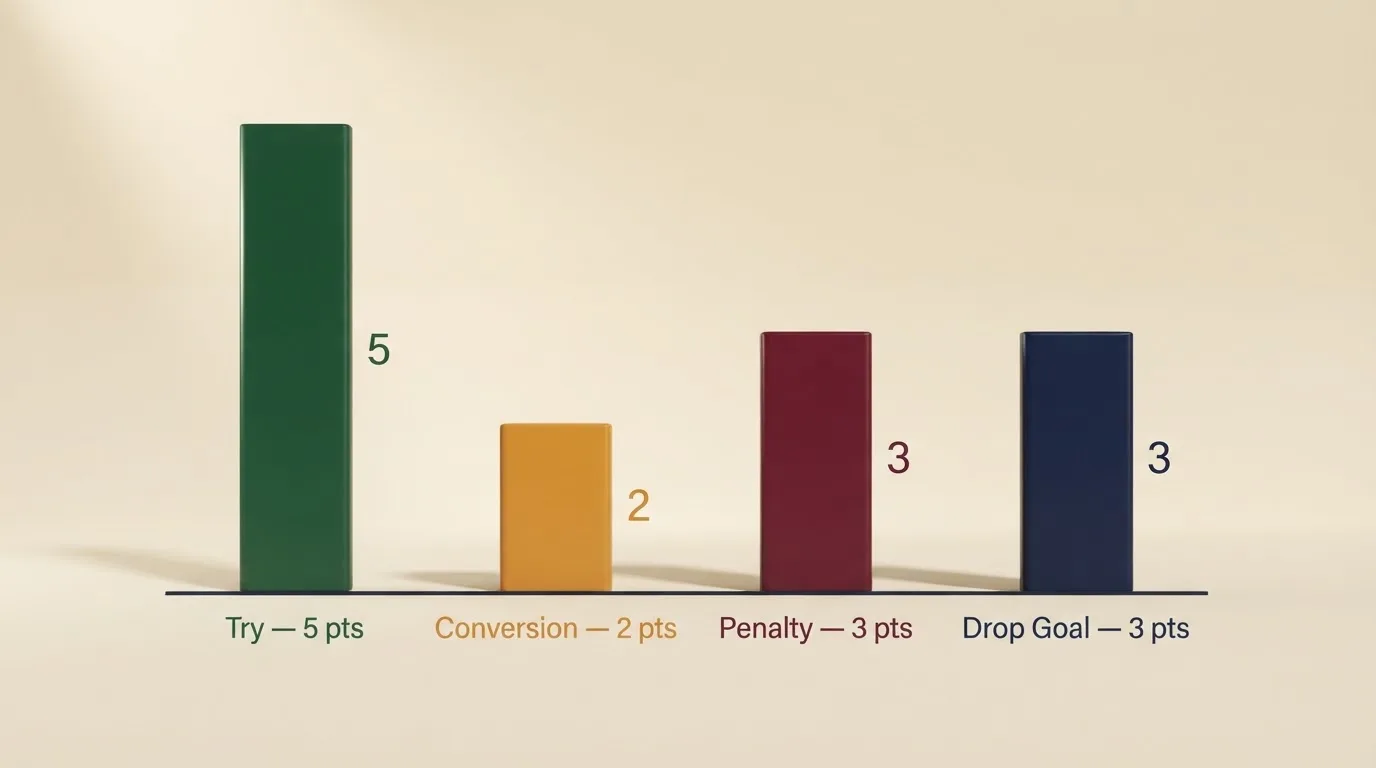
The Rugby World Cup is the headline event for outright betting. Behind it sit the Six Nations and the Rugby Championship in the international window, and four domestic leagues whose fixtures drive most weekly betting: the English Premiership, the United Rugby Championship across Ireland, Italy, Scotland, South Africa and Wales, the French Top 14, and Japan’s League One. A punter looking at rugby union odds will spend most of the season betting on those four competitions plus the internationals, with the Lions tour and the autumn internationals as two windows that briefly dominate the outright market.
The bookmaker’s offering mirrors that calendar. Match result, handicap, total points and try-scorer markets are universal. Outright markets on league winner, top try scorer, regular-season finish and Wooden Spoon are common for the bigger competitions. A few brands push further into player props — first tryscorer, total tries, anytime tryscorer — but the depth varies, and the number of player-prop selections on a non-televised United Rugby Championship fixture is a fair proxy for how seriously a bookmaker treats the sport beyond England.
Reading a rugby union price
Two price formats sit on British bookmakers. Fractional odds write the profit over the stake: 5/1 means a £1 stake returns £5 profit plus the £1 stake, total £6. Decimal odds write the total return over the stake: 6.00 means a £1 stake returns £6 total, of which £5 is profit. To go from fractional to decimal, divide the top number by the bottom and add one: 5/1 becomes 5 ÷ 1 + 1 = 6.00. 11/4 becomes 11 ÷ 4 + 1 = 3.75. Evens (1/1) becomes 2.00.
The actual return for any winning single bet is straightforward: return = stake × decimal odds; profit = stake × (decimal odds − 1). On a £10 stake at 3.75, return = £37.50, profit = £27.50. For a combination bet — a double, a treble, an accumulator or an each-way multiple — the prices of each leg multiply into one combined price, then the stake is applied once to that combined price. A double at 2.00 and 3.00 is 6.00; a treble at 2.00, 3.00 and 1.50 is 9.00. That compounding is also why an accumulator’s promise can behead the punter: a short-priced favourite’s leg does not get safer with more legs added, but the combined price looks bigger.
The bookmaker’s margin is the slice of every pound staked that the firm expects to keep across a market. For a two-way market (a handicap or a total), the payout share is 1 ÷ (1 ÷ odds of side one + 1 ÷ odds of side two); the margin is 1 − payout share. Take an illustrative two-way market priced at 1.90 / 1.90. The payout share is 1 ÷ (1 ÷ 1.90 + 1 ÷ 1.90) = 1 ÷ 1.0526 = 95.0%; the margin is therefore 5.0%. The closer the two prices are to evens, the lower the margin tends to be; the further apart, the higher. The same calculation extends to a three-way market like 1X2 — home win, draw, away win — by adding the third outcome to the sum.
A concrete example: an illustrated 1X2 with home 1.50, draw 3.50 and away 6.00 gives a payout share of 1 ÷ (1 ÷ 1.50 + 1 ÷ 3.50 + 1 ÷ 6.00) = 1 ÷ (0.6667 + 0.2857 + 0.1667) = 1 ÷ 1.1190 ≈ 89.4%; the margin sits near 10.6%. That is a typical overround for a rugby union 1X2 on a competitive fixture. Margins on totals and handicaps usually sit lower; margins on long-shot outright markets sit higher.
The arithmetic above is what it is — a statistical estimate, not a guarantee of any single bet. The conclusion it allows is plain: a lower-margin bookmaker returns more per pound staked across the long run, and on two prices that look similar, the one closer to true evens is the cheaper place to put the stake.
How UK bookmakers are regulated
Every bookmaker on this page is licensed by the Gambling Commission for customers in Great Britain, under the Gambling Act 2005 and the Gambling (Licensing and Advertising) Act 2014. The 2014 Act brought remote operators into the Commission’s reach wherever the operator is based, so a Gibraltar or Malta licence is no substitute. The Commission’s public register is the whole test of who holds a licence: a punter can search by business name, trading name, domain or account number, and a brand not on the register is not licensed for Great Britain. The licence categories relevant to rugby union are remote general betting standard (real events) for the fixed-odds firms, remote betting intermediary for exchanges, and remote pool betting for the Tote-style pool products.
A licence comes with conditions. Identity is verified before the first deposit — name, address and date of birth, and source of funds at higher spend — so anonymous play is gone from licensed British sites. Credit cards have been banned for gambling since 14 April 2020, even when the credit card sits behind an e-wallet. GAMSTOP, the multi-operator online self-exclusion scheme, is mandatory for online operators, and the Commission has layered extra player-protection conditions onto licensed remote betting over the last two years: a financial vulnerability check at £150 of net deposits over a rolling 30 days from 28 February 2025, and a deposit-limit framework whose first phase applied from 31 October 2025 with a second phase postponed to 30 September 2026. A bonus cap — a maximum 10x wagering requirement on any bonus — has been in force since 19 January 2026, and a mixed-product bonus (one that demands play across betting and casino at once) is banned outright.
The player’s side of the deal is simple. There is no British tax on betting winnings for the punter. General Betting Duty is the operator’s tax on gross profits at 15% until 1 April 2027, when a new 25% rate applies to remote bets other than UK horse racing, pool betting and self-service terminal bets. None of that comes off the punter’s stake; the price the bookmaker quotes is the price the punter pays. A professional gambler is in a different tax position and should ask HMRC or a tax adviser — that is general information, not advice.
Outside the licensed market sits a long tail of offshore brands. A Curaçao or Anjouan licence is not a substitute for a Commission licence for customers in Great Britain, and the Commission’s enforcement work — cease-and-desist, payment-provider referrals, registrar work and search-engine delistings — is the difference. An unlicensed site offers no GAMSTOP coverage, no Commission complaints route, no approved alternative-dispute-resolution body, no British consumer protection if funds are withheld, no £150 vulnerability check and no 10x bonus cap. None of this means it is a criminal offence for a customer to use one; the offence is on the operator under section 33 of the 2005 Act. The honest framing is that an unlicensed site is unprotected by the British framework, not that it is “illegal to use”. A punter who keeps funds at an unlicensed site has, in practical terms, no British redress.
Safer gambling at a rugby union bookmaker
Three protections matter for a punter weighing the rugby union calendar. GAMSTOP lets a customer self-exclude from every UK-licensed online operator for six months, one year, five years, or five years with auto-renewal; after the chosen minimum period the exclusion stays in force for a further seven years unless the customer actively asks GAMSTOP to remove it. The scheme covers online sites and apps; high-street betting shops use a separate service. Registration is free and reversible only at the end of the chosen period.
The financial vulnerability check is the second. From 28 February 2025, a licensed remote operator runs a public-record check — not a credit-reference check, not an income check — when a customer’s deposits minus withdrawals cross £150 in a rolling 30-day window. The check looks at county court judgments and bankruptcy entries; a flag does not freeze the account but does trigger a conversation about play. A separate financial risk assessment has been announced in stages by the Commission, with no start date as of the register check; that is the “affordability check” of the press, and it remains “announced, staged, no start date” rather than in force.
The third protection is the punter’s own. Deposit limits, time-outs, reality checks and product blocking are operator-side tools every licensed brand offers; the Commission’s deposit-limit framework requires a gross deposit limit on a fixed time frame, and operators must offer the customer that limit. The actual numbers are the customer’s choice. GamCare runs the National Gambling Helpline, GambleAware publishes guidance on safer gambling, the NHS runs gambling clinics, and Gamblers Anonymous runs peer-support meetings — all named on every UK-licensed bookmaker’s safer-gambling page. A punter in trouble has a British route to support at every brand on this list.
Bonuses and free bets on rugby union
Bonuses in Great Britain are capped. Since 19 January 2026 the wagering requirement on a bonus cannot exceed 10x the bonus amount, and a promotion that demands play across two or more product types — say betting plus casino — is banned. The cap does not apply to free bets with no rollover condition, and the maximum money value of a bonus is not set in the rules; what the cap does is stop the £10-bonus-at-50x-that-needs-£500-of-bets pattern the industry ran for years.
The mechanics matter more than the headline. A “free bet” is a stake the bookmaker gives that is not returned with a win: a £10 free bet at 3.00 pays £20 profit, not £30. A cash bonus has the stake returned. A “bet £10, get £10” welcome is two parts in practice — a £5 sports single, a £5 accumulator — not one. A “risk-free” first bet that refunds the stake as a free bet on a loss is not a refund in money; the refunded stake carries the free-bet rule and expires. Reading the small print tells the punter which of these sits behind the marketing line.
The arithmetic behind a free bet is short. Value = free-bet amount × (decimal odds − 1) ÷ decimal odds × payout share of the market. A £10 free bet at 3.00 on a market with a 95% payout share is worth £10 × 2 ÷ 3 × 0.95 = £6.33 — about 63% of the free-bet amount. The same free bet at 5.00 on the same market is worth £10 × 4 ÷ 5 × 0.95 = £7.60, or 76%. The marketing word “free” hides a real cost; the smaller the price, the smaller the value. Putting the free bet on a long-priced selection is the standard move for that reason.
A matched deposit bonus carries its own arithmetic. Required turnover = bonus base × wagering factor; the base is whichever the offer names — the bonus, or the bonus plus the deposit. Bets needed = turnover ÷ stake per bet. With a £25 bonus at 10x, turnover is £250, and at a £5 stake that is 50 bets. The expected cost of clearing the bonus is turnover × market margin. On a 5%-margin market, clearing a £250 turnover costs £12.50 in expected house edge; on a 10%-margin market, £25. A punter looking at the headline “100% up to £25” should look at the wagering factor and the market they will bet on; those two numbers decide whether the offer is worth taking.
The market margins a rugby union punter walks into change that calculation. The 1X2 on a Six Nations fixture typically sits around 5% to 11% margin; the handicap and total points sit a little lower; the long-shot outright markets for the World Cup sit well into the teens. Putting the rollover through a tight handicap market costs the punter less per pound cleared than running it through an each-way ante-post accumulator on a 25/1 outsider. The same bonus has a different value depending on where it is spent.
Live betting and cash out on rugby union
In-play betting on rugby union has its own rhythm. The clock does not stop, so a 60th-minute try cuts the live price for the trailing side at once; a yellow card lifts the favourite’s price immediately. The bookmaker’s in-play platform has to be fast enough to handle the try-to-price gap, and the depth of in-play markets varies sharply across the ten brands. A pre-match selection menu of forty markets on a Springboks v All Blacks test drops to maybe a dozen markets in-play on the same fixture at a smaller bookmaker.
Live streaming is part of the in-play package at the bigger brands — picture, statistics and live market in one app. Betfair streams UK and Irish racing and football free within its app; other brands stream selected international fixtures. Streaming does not change the price but does shorten the punter’s reaction time. Bet Builder markets are often in-play too, allowing a same-game multi to be built around a developing match.
Cash out is the other side of in-play. The bookmaker offers to settle the open bet early at a price the trader sets; the punter accepts and locks in either a smaller profit than the maximum or a smaller loss than the maximum. Cash out is useful when the in-play picture has shifted sharply — a red card for the team the punter backed — and the original price now looks the wrong side of fair. It is not free: the cash-out price the bookmaker quotes contains its own margin on top of the live price, and the punter pays for the convenience. Auto cash-out, available at Sporting Index among others, sets a trigger price at which the bet is closed without the customer being at the screen.
Predictions, form and strategy on rugby union
The word “prediction” is doing a lot of work in rugby union markets, and most of it is hiding the cost. A punter reading form for a Six Nations fixture looks at recent results, head-to-head, injuries and home advantage; the same job for an outright market looks at squad depth, the fixture list and the player pool. None of that tells the punter the outcome — it shifts the probability, and the bookmaker’s price already reflects the same information. The honest framing is that the work changes which side of a price the value sits on, not whether the bet wins.
Bankroll management is the part of strategy that actually decides whether the punter is ahead over a season. A flat stake — a fixed percentage of bank on every selection — survives losing runs; an aggressive stake does not. Rugby union’s seasonal shape (six weeks of Six Nations, four months of domestic, autumn internationals, summer tours, the World Cup every four years) means the punter’s bankroll gets tested unevenly, and a bad autumn can wipe out the gains of a settled spring.
A few tactical points are worth naming. Handicap betting on a mismatched fixture (the All Blacks v a Tier 2 nation) is often a better price than the 1X2 because the bookmaker’s margin sits lower on the handicap. Total points markets — over or under a line — sit closer to true evens than the match result because the line absorbs the favourite’s edge. Outright ante-post betting pays better than the final-day show, but only if the punter reads non-runner rules — a long-priced outsider that withdraws from the World Cup before the tournament can cost the stake under some operators’ rules and not others. Spread betting, available at Sporting Index, has a different risk profile from fixed odds: the loss can exceed the stake, and the FCA rather than the Gambling Commission regulates the financial version.
The markets a rugby union bookmaker puts on
The core markets are universal: match result (home, draw, away in the 1X2), handicap (the favourite gives points, the underdog takes them), total points (over or under a line around 40 to 55 depending on the competition), and any try-scorer. From there the menu opens up. Half-time and full-time double result, winning margin, race to 20 points, race to 10 points, total tries, first scoring play, time of first try — each is a small market with its own margin.
Outright markets drive the long arc of the season. Six Nations winner, Grand Slam, Wooden Spoon, Triple Crown. Rugby Championship winner. Premiership regular-season top four, top try scorer, league winner. World Cup outright, top try scorer, group stage qualification. Player props — first tryscorer, anytime tryscorer, total tries, total points — sit on the bigger televised fixtures and rarely on a quiet Friday-night URC match. A punter who bets weekly on the domestic game will use handicap, total points and match result most often; a punter who bets on the World Cup will sit on outright markets for months.
Bet Builder combines several markets from one fixture into a single price. A combination of Springboks to win, over 45.5 total points and Cheslin Kolbe to score a try is one bet, one stake, one combined price. The combined price is bigger than any of the legs, but the margins on each leg stack — a five-leg bet builder carries the margin of each leg added together. Two or three legs is the sensible ceiling for a punter who wants the bet-builder bonus without the compounded house edge.
Rugby union competitions and the betting calendar
Six windows drive the rugby union betting year. January to March: the Six Nations, with five rounds over six weeks and the title decided on a points difference that creates its own in-play market on the final day. March to June: the domestic leagues finish their regular seasons and play knockout rugby — the Premiership playoffs, the URC playoffs, the Top 14 finals. July: the summer tour window, with the British and Irish Lions on a southern-hemisphere tour every four years and national sides touring in between. August to October: the Rugby Championship in the southern hemisphere and the start of the northern-hemisphere domestic season. November: the autumn internationals, four matches per major nation, the heaviest single month for one-off betting on international rugby. Every fourth year the World Cup replaces a slice of the autumn window.
The 2027 Rugby World Cup is due to run from 1 October to 13 November 2027 in Australia, with 24 teams in six pools of four and 52 matches. South Africa are the defending champions. Outright ante-post markets for the World Cup open two to three years out and prices move with form, injury news and the draw. A punter watching the outright market during the Six Nations has a fair read on whether the favourite has tightened or drifted.
The domestic leagues sit alongside. The Premiership runs from September to June with a 14-game regular season and a four-team playoff; the URC runs from September to June with regional franchises from five countries; the Top 14 has the longest regular season in the sport at 26 rounds plus playoffs; League One in Japan runs a calendar year and offers a quieter market for most British punters. Each competition has a different bookmaker coverage, and the brand whose outright market offers twenty teams rather than six is the brand treating the competition as core rather than peripheral.
How each bookmaker on the list treats rugby union
1. Tote
Tote is the pool-betting brand on the list. The remote licence is held by TDCO Limited against Gambling Commission account 54779, and the product is pool betting on horse racing — a model where prices are set by the pool rather than by a trader, and dividend is paid once the result is in. For rugby union the Tote offering is more limited than a fixed-odds sportsbook: outright pools on major tournaments where offered, and a fixed-odds sportsbook alongside. The Tote is a viable option for a punter who prefers pool-betting models on major racing events and wants a similar experience on international rugby union tournaments; a punter specifically seeking handicap markets, player props, or a Bet Builder will find a more comprehensive menu at a fixed-odds sportsbook.
2. Hollywoodbets
Hollywoodbets’ welcome offer for new GB players who deposit £10 or more by card is a free bet of up to £30 on the first qualifying losing accumulator — stake £10+, three legs or more, odds of 4/1 (5.00) or greater, settled within seven days, one free bet per customer. The remote licence is held by Hollywoodbets International UK Limited against Gambling Commission account 53028. The structure rewards an accumulator bettor — the qualifying bet is a multiple, and the refund is a free bet — and a punter whose rugby union bets are mostly doubles and trebles can sit naturally inside the qualifying terms. A punter who bets singles will find the welcome offer does not match their pattern, and that mismatch matters more than the headline.
3. Sporting Index
Sporting Index offers both fixed odds and spread betting on sports, with in-play markets, Bet Builder for football, auto cash-out and Multi-Markets. The remote licence is held by Sporting Index Limited against Gambling Commission account 27343. The spread-betting product is the differentiator: a punter can take a position on a sporting index (total tries, total points, winning margin) where the loss can exceed the deposit, and the financial-spread side is regulated by the FCA. The dual product is ideal for a punter who wants to trade spread bets alongside fixed-odds options on a Six Nations fixture; however, the same punter must read the risk warning carefully, as the downside on a spread bet is not limited to the initial stake.
4. QuinnBet
QuinnBet’s sportsbook runs Best Odds Guaranteed on UK and Irish horse racing from 10:00am daily on singles, multiples and system bets, with a maximum benefit of £150 per customer per race. The remote licence is held by QuinnBet (Gibraltar) Limited against Gambling Commission account 61011. For a rugby union punter the BOG promotion does not apply, because rugby union is not horse racing, but the wider market depth and the in-play offering are the relevant questions for this list. QuinnBet suits a punter who mixes racing and other sports in the same account and values the racing-side guarantee.
5. Betboro
Betboro’s sports welcome is a 100% matched free bet of up to £25 on the first qualifying wager — debit card deposit of £10 or more, first bet £5 to £25, at least three selections each at 3/5 (1.60) or higher. The remote licence is held by Webmedia Development N.V. against Gambling Commission account 44181. The qualifying bet is an accumulator with a minimum-odds floor of 1.60 per leg, and the matched free bet is the headline. A punter whose rugby union accumulator already has three legs at 1.60 or more can land inside the terms without changing strategy; a punter who bets singles and doubles has to manufacture an accumulator to qualify.
6. BetGoodwin
BetGoodwin’s sports welcome is “Bet £10 & Get £15 in Free Bets”, split across a £5 sports bet, a £5 acca and a £5 Sub-Cover bet. The remote licence is held by Goodwin Racing Limited against Gambling Commission account 2927. The three-part structure is the giveaway: a Sub-Cover bet is a separate product where the stake covers a defined market outcome, and the punter needs to read what Sub-Cover actually covers before treating the £5 as a sportsbook free bet. This operator is a strong choice for a punter who focuses on accumulator bets and values the additional Sub-Cover protection, while a punter who primarily places single-match wagers may find less direct value in the three-part welcome offer.
7. Fitzwilliam Sports
Fitzwilliam Sports describes itself as a Dublin bookmaker with capped membership, and its welcome is a “High Stakes Welcome” subject to compliance criteria. The remote licence is held by SBKI Limited against Gambling Commission account 48760. The brand offers instant deposits, fast withdrawals, timeouts and deposit limits, and links to GambleAware, GamStop and Gamblers Anonymous from the safer-gambling page. The capped-membership model is the differentiator: this is not an open-market sportsbook chasing sign-ups, it is a smaller bookmaker serving a defined customer base. A punter looking for the welcome headline should read the compliance criteria before assuming access.
8. Betfair
Betfair runs both a sportsbook and an exchange under the same brand, with in-play markets, Bet Builder, free live streaming of UK and Irish horse racing and football inside the app, and a 90 Minute Payout market on football. The remote licence is held by PPB Counterparty Services Limited against Gambling Commission account 39439. For a rugby union punter the exchange is the differentiator: prices on the exchange are set by other punters, the margin on the headline market tends to be tighter than a sportsbook, and a lay bet lets the punter take the opposite side of a backer’s position. A rugby union exchange market is thinner than a football or horse-racing one, but on a Six Nations fixture the price advantage is real.
9. Bet Ahoy
Bet Ahoy’s welcome is “Bet £10 & Get £10 in Free Bets”, split across a £5 sports bet and a £5 acca. The remote licence is held by Bet Ahoy Ltd against Gambling Commission account 100094. The structure mirrors BetGoodwin’s pattern but smaller, and the qualifying bet is a single £10 stake that the punter places in the normal course of a betting week. A punter who already bets £10 singles on rugby union can land inside the terms without an additional outlay; the £5 acca piece is the part the punter needs to add. The brand suits a punter looking for a small, clear welcome rather than a headline-grabbing matched deposit.
10. Kalooki Sportsbook
Kalooki Sportsbook is operated by Kalooki Sports Book Ltd (company number 12938274) and licensed by the Gambling Commission under account number 57730, and is a GAMSTOP member. The remote licence is held by Kalooki Sportsbook Limited against Gambling Commission account 57730. Identity is verified before the first deposit — name, address and date of birth — as at every UK-licensed bookmaker since 7 May 2019. The brand is the smallest of the ten by customer base and sits on the list as a working alternative for a punter who wants a smaller bookmaker with the full UK regulatory frame around it.
The calculation: how much margin sits inside a price
A worked example shows what the margin does to a stake. Take an illustrative two-way market — a handicap, a total — priced at 1.90 / 1.90 (fractional 9/10 each side). The payout share is 1 ÷ (1 ÷ 1.90 + 1 ÷ 1.90) = 1 ÷ 1.0526 = 95.0%; the margin is 5.0%. A punter staking £10 on each side at those prices stakes £20 in total and gets back £19 on a winning side — the £1 difference is the bookmaker’s expected take on this market.
The same exercise on a one-sided market shows the cost more sharply. Take an illustrative 1X2 priced at home 1.50, draw 3.50, away 6.00. The payout share is 1 ÷ (1 ÷ 1.50 + 1 ÷ 3.50 + 1 ÷ 6.00) = 1 ÷ 1.1190 ≈ 89.4%; the margin is 10.6%. A punter staking £10 on the favourite at 1.50 will receive £15 on a home win — a £5 profit on a 67% chance of winning — and the difference between that £5 and the expected profit at true odds is the slice the bookmaker takes.
The conclusion the arithmetic allows is plain and only goes as far as the arithmetic does. A market priced closer to true evens is a cheaper market to bet on; the same match at a different bookmaker can carry a margin a point or two lower, and on a high-volume punter that difference compounds across the season. The price the punter pays is the margin, and the method for reading it is the calculation above. The calculation is a statistical estimate of average cost across many bets, not a promise of any single outcome.
Frequently asked questions
How does rugby union betting work in the UK?
A licensed bookmaker offers odds on each outcome of a rugby union match or tournament. The punter backs a selection at the price shown, stakes an amount, and on a win receives the stake plus the profit (in fractional odds the profit is stake × top ÷ bottom; in decimal odds the return is stake × decimal odds). Every licensed bookmaker in Great Britain is on the Gambling Commission’s public register and takes part in GAMSTOP.
How do you place a bet on rugby union?
Open an account with a UK-licensed bookmaker, complete identity verification (name, address, date of birth), deposit by debit card or bank-based payment (credit cards are banned for gambling), and pick a market on the fixture — match result, handicap, total points, or first tryscorer. Enter the stake, confirm the bet, and the price at confirmation is the price that settles. Credit cards cannot be used even via an e-wallet.
How can it be checked that a bookmaker holds a Gambling Commission licence?
Search the Commission’s public register by business name, trading name, domain, or account number. Each row above shows the Commission account number for the company behind the brand; a brand not on the register is not licensed to take bets from customers in Great Britain. The register is online and free to search.
How is the return on a bet worked out from the stake and the odds?
Return = stake × decimal odds; profit = stake × (decimal odds − 1). On a £10 stake at 3.75 decimal, return is £37.50 and profit is £27.50. For a combination bet the legs’ prices multiply into one combined price, and the stake is applied once to that combined price. Each-way bets are two equal stakes: one on the win, one on the place.
What is the bookmaker’s margin and how is it visible in the odds?
The margin is the slice of every pound staked the bookmaker expects to keep across a market. For a two-way market, payout share = 1 ÷ (1 ÷ odds₁ + 1 ÷ odds₂); margin = 1 − payout share. A 1.90 / 1.90 market has a 95% payout share and a 5% margin. A 1.50 / 3.50 / 6.00 1X2 has a roughly 89.4% payout share and a 10.6% margin. The closer prices are to true evens, the lower the margin.
How do fractional odds such as 5/1 convert to decimal odds such as 6.00?
Divide the top number by the bottom and add one. 5/1 → 5 ÷ 1 + 1 = 6.00. 11/4 → 11 ÷ 4 + 1 = 3.75. Evens (1/1) → 2.00. Decimal odds write the total return (stake + profit); fractional odds write the profit alone, with the stake returned on top. To go the other way, decimal − 1 then write as a fraction: 6.00 − 1 = 5, written as 5/1.
Rugby, cricket & Gaelic – Free bets
Content created by the «Free bets» team
