
Handball betting odds 2026: markets, margins and what licensed UK sites charge
 Available in US
Current as of 27 October 2026; cross-checked against the Gambling Commission’s public register of operating licences and each operator’s own published terms.
A price on a handball match looks like a single number, but two things live inside it. One is what the bookmaker thinks will happen on court. The other is what the bookmaker keeps, on average, from every pound that crosses the counter. The second figure is called the margin, or the overround, and it is the one constant in any market you look at — league winner, match result, total goals, handicap, player props, each one carries its own margin, set by the firm that lists it. Get comfortable with that, and the rest of this page falls into place.

This is a guide to handball betting odds as they sit in 2026: the markets licensed UK bookmakers run on the sport, how the prices are built, which tournaments the calendar actually offers, where the regulatory frame sits, and what the leading sites in the British market charge for the privilege of betting with them. No tip, no prediction of a winner — outcomes are unknowable in advance, and anyone selling certainty on a handball match is selling something that does not exist.
How handball betting odds are set
What a price says
Decimal odds are a multiplier on the stake. At 2.50, a £10 bet returns £25 if it wins — the £10 stake plus £15 of profit. At 1.40, the same £10 returns £14, which is mostly stake. The shorter the price, the less the bookmaker is paying for the risk it is taking; the longer the price, the more it pays, but the less often the selection is expected to win. Fractional odds, still common on British slips, be expressed in decimals: 5/1 is 6.00, 11/4 is 3.75, evens is 2.00.

Handball markets follow the same grammar as football or tennis markets, and the standard match-result line — home win, draw, away win — is the entry point most readers meet first. Below that sit totals (over/under a given number of goals, usually in a band around 55 for men’s senior matches), handicaps (one side starts the match a goal or two behind on the betting line), half-time and full-time doubles, team totals, and, on bigger fixtures, player-specific markets on goals scored or shots. Outright markets cover tournament winners, group qualifiers, top scorer, and reaching the knockouts.
Where the margin sits
A two-way market with decimal odds 1.90 on each side looks fair on the surface — even money, give or take. It is not. The implied probability of 1.90 is 1 ÷ 1.90, or about 52.6%; two sides at 52.6% sum to 105.3%. That excess over 100% is the margin. Take it off evenly and the “true” probability of each side is around 50%, with the rest kept by the bookmaker regardless of the outcome. The margin is the cost of betting on this market with this bookmaker — paid invisibly, on every bet, by every customer.
A worked example: a market quoted at 1.90 / 1.90, even on both sides. The payout share, which is the fraction of every pound staked that comes back to bettors across all outcomes, is 1 ÷ (1/1.90 + 1/1.90) — roughly 95%. The margin is 100% minus that, or roughly 5%. Move either price to 1.85 / 1.95 and the payout share rises very slightly; push one side to 2.10 / 1.70 and it falls. The arithmetic is the same for every two-way market, and for three-way markets (home / draw / away) it extends naturally: each outcome’s implied probability sums to more than 100%, and the gap is what the firm keeps.
A margin should be read as a band, not a single number, because the firms quote different prices at different moments and the margin drifts as the book rebalances. A typical handball match-result market at a mainstream UK bookmaker runs at a margin somewhere between 4% and 8% depending on the event and the timing; lower-profile leagues and outrights sit higher. Anything below about 4% on a mainstream market is unusually tight for handball; anything above 10% is the kind of line that makes a careful punter look elsewhere.
Why margins move
Bookmakers do not pick prices out of the air. A trading team sets an opening line based on a model of how the match might play out, then moves it as money comes in and as team news lands. An injury to a starting goalkeeper, a long travel schedule, a rest day before a knock-out game — each shifts the price. The margin can also widen when the firm has less confidence in its line, which is why lower-profile leagues often price with a heavier cut.
For the bettor, the practical reading is that the headline price is not the price that matters — the margin around it is. A 2.10 at one firm on a side that another firm has at 2.05 may look better, but if the second firm’s wider market runs at a 3% margin against the first’s 6%, the second firm is cheaper across the card, and that cheaper card is the price the bettor is actually paying.
The handball calendar and what gets priced
The sport and its shape
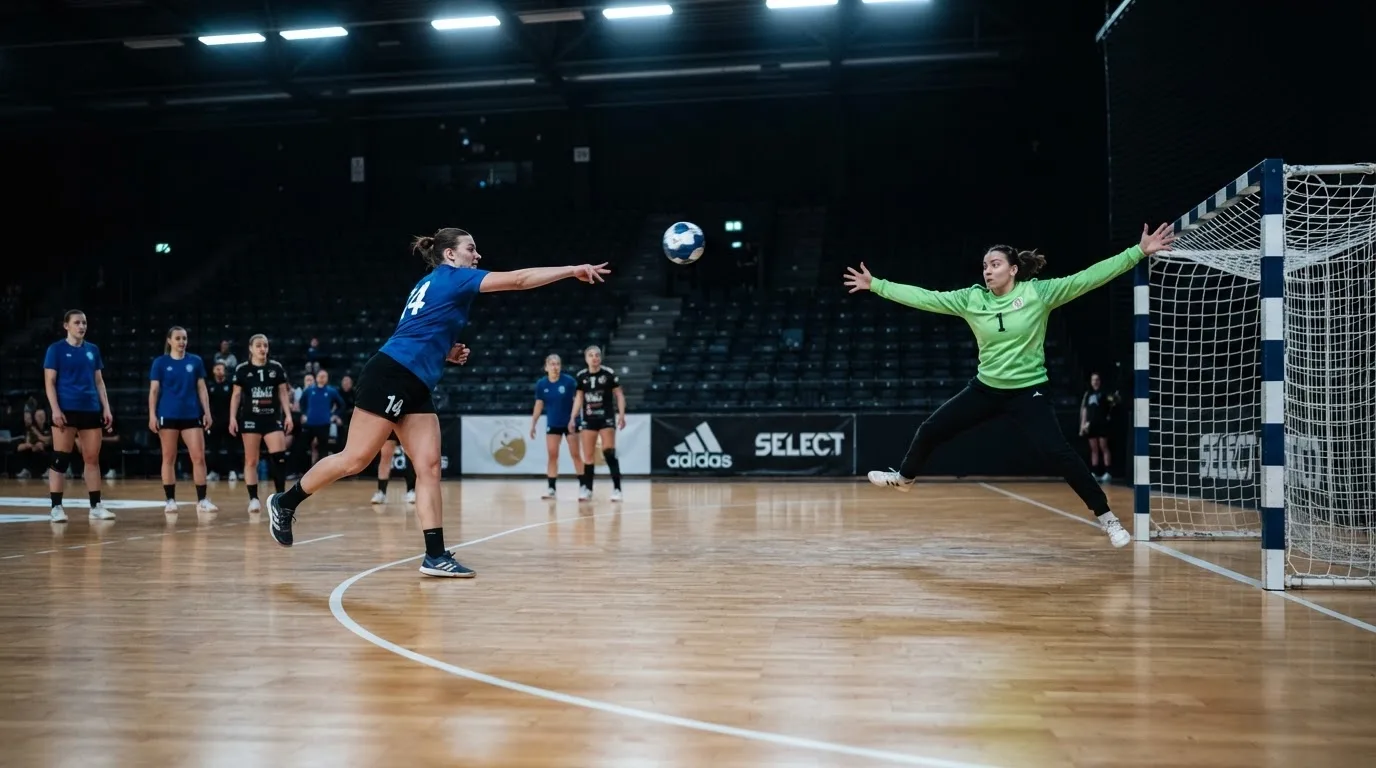
A handball team puts seven players on court, six outfield plus a goalkeeper, and a senior match is two 30-minute halves. The court is 40 metres by 20 with goals two metres high and three metres wide, and professional teams typically score 20 to 35 goals each, so the totals market on a senior men’s fixture is usually set somewhere in the mid-50s. In a decisive match, a draw sends the sides into up to two five-minute overtime periods and then a penalty shootout — a settlement rule bookmakers apply by their own terms, not by any single statute.
The scoring rhythm is dense. A goal every 30 to 60 seconds in senior play, with stoppages for fouls, suspensions and timeouts, makes handball a fluid sport to watch and a busy one to trade. The two-minute suspension for a foul, the seven-metre penalty, the fast break off a turnover — these shape the live market as much as the underlying talent gap does, which is part of why in-play is where most liquidity sits.
Tournaments and when they run
The International Handball Federation runs men’s and women’s world championships in odd-numbered years; the men’s event has been staged every two years since 1995. Denmark holds the 2025 men’s world title; France holds the 2023 women’s title. The IHF World Championship is the headline event of the calendar and the one that pulls the widest outright market, followed by continental championships (the EHF Euro for European national teams) and the IHF Emerging Nations competition for the smaller federations.
At club level, the EHF Champions League is the prestige competition for men’s clubs across Europe, with the Machineseeker EHF Champions League Men running a group stage and knock-out rounds through the autumn and spring, and the equivalent women’s competition (the EHF Champions League Women) running in parallel. National leagues sit beneath that — Germany’s Handball-Bundesliga, Spain’s Liga ASOBAL, France’s Starligue, Denmark’s Herreligaen, Hungary’s K&H Liga — and they price through the season with shorter outright markets than the European competitions. The Olympics have carried handball since 1972 for men and 1976 for women, and an Olympic handball tournament pulls outright and group markets the way a World Championship does.
For a bettor, the practical rhythm is that international windows dominate the calendar (January, May, odd-year July for the World Championship), club handball fills the weeks between, and a GB-licensed bookmaker will price most of it. Lower-tier national leagues and youth competitions are the place coverage thins.
Top handball betting sites in the UK
A shortlist of ten sites that take GB customers under a Gambling Commission remote licence, in the order research has placed them. Every brand named here is on the Commission’s public register against a current remote general betting standard (real events) licence unless noted otherwise. The list is a licensing shortlist, not a ranking — being on it means the site can lawfully take your bet, not that it is the right site for you.
| Brand | Gambling Commission remote licence | Operating company | What the operator’s own terms say on the key’s subject |
|---|---|---|---|
| 10bet | 043173-R-322899-023 (account 43173) | Blue Star Planet Limited | Sportsbook covers football, tennis and horse racing; Cash out, Bet Builder and Live Streaming listed as features |
| Midnite | 101839-R-342850-001 (account 101839) | Midnite Limited | Site shows in-play events, an acca builder, popular accas and price boosts with maximum-stake limits |
| Smarkets | 039173-R-319366-011 (account 39173) | Smarkets (Malta) Limited | Betting exchange; open-bank-transfer deposits are instant from £10 to £10,000 and withdrawals are processed within 6 hours from £10 to £100,000 |
| Bet Ahoy | 100094-R-341742-003 (account 100094) | Bet Ahoy Ltd | Welcome offer is a £10 free-bet package for new customers staking £10 in qualifying bets |
| Betfred | 039544-R-319290-010 (account 39544) | Petfre (Gibraltar) Limited | Sportsbook lists 21 sports plus over 2,000 casino-style games in the same app |
| BetMGM | 039198-R-319450-029 (account 39198) | LeoVegas Gaming PLC | Welcome package splits four £10 free bets across two football accumulators and two sports multiples |
| Spreadex | 008835-R-104580-022 (account 8835) | Spreadex Limited | Combines fixed-odds and spread betting; one-click, auto and partial cash out; live streaming of UK and Irish horse racing, greyhounds, tennis, NFL and selected football |
| Betmaster | 065699-R-339929-002 (account 65699) | BM Solutions GB Ltd | App covers football, cricket, horse racing, NFL and eSports (League of Legends, Dota 2) |
| DAZN Bet | 048756-R-327274-019 (account 48756) | DZBT Limited | Debit-card, Apple Pay, Paysafecard, Trustly and Skrill deposits from £5; PayPal from £20; no processing fees |
| Kalooki Sportsbook | 057730-R-333396-005 (account 57730) | Kalooki Sportsbook Limited | GAMSTOP member, verifies customers before the first deposit under standard identity-check rules |
The licence number beside each brand is the account reference on the Gambling Commission’s public register, the place where the licence type, the licence holder and the registered domain sit together. Searching by that number — or by brand name, trading name or domain — is the standard way to confirm a bookmaker is licensed, and it is the only check that does not rely on the brand’s own marketing. The Commission has not published a single one of these brands as the only licensed site, and a licence register lists many more brands than any article can feature.
What “licensed in Great Britain” actually means
The framework
The Gambling Commission is a non-departmental public body sponsored by the Department for Culture, Media and Sport. It licenses the commercial market under the Gambling Act 2005, which covers Great Britain — England, Scotland and Wales. Northern Ireland sits outside the Act under its own older law, so a “GB-licensed” operator is licensed for England, Scotland and Wales, not for Northern Ireland. Since the Gambling (Licensing and Advertising) Act 2014, an operator whose remote facilities are used in Great Britain needs a Commission licence wherever it is based: a Curaçao, Maltese or Gibraltar licence is not a substitute for customers in Great Britain. Sections 33 and 36 of the 2005 Act, as amended, set that point-of-consumption rule, and providing gambling facilities in Great Britain without the licence the Act requires is an offence under section 33.
The licensing categories a punter meets most often are remote general betting standard (real events), remote general betting standard (virtual events), remote general betting limited, remote pool betting and remote betting intermediary (the licence a betting exchange such as Smarkets holds). Each brand on the Commission’s register is listed under one or more of these, and the licence type matters because it tells you what kind of betting the firm is licensed to take.
Verification, age and identity
A customer at a GB-licensed site is verified before the first deposit or gamble, including with a free bet or bonus. The minimum age is 18, and name, address and date of birth are checked. The requirement has been in force since 7 May 2019, and it is the practical reason no licensed site offers anonymous play. A higher spend brings source-of-funds questions under the money-laundering rules, and a financial vulnerability check applies to remote betting when a customer’s deposits minus withdrawals exceed £150 in a rolling 30 days (since 28 February 2025); it is a public-record check such as a county court judgment or bankruptcy entry, not an income check and not a credit reference check. Financial risk assessments — what the press has called “affordability checks” — were announced on a staged timeline, and as of the date of writing no start date has been set.
What may be bet on
No statutory list of permitted bets or markets exists in Great Britain. A bookmaker holds a licence for a category and offers markets under its own rules and the Commission’s Licence Conditions and Codes of Practice (LCCP). In-play betting is offered by GB bookmakers and is controlled by the operator’s licence conditions and customer-protection duties; whether in-play is “unrestricted” is a phrase to avoid, because the controls sit with the operator and the LCCP, not in any statute. Esports are treated like any other event; virtual events are a separate licence category; politics, TV shows and novelty markets are offered by GB bookmakers and no statutory prohibition was found. Pool betting on horse and dog racing is a separate licence; spread betting that is not a financial product sits inside General Betting Duty; financial spread betting is regulated by the Financial Conduct Authority rather than the Commission.
Tax
The player pays no tax on betting winnings in Great Britain — that is general information, not tax advice, and a professional gambler should ask HMRC or an adviser. General Betting Duty is the operator’s tax on gross profits, currently 15%; from 1 April 2027 a remote rate of 25% will apply within it, while remote bets on UK horse racing, bets on self-service betting terminals in licensed premises, pool betting and in-person betting stay at 15%. Spread betting has its own rates (3% financial, 10% other). The Commission’s statutory levy is a separate charge, not a tax.
Protecting the punter: the safer-gambling layer
GAMSTOP and self-exclusion
GAMSTOP is the national multi-operator online self-exclusion scheme, and participation is a mandatory licence condition for every online operator in Great Britain since 31 March 2020. Self-exclusion runs for six months, one year, five years, or five years with auto-renewal, and after the minimum period the exclusion stays in place for a further seven years unless the customer asks GAMSTOP to remove it. The scheme covers online sites and apps; betting shops use a separate service. Every brand on the shortlist above is a GAMSTOP member, and that membership is the simplest single test of whether a site is licensed for remote betting in Great Britain.
Limits and the customer’s choice
There is no state-set ceiling on deposits or losses in betting. The customer chooses. Operators must offer a gross deposit limit on a fixed time frame under the Remote Technical Standards: the first changes applied on 31 October 2025 and a second phase was postponed to 30 September 2026. Whether that second phase is live is not established here, and any reading should be checked against the firm’s own published terms.
Help and advice
GamCare runs the National Gambling Helpline and offers confidential support; GambleAware funds treatment and research; the NHS runs gambling clinics across the regions; Gamblers Anonymous runs peer-support meetings. These are the routes a customer or a family member can use, and most licensed operators link to all four from a responsible-gambling page that sits a click or two from the home screen.
Bonuses and the rules around them
Promotion rules in force since 19 January 2026 cap wagering requirements on bonuses at 10x: a £10 bonus at 50x would have needed £500 of bets before withdrawal, and the cap limits that to £100. Mixed-product promotions — an offer that requires gambling on two or more product types, such as a free-spin deal tied to a sports bet — are banned. Whether the cap applies to free bets with no wagering condition, and any cap on the money value of a bonus, are not established here and should be checked in the operator’s terms. The Advertising Standards Authority enforces the CAP Code (non-broadcast) and BCAP Code (broadcast) on marketing; section 16 of the CAP Code requires marketing to be socially responsible, not of strong appeal to under-18s, and to feature no one who is or seems to be under 25 in a significant gambling role. The “whistle-to-whistle” rule (no betting ads on TV from five minutes before a live sporting event to five minutes after, before the 9pm watershed, with horse and greyhound racing excluded) is an industry code in force since 1 August 2019, not a statute. The Premier League’s withdrawal of gambling sponsorship from the front of matchday shirts from the 2026/27 season is voluntary, not law.
Crypto, anonymity and what is and is not on offer
Why anonymity is not on the menu in Great Britain
A GB-licensed site verifies the customer before the first deposit. That verification is the practical reason no licensed operator offers anonymous play, and the rule has been in force since 7 May 2019. A customer who wants to bet with cryptocurrency faces the same check: a deposit of bitcoin, ether or another coin still goes through a licensed operator that has identified the customer, and the source-of-funds questions at higher spend apply regardless of the rail. A betting exchange’s published tariff is not the same as the question of whether the exchange accepts crypto at all.
What sits offshore
A site licensed only in Curaçao, Malta, Anjouan or elsewhere outside Great Britain is not licensed to take bets from customers in Great Britain. Using such a site is not framed as a customer offence in the statute — the section 33 offence is on the operator — but the customer loses the protection the GB regime provides. No GAMSTOP coverage, no Commission complaints route, no approved dispute-resolution body, no British consumer redress if funds are withheld, no 10x bonus cap, no £150 vulnerability check. The Commission’s enforcement tools are cease-and-desist notices, search-engine referrals, work with registrars, hosts and payment providers, and the court-order DNS blocking powers it has been given or is about to receive. ISP blocking is not in operation; the framing is disruption at the operator, not blocking at the customer.
What a careful reader should weigh
For a bettor who wants the British framework, the choice is a GB-licensed site. The same firm will verify the customer, take part in GAMSTOP, apply the bonus cap and operate under the LCCP — and it will not offer anonymous play. For a bettor who wants to bet with bitcoin or ether specifically, the practical question is whether any GB-licensed operator takes that rail on handball, and that question belongs to each operator’s deposit page rather than to a generic answer. Offshore sites offer the rails that GB-licensed sites do not, at the cost of the protections named above. Neither is “the safe choice” by default; each is a different package.
Bonuses, free bets and offers on handball
What the marketing word means
A “free bet” is a token the firm credits to the customer’s account after a qualifying condition; the stake is usually not returned with a win. A “risk-free bet” is a refund as a free bet or credit when the qualifying bet loses, not a refund in money. A “price boost” or “enhanced odds” is a one-off inflated price on a named selection. A “100% bonus” is a matched amount of bonus credit on a qualifying deposit, usually subject to a wagering requirement. A “cashback” is a refund of a share of net losses over a period, credited as cash or bonus depending on the terms. Each of these is its own product with its own conditions, and the marketing label tells the reader roughly what to expect — the terms tell the reader what they actually get.
What the conditions cost
The wagering requirement is the headline number. A 5x wagering requirement on a £20 bonus means £100 of qualifying bets before the bonus and any winnings from it can be withdrawn. The minimum price for a qualifying bet is the second number, and it matters: a 1.50 minimum accepts bets the reader would take anyway; a 2.00 minimum forces the reader into selections they would not have taken at all. The deadline is the third number — seven days, fourteen days, thirty days — and it sets the cadence. A cap on bonus winnings is the fourth, often buried, and it is the one that bites hardest: a £100 free-bet package that caps convertible winnings at £200 turns a long-shot winner into a small payout. The 10x cap on wagering requirements is a Commission-side limit since 19 January 2026, and it applies to bonuses at GB-licensed sites.
An offer that reads on the page
Take a free bet of £25 at 2.00. The stake is not returned on a win: the bettor keeps £25 of profit, not £50. On a market running at a 95% payout share (5% margin), the expected value of the free bet is £25 × (2.00 − 1) ÷ 2.00 × 0.95, or roughly £11.88. That is what the offer is worth on average across many uses of it, not what any single bet wins. A free bet is a marketing tool that pays for itself on average, and the bettor’s job is to deploy it at the highest price the terms allow while staying on a market the bettor understands.
How the bonus cap reshapes the picture
The 10x wagering cap changes the arithmetic of the small bonus. A £10 bonus at 50x wagering, which is a long-standing structure in the market, would have required £500 of qualifying bets; the cap reduces that to £100. The change has flattened the gap between a small bonus and a generous one, and the offer the reader sees on a handball match is now more often a token with low conversion cost than a heavy package. Mixed-product offers are banned, so the old “bet on football to get free spins” deal is no longer a route to a sportsbook token. Each of these is a reading of the rules, not a prediction of what a firm will offer next.
Live betting and cash out on handball
Why handball suits the live market
A goal every 30 to 60 seconds in senior play, two-minute suspensions, fast breaks off turnovers, seven-metre penalties and tactical timeouts — handball is a sport where momentum shifts visibly inside a few minutes of play. The bookmaker’s in-play feed tracks score, suspensions, powerplay situations and time remaining, and a market that updates every goal lets the firm and the bettor react quickly. The same scoring rhythm that makes handball exciting to watch makes it expensive to model, and the margin on in-play markets is often wider than on pre-match because the firm takes a bigger cut for its modelling work.
Cash out and partial cash out
Cash out is the operator’s offer to settle a bet before the event finishes, at a price the firm sets in real time. A full cash out closes the bet at that price; a partial cash out closes a share of the stake. Spreadex offers one-click, auto and partial cash out; bet365 offers cash out on a wide range of markets including Bet Builder+ selections. Cash out is not a hedge at zero cost — the price the firm offers is its own, set to include its margin, and it will usually be worse than the price the bettor would get by laying the bet off on an exchange. The point of cash out is convenience, not edge.
Live streaming and the data feed
bet365 streams a wide range of events worldwide and pairs the stream with in-play markets and a tracker; Spreadex streams UK and Irish horse racing, greyhounds, tennis, NFL and selected football. Streaming of handball fixtures is less consistent than for football or tennis because the rights are fragmented, and a GB-licensed site that streams a Bundesliga handball match in one season may not in the next. Where the firm offers a tracker rather than a stream — a graphical feed of score, time and key events — the data is the bettor’s working surface, and the absence of a stream is not necessarily an absence of information.
Predictions, strategy and the limits of both
What a prediction is
A prediction is a guess about a future event, dressed in the language of analysis. A tipster who names a winner is selling a guess; a model that names a probability is selling a calibrated estimate. Neither knows the outcome in advance. Handball is a sport with a high home advantage, a small sample of senior matches per team per season, and a dense scoring rhythm that makes single-match variance large. A model that puts a probability on a side is reading form, suspensions, travel and head-to-head history, but the gap between a 60% favourite and a 40% underdog is one bad half of shooting — and the model that ignores that gap is not a model, it is a slogan.
What a strategy is
A strategy is a rule the bettor applies across many bets, not a single pick. Flat staking — the same stake on every selection — is the simplest rule and the one most likely to outlast a tilt. Bankroll management — staking a fixed percentage of a defined bank — is the second rule and the one that turns a bad week into a survivable one. Price discipline — taking a bet only at a minimum price that pays for the margin — is the third. The three together are the difference between betting as a hobby and betting as a job, and the difference matters because the bookmaker’s edge compounds over many wagers.
What neither is
Neither a prediction nor a strategy tells the reader which side wins tonight. The most a careful reader can do is choose the market with the lowest margin, the offer with the lowest conversion cost, and the stake that fits the bankroll, and accept that the outcome is the outcome. A page that names a winner has crossed a line it cannot defend; this page does not name winners, and a reader who treats the analysis above as a tip sheet has misread it.
The featured operators
Each of the ten brands below sits on the Commission’s public register under a current remote betting licence and offers a sportsbook. The notes below cover what each operator’s own published terms say on the matters that matter most to a handball punter. The order is research’s order; the verdicts are the page’s.
10bet
Blue Star Planet Limited runs the sportsbook at 10bet.co.uk under Gambling Commission account 43173 (remote general betting standard, real events). The app description lists football, tennis and horse racing as covered sports, with Cash out, Bet Builder and Live Streaming named as features. Handball coverage is the question the reader has to ask the betting slip rather than the marketing page; the firm does not name handball as a headline sport in the app copy. Verdict: a mainstream sportsbook with a deep feature set on the sports it names, and a reader who bets handball here should confirm the match and market coverage on the day.
Midnite
Midnite Limited runs Midnite.com under Gambling Commission account 101839, also remote general betting standard (real events). The site shows in-play events, an acca builder, popular accas and price boosts with maximum-stake limits. The welcome offer is a £5-or-more qualifying bet on pre-match odds of EVS (2.00) or greater within 14 days of sign-up for £25 in free bets plus 50 free spins, valid for seven days. Verdict: a builder-focused sportsbook with the welcome offer structured around a minimum price that filters out heavy favourites. For those prioritising accas, this platform is a strong contender; handball fans seeking deep outright markets might find more variety elsewhere.
Smarkets
Smarkets (Malta) Limited runs Smarkets.com under Gambling Commission account 39173, and this one is a betting intermediary (exchange) rather than a traditional sportsbook — the licence type is remote betting intermediary. Deposits by open bank transfer are instant from £10 up to £10,000, withdrawals processed within six hours from £10 up to £100,000; UK debit card deposits are instant from £10 up to £15,000. A betting exchange lets the customer back and lay selections, and the margin is whatever the backer–layer gap makes it — often tighter than a traditional book on liquid events and wider on thin ones. Verdict: the right choice for a reader who wants to lay bets and trade prices, with payout terms that are among the fastest in the British market. The exchange does not carry the same kind of welcome offer a sportsbook does.
Bet Ahoy
Bet Ahoy Ltd runs betahoy.co.uk under Gambling Commission account 100094. The welcome offer is a £10 free-bet package split as a £5 sports bet and a £5 acca for new customers staking £10 in qualifying bets. Verdict: a small, clearly bounded welcome offer for a new sportsbook. The total value of the free-bet package is modest against the larger brands, and the terms — minimum stake, qualifying bets, expiry — matter more than the headline number.
Betfred
Petfre (Gibraltar) Limited runs Betfred.com under Gambling Commission account 39544. The app lists 21 sports plus over 2,000 casino-style games; the sports side is broad and the casino side is deep. Verdict: a high-street name with a long history, a deep sportsbook and a casino bundle that pushes the app past pure sportsbook. It remains a top choice for punters wanting to toggle seamlessly between sports betting and casino games in a single hub.
BetMGM
LeoVegas Gaming PLC runs betmgm.co.uk under Gambling Commission account 39198. The sports welcome offer for new UK customers who deposit £10 or more and place a sports bet within seven days is four £10 free bets — two football accumulators of four selections and two sports multiples of two — valid for seven days, with a minimum-odds requirement and opt-in. Verdict: a welcome package structured as four small free bets rather than one large one, which spreads the conversion cost across several selections and several markets. The structure assumes a reader who will use all four; a reader who uses one is leaving three on the table.
Spreadex
Spreadex Limited runs Spreadex.com under Gambling Commission account 8835. The firm combines fixed-odds and spread betting in one app, regulated by the Commission for fixed-odds and by the FCA for spread betting; spread-betting losses can exceed the deposit. Features include one-click, auto and partial cash out, Bet Builder across fixed odds or spreads, and live streaming of UK and Irish horse racing, greyhounds, tennis, NFL and selected football. Verdict: a hybrid product for a reader who wants both modes in one account, with the FCA-level risk profile on the spread side. The combination is not for a reader who wants a single risk model.
Betmaster
BM Solutions GB Ltd runs betmaster.co.uk under Gambling Commission account 65699. The app description lists football, cricket, horse racing, NFL and eSports (League of Legends, Dota 2) as the covered sports; handball is not named. Verdict: an eSports-and-rails sportsbook where handball coverage is the question the reader has to ask the betting slip rather than the marketing copy. A reader whose primary sport is handball has a wider expectation.
DAZN Bet
DZBT Limited runs DAZN Bet under Gambling Commission account 48756. Deposits start at £5 by debit card, Apple Pay, Paysafecard, Trustly and Skrill, and at £20 by PayPal, with no processing fees. Verdict: a low minimum deposit and a wide range of rails suits a reader who wants to start small and use a specific e-wallet. The processing-fee line is positive on the surface, but the reader should weigh it against the rest of the card.
Kalooki Sportsbook
Kalooki Sportsbook Limited runs kalookisportsbook.co.uk under Gambling Commission account 57730, and the firm is a GAMSTOP member. The operator verifies customers before the first deposit under the standard identity-check rule, name, address and date of birth. Verdict: a smaller brand on the Commission’s register, with the safer-gambling framework explicit. A reader who values the explicit safer-gambling posture above the size of the brand should look here; a reader who wants the deepest market on a Champions League handball match should weigh that against the depth.
How the price becomes a payout
The mechanics
A bet’s return is the stake multiplied by the decimal odds. At 2.50, a £10 stake returns £25 on a win, made up of the £10 stake and £15 of profit. At 1.40, the same £10 returns £14, made up of £10 stake and £4 of profit. A combination bet multiplies the odds of each leg into one price; a treble at 2.00, 3.00 and 4.00 prices at 24.00, and a £5 stake returns £120 on a win, made up of £5 stake and £115 of profit. The result is what the bet pays when it wins; what the bet is worth on average depends on the probability of each leg and the margin of the market, and that is the figure the bettor cannot know in advance.
What the odds actually imply
The implied probability of a price is the inverse: 2.50 implies 40%, 3.00 implies 33.3%, 1.40 implies about 71.4%. For a three-way match-result line, the three implied probabilities sum to more than 100%, and the gap is the margin. A line of 1.70 / 3.40 / 5.00 sums to roughly 105.9%, so the margin is about 5.9%; a line of 1.80 / 3.60 / 4.50 sums to roughly 107.3%, so the margin is about 7.3%. The first is the cheaper line for the bettor, even though no single price is lower. A reader who shops the margin across firms is shopping the cost, not the headline.
Worked example: a handball match-result market at 1.65 / 3.40 / 5.50
The implied probabilities are 60.6%, 29.4% and 18.2%. They sum to about 108.2%, so the margin is around 8.2% and the payout share around 91.8%. The same match at 1.70 / 3.40 / 5.00 gives implied probabilities of 58.8%, 29.4% and 20.0%, summing to about 108.2% — same margin, different distribution. The reader who picks the cheaper side at the higher price pays less margin in expectation than the reader who picks the favourite at a tighter line, but the favourite is favourite for a reason. The two readings do not cancel; they sit beside each other.
Frequently asked questions
Is a handball a foul in betting?
Not in the sense the betting public usually means. In football, a “handball” is a foul by hand or arm; in handball, it is just the name of the sport. Bookmakers settle handball bets by the rules of the sport — score, suspensions, overtime, shootouts — not by any football-style handball interpretation. A draw in a knockout handball match goes to overtime and then penalties, and that settlement is set out in each operator’s terms. A reader who wants the sport-specific rules should look at the operator’s house rules for the match in question rather than rely on the name.
Does a handball count as a foul in betting?
Same answer, in different words. A handball is the name of the sport, not a foul in any sport’s betting rule. What the punter should check is the operator’s own house rules for the market: how a match going to overtime settles, how a player withdrawal settles, how a postponed fixture settles, and what counts as a void bet. Each operator states these in its own terms; a one-line question on a forum is not a substitute.
How can it be checked that a bookmaker holds a Gambling Commission licence?
The Commission’s public register is the whole test. Search by business name, trading name, registered domain or account number; the register returns the licence type, the licence holder and the registered trading names. The account numbers on the shortlist above are the ones to search against for the brands on this page. A licence register is a regulatory document, not a marketing one: it tells the reader what the firm is licensed to do and under which entity. A brand that is licensed under one trading name and operates several sites is licensed across all of them.
How is the return on a bet worked out from the stake and the odds?
Return = stake × decimal odds; profit = stake × (decimal odds − 1). A £10 bet at 2.50 returns £25 on a win (£15 of profit plus the £10 stake). A £5 treble at 2.00, 3.00 and 4.00 — combined odds 24.00 — returns £120 on a win (£115 of profit plus the £5 stake). The odds are a multiplier on the stake; the stake is returned with a win in normal cases. A free bet is the exception: the stake is usually not returned on a win.
What is the bookmaker’s margin and how can it be seen in the odds?
The margin is the profit percentage a bookmaker builds into the odds. For a two-way market at 1.90 / 1.90, the implied probabilities sum to 105.3%, resulting in an overround of 5.3% and a true bookmaker margin of roughly 5.0%. For a three-way match-result line at 1.70 / 3.40 / 5.00, the implied probabilities sum to 108.2%, creating an overround of 8.2% and a margin of approximately 7.6%. The margin is the cost the bettor pays on every bet; the lower the margin, the cheaper the market. A reader can spot the margin by adding the inverses of the prices and subtracting 1 from the sum to find the overround.
US & other team sports – Free bets
Content created by the «Free bets» team
