
Where Horse Racing Odds Sit, and How to Read Them
 Available in US
The decimal or fractional number that flashes next to a runner’s name is the end of a long chain rather than the start of one: form, going, draw, market position, the bookmaker’s margin and the price of other runners all feed into it, and every beat of that chain can shift before the stalls open. The page that follows walks through that chain in the order a punter meets it, from which UK bookmakers actually hold a Gambling Commission licence and what Best Odds Guaranteed adds on top of the headline price, to each-way terms, live in-play markets and the spread-betting exception. The two-way 1.90 / 1.90 example near the end shows the arithmetic behind the margin that is otherwise invisible in the board.

Current as of 27 October 2026, verified against the Gambling Commission’s public register.
What Live Betting on Horse Racing Actually Looks Like
British racing is one of the few sports where “in-play” arrived almost by accident: bookmakers had to price in-running because punters could already lay off positions on the exchanges, so the price feed on the screen became as fast as the trading screen behind it. Live horse racing betting odds are therefore a permanent fixture at every major UK bookmaker, with one structural quirk: the market is shortened rather than suspended between races, because the next off time is often under twenty minutes away.
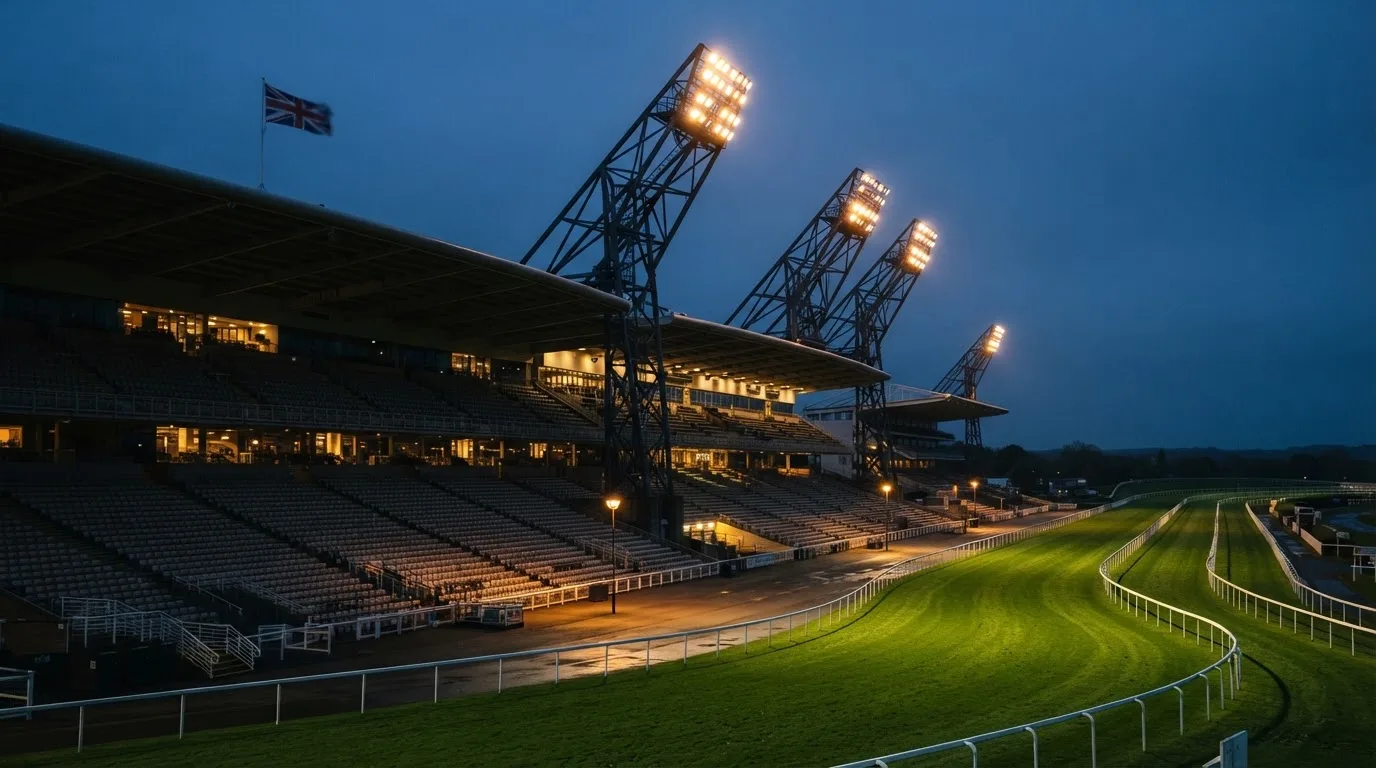
The practical effect on the punter is striking. Each-way terms do not change as the race unfolds, but the win price does, often several times a second in the final furlong. Cash out sits on top of that price feed, and a book that offers cash out is effectively offering to close the bet at the current live horse racing betting odds minus its own spread. The only licensed brands are under the Gambling Commission’s remote general betting licence and participate in GAMSTOP; the section on bookmakers reviews ten of them, including the spread-betting-only firms that the FCA watches separately.
A few mechanics worth pinning down before quoting any price:
- The price displayed two minutes before the off and the SP (starting price) the horse returns at can differ by several points on a busy race. Best Odds Guaranteed narrows that gap and is described further below.
- Live betting is offered subject to the operator’s own trading controls; it is not unlimited and never properly “unrestricted” as a matter of statute.
- The big meetings – the Cheltenham Festival, the Grand National meeting, Royal Ascot, the Derby meeting at Epsom and the autumn Champions Day at Ascot – see the deepest in-running liquidity, because more customers mean market-makers will quote both sides.
Live horse racing betting shows on streaming services are a different product again. Some bookmakers offer a picture feed on UK and Irish meetings, others restrict it to the big festivals. Where a book offers live streaming it usually asks for a funded account or a recent settled bet, and that condition is set by the operator rather than by any rule the Gambling Commission imposes. Live betting shows for horse racing are a selling point on the marketing page and a real limitation in practice: the picture is rarely free of regional rights blackouts, and few punters actually watch the whole race.
Predictions, Form Study and the Systems That Promise Too Much
The internet is plastered with today’s horse racing betting tips, and almost none of them survive contact with the SP. The honest version of the picture in this section is shorter than a tip sheet but more useful: in a sport where the favourite wins roughly a third of the time and the second favourite a fifth, any system that promises a steady winner is either pricing something the market has not yet noticed or describing a streak. Horse racing betting odds today already incorporate everything that is publicly known about form, going, draw and the trainer-jockey combination before the first tip lands in an inbox.

A routine that earns its place on a punter’s desk looks like this:
- Read the racecard: trainer strike-rate at the course, recent runs, going preference, distance suitability, jockey booking and weight carried for handicaps.
- Cross-check against the market: a horse at 10/1 whose form suggests it should be 6/1 is one kind of value; one that should be 16/1 is another, and the price is set by the book rather than the form reader.
- Size the stake against the edge: a 10/1 shot with a one-in-eight chance offers a positive expected value if the true probability is near 12.5%, and zero if it is 10%. The margin in every market eats that edge before the first leg of any system has been placed.
- Keep a ledger: bookmakers will not grade a punter’s record; only the punter can, and only a written record makes “I always back the favourite” testable.
Horse racing betting systems have a long tail, from Dutching to laying favourites through an exchange. None of them cancels the margin, the long-run variance or the time it takes to confirm a strategy works. A “system that wins” is a phrase the marketing department owns; the arithmetic on the page belongs to the punter.
Racecards and statistics are free at the Racing Post and the BHA site, and the same form figures that drive a tipster’s column drive the bookmaker’s model. The cheap edge in UK racing is reading the market rather than reading the form, because the form is already in the price.
The Mechanics of the Price: Markets, Margins and the Each-Way Structure
A bookmaker’s win market on a 12-runner race is not one market; it is twelve overlapping two-way contests, each pair carrying its own margin. The total overround – the sum of the implied probabilities across all runners – sits somewhere between 105% and 125% on a typical midweek handicap, and higher on the minor meetings. Horse racing betting odds in the UK are read in both fractional and decimal form, and the conversion is straightforward: divide the numerator by the denominator and add one. 5/1 becomes 6.00, 11/4 becomes 3.75, evens is 2.00.
The bet types a UK racing book offers
- Win: the horse finishes first. Dead heats are settled as a fraction of the stake.
- Place: the horse finishes in a paying place. Rarely offered alone on UK books, almost always paired with win.
- Each-way: two bets of equal stake, one on win and one on a place that pays a fraction of the win price. A £5 each-way bet costs £10 and yields two payouts if the horse wins, one if it merely places.
- Forecast and tricast: the first two (or three) in order. Pays into double-digit territory on big handicaps.
- Accumulator (“acca”): four or more selections, all must win. The odds of each leg multiply; the payout share falls sharply as legs are added.
- Bet Builder: a same-race or same-meeting combination constructed by the punter. Horse racing bet builders are thinner than football ones because the leg pool is smaller.
The place terms that govern the place half of an each-way bet are the single most-overlooked figure on a UK betting site. Handicaps with more than fifteen runners pay 1/4 odds for four places; twelve-to-fifteen-runner handicaps pay 1/4 for three places; other races with more than seven runners pay 1/5 for three places; five-to-seven-runner races pay 1/4 for two places; under five runners means win only. These are the industry standard; some bookmakers shorten or lengthen them at the bigger meetings.
A worked example makes the doubling plain. A £10 each-way bet on a 10/1 shot at 1/5 place terms (three places, a non-handicap) costs £20. The win half returns £110 if it wins; the place half pays £30; total return £140, total profit £120. Switch the place terms to 1/4 (handicap with twelve to fifteen runners) and the place half returns £35 instead, so the headline figure looks like £145. The number that gets published on forums is almost always the optimistic one.
How the price is built
The technical part. A bookmaker’s trader sets a probability for each runner, then trims each number down by the same percentage to bake in the margin. The result is an overround above 100%. Take a simple match between two horses priced at 1.90 and 1.90 (both evens in fractional, 9/10). The implied probability of each outcome is 1 ÷ 1.90 ≈ 0.5263, or 52.63%. Both outcomes together sum to 105.26%, and the margin is the 5.26 percentage points left over. That is the operator’s expected return on every unit bet on that market, before considering the place side of an each-way bet or the other races on the card.
A margin in the 4-6% range is competitive for a UK win market. Place markets run higher because the number of outcomes is smaller and the price feed is more volatile. Handicaps with deep fields see margins close to 8-10% on the win book, because the liquidity is split across too many runners for any one of them to be priced tightly.
Horse racing spread betting is a different product entirely, and it sits under FCA regulation rather than the Gambling Commission’s. The firm in question settles the difference between a quoted spread and the final figure, and losses can exceed deposits. The comparison table further down keeps spread and fixed-odds brands in separate rows precisely because the licence and the risk profile are different.
Odds conversion and a quick calculator
Decimal odds are the cleanest form for arithmetic: a £10 stake at 6.00 returns £60 and yields a £50 profit. Fractional odds encode the profit fraction directly: 5/1 means a £1 profit for every £1 staked, so a £10 stake returns £60 total. The conversion a/b → a ÷ b + 1 holds for any price, and a betting calculator on a bookmaker’s site does the rest. Many UK racing books default to fractional because the on-course tradition runs deep, but the same price is available in decimal at the toggle of a setting.
A horse racing bet calculator is therefore mostly a way to read an each-way or an accumulator without making an arithmetic slip. It does nothing to lift the margin; the price the punter types in already carries it.
What the Racing Calendar Looks Like in Great Britain
Flat and jump seasons sit in opposite halves of the year. Flat racing runs from March to November, peaking with Royal Ascot in June, the Derby at Epsom, the Oaks, the July Cup at Newmarket and the Champion Stakes on Champions Day. Jump racing – called National Hunt – runs from late autumn through to the following spring, peaking with the Cheltenham Festival in March, the Grand National meeting at Aintree in April, and the Champion Hurdle and Gold Cup as their centrepieces. The two strands cross briefly in the winter all-weather meetings and the spring trials.
The British Triple Crown, open only to three-year-old colts and fillies, is the 2000 Guineas at Newmarket, the Derby at Epsom and the St Leger at Doncaster. Wins in all three are rare – the last was Nijinsky in 1970 – and the absence of a Triple Crown attempt is a regular feature of the racing press rather than a glitch in the schedule. A modern alternative crown, the Triple Crown of Thoroughbred Racing, sweeps the Kentucky Derby, the Preakness Stakes and the Belmont Stakes in the United States.
Distances vary more than the casual reader of a racecard may realise. Flat races range from five furlongs (the minimum) up to two and a half miles, with five to twelve furlongs the most common band. National Hunt races start at two miles and run as far as four miles plus, with obstacles at regular intervals. Handicap races assign each horse a weight based on its official rating, so a horse rated 110 carries more weight than one rated 90 even if it is the better animal on form. Conditions races level the weights and instead offer allowances to younger and female runners. Understanding which type of race a racecard carries changes which piece of form matters – weights and ratings in handicaps, age and sex allowances in conditions events.
The race types a UK bookmaker offers at the major meetings include win and each-way singles, forecasts and tricasts on the feature races, placepots on the bigger handicaps and jockey specials around the festivals. Markets at smaller meetings often run to win and each-way only.
The Ten UK Bookmakers That Belong on a Shortlist
A shortlist of ten looks ordered at first sight, but the order below is not a ranking by price or quality. It is ten Gambling Commission remote licence holders each compared on the same four points – the licence that lets them take bets from a customer in Great Britain, the holder of that licence, the live product available on horse racing and the financial terms of the welcome offer. Some are generalist books with a deep racing product; one is a spread-betting firm whose licence sits under a different regulator. The choice is yours and depends on what the punter values.
| Operator | Licence and holder | Racing offer | Welcome offer |
|---|---|---|---|
| Tote | 054779-R-331321-008 (TDCO Limited) | Pool betting on UK racing, SP and Tote prices | Modest welcome credit |
| BetGoodwin | 002927-R-327985-008 (Goodwin Racing Limited) | Racing-focused book with BOG | Bet £10, Get £15 in Free Bets (£5 sports, £5 acca, £5 Sub-Cover) |
| Geoff Banks | 054095-R-330366-010 (GB Sports Advisors Limited) | Live in-play and ante-post racing prices | Modest welcome credit |
| VBet | 044662-R-324273-022 (SCGO Limited) | Racing markets with cash out, bet builder, live streaming | £10 free bet if a first £10+ stake loses |
| Sporting Index | 027343-R-308898-011 (Sporting Index Limited) | Spread betting with fixed-odds and in-play options | Modest welcome credit |
| Kalooki Sportsbook | 057730-R-333396-005 (Kalooki Sportsbook Limited) | Pre-match racing markets under a smaller brand | Modest welcome credit |
| LiveScore Bet | 056859-R-332720-005 (LiveScore Betting and Gaming (Gibraltar) Limited) | Racing among a football-led Bet Builder offering | Modest welcome credit |
| Dabble | 065677-R-340363-005 (Dabble Sports UK Ltd) | Racing markets in a social-feed format | Bet £10, Get £10 in Free Bets, 7-day expiry, stake not returned |
| 10bet | 043173-R-322899-023 (Blue Star Planet Limited) | Racing with cash out, bet builder, live streaming | Modest welcome credit |
| Betfred | 039544-R-319290-010 (Petfre (Gibraltar) Limited) | Racing with a long-standing BOG policy | Modest welcome credit |
Every row above is a Gambling Commission remote licence holder participating in GAMSTOP. Welcome offers are described only as the operator’s own terms state them, with the two that publish a headline figure on their app store page quoted from that source. The other eight carry the standard small welcome credit, and the terms decide whether it suits the punter rather than the headline number.
Tote
Tote runs pool betting on British and Irish racing, which means the dividend is set by the pool’s total stakes minus the operator’s take rather than by a bookmaker’s margin. The pool structure lifts the margin question into a different shape: the operator takes a known percentage of the pool, and the dividend is whatever remains. On a busy race the dividend can land noticeably above the SP because the pool is a separate, deeper book; on a quiet race the dividend can fall short. Tote’s strength is the product itself, and the punter who likes the structure pools bring should be looking at the win, place, exacta, tricast and jackpot pools before opening the standard fixed-odds book.
For a customer who bets small and often, Tote’s structure is exactly what the punter expects from racing. A racing-focused punter seeking BOG and the traditional fixed-odds book should look elsewhere, however.
BetGoodwin
A racing-led bookmaker with BOG on UK and Irish racing and a welcome offer of three £5 free bet tokens on a £10 qualifying bet. The licence holder is Goodwin Racing Limited on Commission account 2927, and the offer’s three tokens (£5 sports, £5 acca, £5 Sub-Cover) are constrained to those three products rather than spent anywhere on the racing board. A token that can only be spent on the sportsbook, the acca or a “Sub-Cover” product is a thin welcome credit for a racing-first punter; the BOG policy is the product worth coming for.
For a racing-led punter who values BOG above all else, BetGoodwin is a sensible fit. Those looking for a single free bet credit to spend freely on the racing board may find the three-token split restrictive.
Geoff Banks
A smaller brand published by GB Sports Advisors Limited, with a licensed in-play product and ante-post markets. Its site is less crowded than the major books and tends to over-respond to information the market has not yet priced in, which is the kind of behaviour a sharp punter likes and a casual one misses. The welcome offer is modest and the brand’s marketing leans on phone-assisted service as much as on the price feed.
Geoff Banks fits a customer with a small book and time to read the market. For the customer who just wants a one-screen racing app with BOG and a deep card, Geoff Banks is the wrong shape.
VBet
A multi-product book covering horse racing alongside football, with cash out and a bet builder. The welcome offer is a £10 free bet on a verified first £10+ stake, contingent on the first bet losing. The licence holder is SCGO Limited, which has the same remote general betting standard licence as every other brand in this list. The free bet’s “if you lose” framing is the kind of refund that arrives after the result, and the stake of the free bet is not paid back on a win, which is the structure research consistently reports.
For a customer looking for a full racing and football book from one account, VBet is one of the wider products. For a customer chasing BOG specifically, VBet’s offer competes with William Hill and Betfred rather than dominating either.
Sporting Index
A spread-betting firm licensed under the Commission’s general betting standard, sitting under FCA supervision for the financial product. The firm’s own material is clear that spread betting losses can exceed deposits. The booking interface offers fixed-odds and spread products side by side, which is unusual and lets a customer switch rather than pick a book.
For a customer who wants to bet spreads on a horse’s finishing position or the winning margin, Sporting Index is a fit. For a customer who expects a fixed-odds horse-racing book and arrives at the spread interface, Sporting Index is the wrong product for that trip.
Kalooki Sportsbook
A smaller brand on a Commission account held by Kalooki Sportsbook Limited, with the standard identity checks before the first deposit and a GAMSTOP membership. The racecard is narrower than the major books and the welcome offer is modest, but the structure is the same as the bigger names. A smaller brand on a Commission licence is not a smaller product in a regulatory sense – it carries the same licence conditions – but it is a smaller book in a margin sense, and the price feed on the less-popular meetings is less competitive.
For a customer who wants a Commission-licensed book and has a specific reason to avoid the major brands, Kalooki is a fit. Bettors seeking the deepest racecard and the most aggressive pricing will likely find better value at the major operators.
LiveScore Bet
A betting-led product of the LiveScore scores-and-results brand. Racing is one market among many, with a Bet Builder product running alongside the standard singles. The licence is held by LiveScore Betting and Gaming (Gibraltar) Limited on account 56859. The Bet Builder product runs up to ten selections on match result, both teams to score, corners, total goals, player scoring and card markets – the same product football offers, scaled across the rest of the sportsbook.
For a customer who already watches scores on the LiveScore app and wants to bet from the same interface, LiveScore Bet is a smooth fit. However, a customer prioritizing a racing-first experience might find LiveScore Bet better suited as a secondary option.
Dabble
A social-feed betting product where customers can follow, chat and copy each other’s bets. The welcome offer is “Bet £10, Get £10 in Free Bets” with minimum odds, a seven-day expiry and the stake not returned. The minimum-odds condition is the kind of term that is ordinary for a free bet and punishing for a casual punter who backs anything at 1.10.
For a customer who wants a feed of bets from other customers and a free bet on top, Dabble fits the bill. For a customer who wants the free bet to land without minimum-odds gymnastics, the seven-day clock and the no-stake-return rule are the bones to read for.
10bet
A book covering football, tennis and horse racing, with cash out, bet builder and live streaming. The licence is held by Blue Star Planet Limited on account 43173. The product list reads like a generalist European bookmaker’s racing module, with the standard tools a UK customer expects on football racing.
For a customer who wants one generalist book covering racing and the rest of the sportsbook, 10bet is a fit. For a customer who wants BOG and an extensive racing product across UK and Irish meetings, 10bet is one book among several rather than the obvious pick.
Betfred
A legacy high-street book with a long-standing horse-racing product, Best Odds Guaranteed on UK and Irish racing from 8 AM on the day of the race, covering both single and multiple bets. The licence is held by Petfre (Gibraltar) Limited on Commission account 39544. The app covers 21 sports plus over 2,000 casino-style games, which is its breadth rather than its racing focus.
For a customer who wants BOG on the morning of the race and a wide sportsbook behind it, Betfred remains a fit. For a customer who wants a product built around racing rather than running racing as a category, Betfred is one of many competing books.
The Legal Frame Around UK Horse Racing Betting
Horse racing sits in a deregulated commercial market under the Gambling Act 2005, which covers Great Britain. Northern Ireland is outside the Act, so a GB licence is the wrong instrument to take bets from a customer in Northern Ireland and a Northern Ireland licence does not authorise a GB customer. A bookmaker serving customers in Great Britain needs a Gambling Commission licence wherever it is based – the point-of-consumption shift in 2014 closed the loophole that let offshore firms take GB bets without one. A Curaçao or Malta licence is not a substitute.
Licences come in five categories: remote general betting standard (real events), remote general betting standard (virtual events), remote general betting limited, remote pool betting and remote betting intermediary (the exchange licence). The bookmakers in the comparison table sit under the first; Tote sits under pool betting; the spread-betting firms come under the FCA for the spread product and the Commission for the fixed-odds side. The Commission’s public register lets a punter check a licence by business name, trading name or domain, and the account number is the most reliable search key. No single brand is the only licensed one: the register lists many more than any comparison feature.
Identity verification before the first deposit has been in force since 7 May 2019, which is why no GB-licensed book offers anonymous play. The credit-card ban for gambling in Great Britain covers credit-card-funded e-wallet deposits too, and has been in force since 14 April 2020. Debit cards, bank transfers and most e-wallets are not affected. Cryptocurrency deposits are not covered by a specific rule at the licensed operators; the operators’ own terms decide whether they accept them.
The financial vulnerability check applies to licensed remote betting when deposits minus withdrawals exceed £150 over a rolling thirty days, in force since 28 February 2025 under LCCP condition 3.4.4. The check is a public-records search (bankruptcy, county-court judgments), not an income or credit-reference check. The “affordability checks” sometimes reported in the press are a related but staged plan: the Commission has announced the policy in stages, with the first stage live and later stages on a published timeline that does not yet have a firm start date. The state has not set a deposit or loss ceiling for betting: any limit the punter sees on screen is the punter’s own choice or the operator’s own risk controls, not a statutory cap.
Bonuses at licensed operators are subject to the Commission’s promotion rules in force since 19 January 2026: a 10x cap on wagering requirements, and a ban on mixed-product offers that require the punter to gamble on two or more product types at once. The cap’s reach to free bets with no wagering condition, and any cap on the money value of a bonus, are not established. Marketing on broadcast and non-broadcast channels is governed by the CAP and BCAP Codes enforced by the ASA rather than the Commission, and the ASA’s section 16 sets a strong rule against images and content with strong appeal to under-18s – a rule about marketing who may appear, not about who may bet.
The operator pays General Betting Duty on gross profits at 15% in 2026, with a new remote betting rate of 25% inside GBD applying from 1 April 2027 on bets that are not UK horse racing, not pool and not in-shop. Bets on UK horse racing stay at the 15% rate. The punter pays no tax on winnings, and the duty does not pass through the odds in a way the punter can see. The general rule for the punter is: winnings are tax-free in Great Britain, and a professional gambler should ask HMRC or an adviser because the line between hobby and trade is different from the duty itself.
Offshore gambling – placing bets with an operator that holds no Commission licence – is regulated at the operator end rather than the customer end. There is no offence aimed at a customer who merely bets on an unlicensed site, but the customer loses the protection of a GAMSTOP exclusion, of a Commission complaints route, of an approved alternative-dispute-resolution body, of the 10x bonus cap and of the £150 vulnerability trigger. Funds withheld by an offshore firm have no British consumer-redress route. Neither choice is “the safe choice” by default: a licensed site means verification and limits; an unlicensed one means a thinner check at registration and no Commission backstop. The framing here is honest on both sides rather than tilted.
Where to Find Help If Betting Becomes a Problem
The Gambling Commission’s safer-gambling duties require every licensed operator to link to help organisations and to participate in GAMSTOP. GAMSTOP is the national multi-operator online self-exclusion scheme and a mandatory licence condition for online operators since 31 March 2020. Self-exclusion periods are six months, one year, five years, or five years with auto-renewal; after the minimum period the exclusion stays in place for a further seven years unless the customer asks GAMSTOP to remove it. The scheme covers online sites and apps; betting shops use a separate self-exclusion service. Older licences sometimes called the scheme “Multi-Operator Self-Exclusion Scheme” or “MOSES”; both names refer to the same product.
Operator-side tools at the licensed books run alongside GAMSTOP. Deposit limits, time-outs, reality checks, product restrictions, session-time reminders and self-exclusion from the operator itself are all standard, and operators must offer them under the Commission’s Remote Technical Standards. A punter who wants to cut deposit spend can do so without referring to GAMSTOP, and a punter who wants to cut all online spend registers once with GAMSTOP and is blocked at every participating book. The two are not substitutes; the operator-side tool wins for a single book, GAMSTOP wins for the wider lockdown.
The help organisations the Commission’s own rules name are:
- GamCare operates the National Gambling Helpline and runs chat and text services. Its services are free and confidential.
- GambleAware funds research, treatment and education on gambling harms.
- NHS gambling clinics provide specialist treatment in several regions.
- Gamblers Anonymous runs peer-support meetings across the UK and Ireland.
Fitzwilliam Sports links to all four of GambleAware, GAMSTOP and Gamblers Anonymous on its home page, which is the format every licensed book should follow. A book that buries its help links in a footer is signalling less than one that puts them up next to the safer-gambling tools.
The best time to set a deposit limit is before the first bet, not after a losing streak. The reality check the operator offers is partly a regulatory tick-box and partly a useful tool, and a punter who treats the latter seriously is treating themselves seriously. None of this cures a problem that has already taken hold, but it lowers the temperature of one that is starting to.
Crypto, E-Wallets and Payments at Horse Racing Books
The crypto horse racing betting conversation has a footnote: no GB-licensed book has been established as accepting cryptocurrency deposits. The Commission’s own rules do not forbid them, and credit cards have been banned since 14 April 2020 (LCCP condition 6.1.2), but the standard identity verification before the first deposit means the player is known by the time a deposit is made and the operator’s payment terms decide whether a crypto route is open. A punter looking to bet on racing with crypto will most often land on an unlicensed offshore site, and the legal frame above describes what that costs in protection.
The conventional payment set a UK punter meets is debit cards, bank transfers, e-wallets and the occasional prepaid voucher. Identity verification before the first deposit applies to all of them, and a punter moving from one book to another will usually re-do that verification under the second operator’s own checks rather than port it from the first. The Commission has not laid down a list of permitted methods, and the operator’s terms are the source.
Source-of-funds questions at higher spend are normal under the anti-money-laundering rules and the Commission’s vulnerability trigger. A punter reaching the £150 deposit-minus-withdrawal threshold in a rolling thirty days will get a public-records check (bankruptcy, county-court judgments), not a salary check. The punters who find these intrusive are usually the ones whose deposit pattern is no longer recreational, which is the point of the check. A punter whose betting is smaller than the threshold will rarely see a check.
Bet365’s partnership with the UEFA Champions League and the betting apps of every major book have made the app the dominant payment channel. The racecard, the betting slip, the live-streaming window and the deposit button are all on the same screen, and a punter who started on a website ten years ago now does most of their betting from a phone. The next section covers the apps in more depth.
Bonuses, Free Bets and the Promotion Cap
A free bet on horse racing is a token that pays out the profit only, not the stake, and the promotion rules in force since 19 January 2026 cap the wagering requirement at 10x. A £10 bonus at the 50x mark that used to be common now requires £500 of qualifying bets; under the cap, no more than £100. Mixed-product offers that ask the punter to bet on racing and casino, or on football and bingo, in one promotion are banned. Welcome offers on the ten operators above stay within those rules, and the welcome credit on each row is the operator’s own terms.
Free horse racing bets no deposit sound free and rarely are. A token whose stake is not returned is worth less than the headline figure, and the minimum-odds condition on any free bet is the part that decides whether the punter can actually spend it. Horse racing betting offers cluster at the Cheltenham Festival, the Grand National meeting and Royal Ascot, and the conditions on festival-specific offers are usually tighter than the welcome credit.
The calculation that matters most on a bonus is turnover, and turnover equals bonus base times wagering factor. A £10 bonus at 5x requires £50 of qualifying bets at the minimum price; a £30 bonus at 5x requires £150 of qualifying bets; the higher the number the lower the punter’s expected value, because every qualifying bet pays the bookmaker’s margin and the bookmaker keeps that margin under the bonus cap. Promotion rules do not set a cap on the bonus’s money value or on the size of a free bet token: only the wagering factor is capped, and offers with no wagering condition sit outside the cap. Whether a free bet with no wagering condition is exempt is not established.
The two products that recur on UK racing books and read best in plain prose are:
- Best Odds Guaranteed. William Hill pays BOG on UK and Irish horse racing from 8 AM on the day of the race, on both single and multiple bets. It does not apply to ante-post, tote or pari-mutuel bets. BOG pays the higher of the price taken and the SP, which is the kind of cushion a small punter feels more sharply than the headline margin of the morning price.
- Cash out. Settle a bet before the race finishes at a price the book has discounted from the live market. Useful when the leader has drifted and the punter wants to lock in profit; costly when the punter misreads the in-running price.
The promotion cap is the most concrete piece of customer protection the 2026 rules delivered, and the mixed-product ban is the one that closed a category of offers the punter often accepted because the headline looked good. The two together let a punter take a welcome offer at face value in a way the 2019 free-bet landscape did not.
The Apps That Have Pulled Racing Onto the Handset
The best betting app for horse racing on a UK punter’s phone is whichever app the punter actually opens first. Bet365’s app is described by its own listing as the most-downloaded sports-betting app in the UK and has the deepest racecard, the live-streaming window and the Bet Builder product (pre-match and in-play), alongside Super Boosts and Winnings Boosts on Bet Builders and selected singles. Betfred’s app covers racing among 21 sports and runs alongside 2,000 casino-style games on the same login, which is breadth rather than focus. LiveScore Bet bundles scores, betting and a Bet Builder (up to ten selections on match result, both teams to score, corners, total goals, player scoring and cards) into the same interface, which is the selling point for a punter who already has the LiveScore scores app on the home screen.
Best horse racing betting apps for a customer who bets small and often meet a few practical tests:
- Live streaming on UK and Irish meetings without a separate subscription or cable login.
- A racecard that opens quickly on a 4G connection and stays current as the off time approaches.
- A cash out button on the live page rather than tucked under the bet history.
- A betting slip that lets the punter construct an each-way bet or an accumulator without re-entering the stake.
- A deposit limit that the punter can set from inside the app rather than by phone.
A horse racing betting app that fails any one of these is a working app, but not a sharp one. The bookmakers in the comparison table all ship an iOS and Android app, and several of them are listed on the UK App Store under the names in the table. The first app a punter installs is rarely the best one for racing; the app that scores the five points above is the one to keep.
Browser-based betting still works on a tablet and a desktop, and some legacy books are easier to navigate on a full screen. The shift to handset is, however, irreversible.
The Margin in a Two-Way Market
A worked example of the arithmetic the rest of the page has been hinting at: a two-way market at decimal odds of 1.90 and 1.90. The implied probability of each outcome is one divided by 1.90, which is approximately 52.63%. Both outcomes together imply 105.26%, which is the overround. The margin – the bookmaker’s expected return on every unit bet on this market – is the overround minus one, which equals 5.26%.
That 5.26% is what the book keeps, on average, of every £100 bet on this market. The two-way example is the cleanest possible illustration because every other market – a twelve-runner handicap, an each-way bet, a four-leg accumulator – layers additional margin on top, and the punters who think they have found a “low-margin market” are usually looking at the wrong line in the bet history.
The honest framing for the punter is that the margin is the cost of admission to a UK racing book, and the move is to pick markets at the lower end of the band rather than to argue the margin out of existence. The markets the margin bites least on are morning prices on the heavily backed favourites at the big meetings, where competition is fiercest and the price feed is more liquid. The markets it bites hardest on are place markets at the smaller meetings, exotic bets (forecasts, tricasts) and long-priced accumulators with many legs.
Expressed as a band, the margin of a UK win market usually sits between 4% and 8%, depending on the meeting and the time of day, and the margin of a UK place market sits between 6% and 12%. The lower bound of the win-market band is the kind of margin a punter notices at the major festivals; the upper bound is the kind of margin a punter pays at the minor meetings. The 5.26% of the worked example sits comfortably in the band and is a useful benchmark for what “competitive” looks like.
Frequently Asked Questions
How do you bet on horse racing in the UK?
Place a single bet or an each-way bet through a Gambling Commission-licensed bookmaker, choose a market (win, place, each-way, forecast, accumulator), stake £X or more at the displayed price, and the book settles the bet once the result is confirmed by the racecourse stewards. A £5 each-way bet costs £10 because it is two bets of equal stake, and the same racecard structure applies at every licensed book.
How are horse racing bets worked out?
Win bets pay stake times odds (decimal), or stake plus stake times the fractional odds. Each-way bets are two bets of equal stake, so a £10 each-way bet costs £20 and pays out separately on win and place. UK place terms vary by race type and number of runners, with handicaps of more than fifteen runners paying 1/4 odds for four places.
How do betting odds work on horse racing?
A decimal odds figure is one divided by the implied probability, so 2.00 is a 50% chance and 6.00 is a 16.7% chance. Fractional odds show the profit fraction – 5/1 is £5 profit per £1 staked – and the conversion is a over b plus one. The bookmaker’s margin sits inside every price and inflates the implied probabilities of all runners above 100%.
How can a bookmaker’s Gambling Commission licence be checked?
Search the Commission’s public register by business name, trading name, account number or domain, and confirm the licence is in force for remote general betting standard (real events) or another relevant category. The licence holder’s name on the register should match the operator’s own site, and the licence categories should cover the products the punter intends to use. A brand on a UK betting site without a register entry is not licensed for Great Britain.
How is a bet’s return calculated from the stake and the odds?
For decimal odds, the return is stake multiplied by odds, and the profit is stake multiplied by odds minus one. For fractional odds, the profit is stake multiplied by the numerator divided by the denominator, and the return is stake plus profit. For an each-way bet, the calculation runs twice – once for win, once for place – and the total payout is the sum of the two.
What is the bookmaker’s margin and where is it visible?
The margin is the percentage of every unit bet that the book keeps on average; it is the overround minus 100%, and the overround is the sum of implied probabilities of all outcomes in a market. In a two-way market at 1.90 and 1.90, the overround is 5.26% and the margin is 5.0%, and in a twelve-runner handicap these figures sit higher because the bookmaker layers the margin across more runners. The margin is the single most important number a punter does not see on the screen, and the lower it is, the better the price on offer.
Horse racing & greyhounds – Free bets
Content created by the «Free bets» team
