
Online Horse Racing Betting in Great Britain
 Available in US
*Current as of 27 October 2026 · verified against the Gambling Commission’s public register and each operator’s published terms*
Choosing where to back a runner used to mean choosing between the betting shop on the high street and the one in the next town. The internet changed that quietly. Today a British punter can price a handicap at Newmarket from a phone on the bus, place an each-way double on the Festival, lay a non-runner on an exchange, and still have the cash-out window open at the final flight of hurdles. The choice is no longer whether to bet online but which licensed operator deserves the stake, and on what terms.
This guide walks through what online horse racing betting actually involves in Great Britain: the live markets that move through a race card, the predictions and form tools punters reach for, the bet types from singles to Lucky 15s, the sports and tournament calendar that drives the calendar, and the ten licensed bookmakers the comparison rests on. Then comes the regulatory frame, the safer-gambling scaffolding, what crypto and offshore really mean for a British customer, the offers behind the welcome banners, and the mobile apps that deliver the slip. It closes with the arithmetic every punter eventually needs: how a payout is built, and what the margin eats on the way through.
In-play markets and cash out on the races
What in-play actually offers during a race
Live betting on horse racing used to be a window between the off and the finish, and most bookmakers kept it almost closed. That window has widened substantially. The same firms that took a single price before the off now stream the race and reprice it jump by jump on the flat, fence by fence over the sticks. In-play horse racing covers most UK and Irish fixtures priced before the off, and the major overseas meetings (the Melbourne Cup, Royal Ascot’s international fields, the Breeders’ Cup) where the feed is good enough to support a market.
The mechanics are straightforward but worth stating plainly. A bookmaker lays a price at the off; a trader watches the run; when something happens — a horse is hampered at the bend, the favourite takes a muddling kick at a hurdle, the leader pulls four lengths clear in the final furlong — the trader pulls the price on the affected runners and pushes the price on the others. The screen updates, sometimes in under a second on the firm mobile apps. The bettor sees a new price and either takes it or does not.
Three things matter about an in-play horse racing market that do not matter before the off. The first is suspension: between the moment a race starts and the moment it settles, the bookmaker will frequently take the market down for a second or two when something happens on the track that needs pricing in. The bettor sees a greyed-out market or a “market suspended” message. The second is the price on offer: it is rarely as generous as the price before the off, because the bookmaker has less information about what happens next than the form book suggested. The third is the speed of settlement: in-play bets on horse racing settle quickly once the result is confirmed, but a photo finish or a steward’s inquiry can hold the result for several minutes.
The official Apple App Store listings for the bookmakers reviewed here describe their in-play offerings in fairly uniform terms. Fitzdares’ app carries in-play live odds on horse racing alongside football, tennis, rugby, cricket, golf and American football. London Bet combines sports betting on horse racing, greyhounds, football, tennis, darts, golf, cricket, NFL, NBA, MLB and snooker with Pragmatic Play casino slots and live in-play betting. Matchbook, which is a betting exchange rather than a traditional bookmaker, runs in-play betting alongside live streaming of horse racing and greyhounds.
Cash out as a settlement option
Cash out turns a position held against an unsettled race into a closed one. The bookmaker offers a sum — usually a fraction of the maximum the bet would pay if held to settlement — and the bettor can take it before the result is known. On horse racing it is used in two patterns: closing out a single bet mid-race when the runner is travelling well but the price has shortened, and closing out one leg of an accumulator when the other legs are still to run.
The cash-out figure is the bookmaker’s own number, and it sits inside the same margin that priced the bet in the first place. A backer who cashes out a winning position early is selling the remaining upside to the bookmaker at a discount; a backer who cashes out a losing position is paying the bookmaker to take the risk off the table. Either can be the right call, and either can be the wrong one. The trade is that the bookmaker keeps a slice whichever way the bet is closed. Fitzdares’ app lists cash out among its core features, alongside accumulators, Lucky 15s, specials and antepost markets; it is one of the operators that explicitly carries the function into horse racing.
Cash out is not universal. Several of the ten operators reviewed here do not advertise it on horse racing, and a smaller bookmaker may run cash out on football only. Before staking the bet, it is worth checking that the market carries a cash-out button at all, and if so, that it is available on the specific selection.
What to watch in a live market
Three things tell a punter whether an in-play horse racing market is worth holding. The first is the suspension pattern: a market that suspends every thirty seconds is one the bookmaker is uncertain about, simply because each suspension costs the firm time and money. The second is the spread: a market that offers a back price at 2.80 and a lay price at 2.60 on the same runner is wide and short. The third is the price movement: if the favourite drifts from 3.00 to 4.50 between the stalls and the start, the market is telling the bettor something the form book did not.
Live racing prices are also a place where Best Odds Guaranteed changes the arithmetic. William Hill pays Best Odds Guaranteed on UK and Irish horse racing from 8 AM on the day of the race, on both single and multiple bets; it does not apply to ante-post, tote or pari-mutuel bets. That guarantee means the punter takes the higher of the price at placement time and the starting price. A backer who takes 6.0 before the off and the runner drifts to 8.0 at the off still settles at 8.0. Inside an in-play market, BOG typically no longer applies once the race is under way.
Predictions, form and staking systems
What “predictions” actually means in horse racing
The phrase “horse racing tips” pulls a lot of material that is not analysis. Newspapers carry tipsters, some of whom have a long record and some of whom do not; tipster services sell subscriptions of variable quality; tipsters on social media range from the rigorous to the plainly reckless. The honest framing is that a tip is one person’s opinion, sometimes informed by form study and pace analysis and sometimes by nothing visible at all.
Form study is the part of predictions that has the most evidence behind it. A horse’s previous runs, the going (the state of the ground), the distance, the course, the class of the race, the draw (in a large field at a turning track), the jockey and trainer combination, and the weight carried all shape a horse’s chance. None of these is decisive on its own, and a runner that looks ideal on paper can be beaten by something the form book does not record — the horse that does not try, the horse that needs the run, the horse that fluffs the start. Form narrows the field; it does not pick the winner.
Pace is the variable that experienced punters weight more than the form figures suggest. A race with one front-runner and several hold-up horses shapes one way; a race with several front-runners shapes another. The racecourse’s draw, the going and the distance all feed the pace map. A horse that needs a strong pace to produce its best run will not produce it in a slowly run race.
Bankroll and staking systems
A staking system is a rule for how much to bet on each race. The simplest is a flat stake: the same amount on every selection, regardless of confidence. The next is proportional staking: a fraction of the bank on each selection, the fraction rising with confidence. The more elaborate systems — Martingale (double after a loss), Fibonacci (step up the sequence after a loss), Labouchere (a planned sequence that closes on a target) — are progressions that vary the stake by recent results.
The honest framing is that no staking system changes the expected return of the bets themselves. A staking system can change the shape of the bankroll curve — flatter or steeper, more or less volatile — but it cannot lift a negative-expectancy series into a positive one. The margin that the bookmaker keeps on every market sits inside every bet, and a progression magnifies the damage of a bad run rather than curing it.
What a staking system can do is keep the punter betting at a level they can afford to lose. A £100 bank bet at £2 per race is sustainable across a long losing run; the same bank bet at £20 per race is not. The arithmetic of staking is the arithmetic of survival, and the only system that works is one that the punter can keep betting through when the results turn cold.
What the punter actually controls
Three things are under the punter’s control on race day: which races to bet in, which runners to back, and how much to stake. Everything else — the going, the draw, the jockey’s ride, the horse’s temperament on the day, the photo finish — is outside the punter’s reach. The form book and pace map narrow the field; the staking plan keeps the bank alive long enough for the form to find a winner; and the rest is luck, in the precise sense that no amount of preparation removes it.
That framing matters because the alternatives on the market are dishonest. Tipster services that promise a steady income from horse racing are selling certainty that does not exist. Betting systems marketed as “winning systems” are progressions dressed up as insight. The punter who bets on horse racing bets against a margin, with the knowledge that the form book tilts the field and the staking plan keeps the bank alive. Nothing else.
Bet types and how odds are built
The each-way bet, explained properly
An each-way bet is two bets of equal stake: one on the horse to win, one on the horse to be placed. A £5 each-way bet costs £10. The place part pays a fraction of the win odds, set by the place terms for the race. If the horse wins, both parts pay. If the horse is placed but does not win, only the place part pays. If the horse finishes outside the places, both parts lose.
UK each-way place terms are settled by field size and race type. The standard scale for non-handicap races with more than seven runners is one-fifth of the win odds for three places. Handicaps with more than fifteen runners pay one-quarter odds for four places; handicaps with twelve to fifteen runners pay one-quarter for three places; non-handicap races with five to seven runners pay one-quarter for two places; races with fewer than five runners are win only — no place part is accepted. These terms vary slightly between bookmakers and are stated in the each-way section of the betting rules.
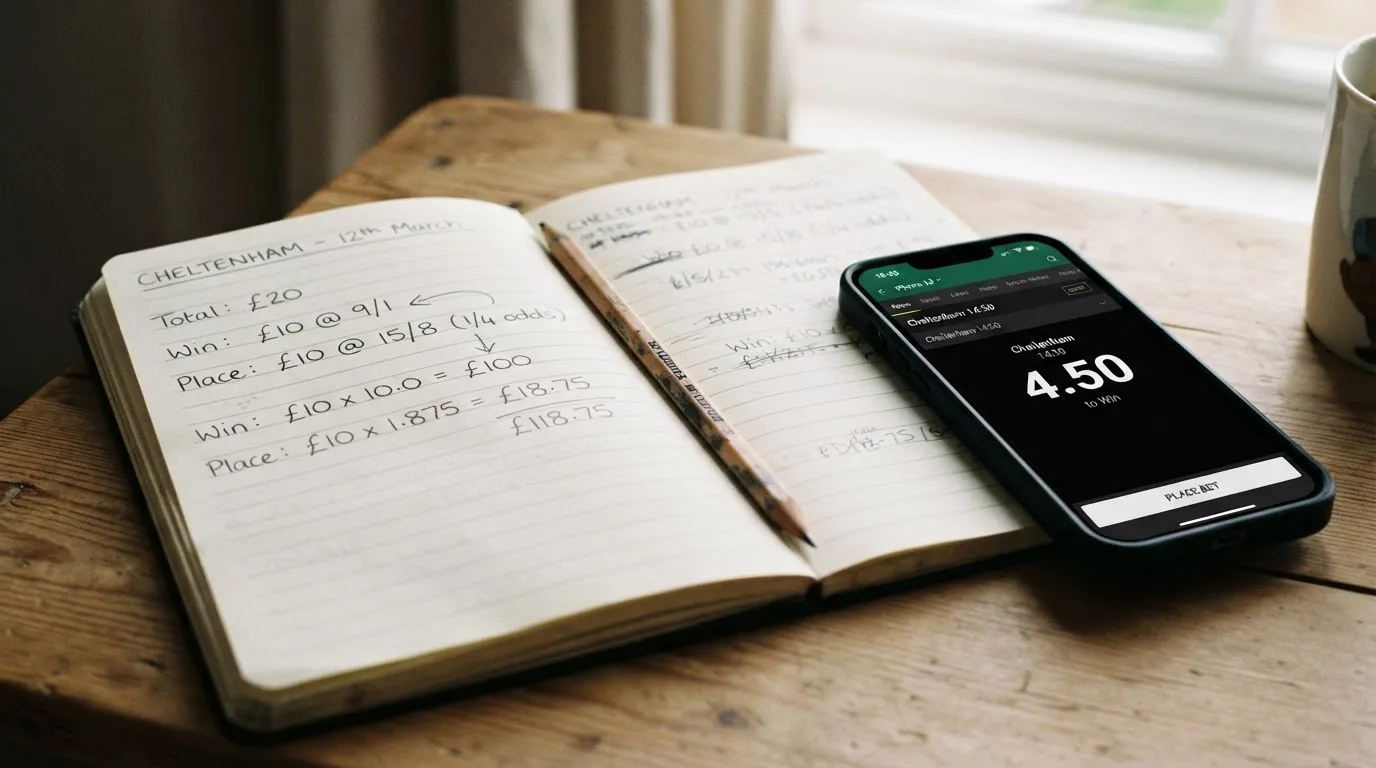
A worked example makes the arithmetic plain. A £10 each-way bet on a 10/1 horse at one-quarter place terms for three places costs £20. The win part pays £10 × 10 = £100 profit plus the £10 stake back, so £110 returned. The place part pays £10 × (10 ÷ 4) = £25 profit plus the £10 stake back, so £35 returned. Total returned if the horse wins: £145. Total returned if the horse is placed but does not win: £35. Total lost if the horse finishes outside the places: £20.
Singles, doubles and accumulators
A single is a bet on one selection. A double is a bet on two selections, both of which must win for the bet to pay. A treble is three selections, all of which must win. An accumulator — “acca” in the British vernacular — is four or more selections, all of which must win. The odds multiply into a single price. Two selections at 3/1 and 4/1 form a double at roughly 17/1 (3 × 4 + 3 + 4 = 19 in fractional terms, 20.00 in decimal, after rounding). Each leg must win for the bet to pay.
The accumulator is the bet the bookmakers promote hardest and the bet most punters over-rate. The bookmaker’s margin compounds across the legs, so an accumulator of four selections at 5/1 (6.00) each carries a margin larger than any one of its legs. A £10 accumulator at four legs of 6.00 each returns £12,960 if all four win — a memorable number that explains the marketing. The probability of all four winning is much lower than the probability of any one of them winning, and the bookmaker’s margin sits inside the price at every stage.
Multiples, Lucky bets and the bet builder
A Lucky bet combines singles and all the multiples from a set of selections. A Lucky 15 is four selections, fifteen bets: four singles, six doubles, four trebles and one four-fold accumulator. A Lucky 31 is five selections, thirty-one bets. A Lucky 63 is six selections, sixty-three bets. A Trixie is three selections, four bets (three doubles and one treble). A Yankee is four selections, eleven bets (six doubles, four trebles and one four-fold). A Patent is three selections, seven bets (three singles, three doubles and one treble). A Heinz is six selections, fifty-seven bets. A Goliath is eight selections, two hundred and forty-seven bets. The total stake is the unit stake multiplied by the number of bets, so a £1 Lucky 15 costs £15 and a £1 Goliath costs £247. Fitzdares’ app lists Lucky 15s among its core features on horse racing.
A bet builder combines markets from one event into a single bet. Midnite’s app shows an acca builder alongside its in-play events and price boosts. Bet365 runs Bet Builder+, which combines markets from one event into a single bet available pre-match and in-play. The bet builder works on football most prominently, where the firm markets for a player to score, both teams to score, and the total goals can be combined; on horse racing the equivalent is rarer and is typically confined to combining the race winner with a place finish, or combining the result of two races in a double.
Spread betting on horse racing
Spreadex is regulated by the Financial Conduct Authority for spread betting and by the Gambling Commission for fixed-odds betting. Spread betting on horse racing is a different product from fixed-odds betting. The punter does not back a horse at a price; the punter trades a spread, and the firm settles the difference between the spread and the result. The Spreadex homepage states that spread betting losses can exceed the deposit, which is the regulatory point that distinguishes spread betting from fixed-odds betting: the punter can lose more than the stake put down. Spread betting on horse racing typically covers the winner’s finishing position in lengths, the winning distance, the time of the winner and similar measurable figures.
What a bet calculator does
A bet calculator takes the stake, the odds and the bet type and produces the return. On horse racing the calculation covers each-way bets, where the place part pays a fraction of the win odds, and multiples, where the odds of the legs multiply into a single price. The calculator handles Rule 4 deductions (a bookmaker rule that adjusts payouts when a runner is withdrawn and the market is reformed), dead-heat rules (when two horses finish in the same position), and the place-term variations across handicaps and non-handicaps. A punter who places each-way bets on a regular basis keeps a bet calculator open.
How decimal and fractional odds relate
British racing prices are quoted in fractional form (5/1, 11/4, evens) and in decimal form (6.00, 3.75, 2.00). The conversion is straightforward: a/b in fractional becomes a ÷ b + 1 in decimal, so 5/1 is 5 ÷ 1 + 1 = 6.00, 11/4 is 11 ÷ 4 + 1 = 3.75, and evens is 1/1 = 2.00. Odds-on means the selection is shorter than evens, so the decimal price is below 2.00. Decimal odds show the total return per unit staked; fractional odds show the profit per unit staked. The two formats carry the same information in different shapes.
The margin in the odds
The margin is what the bookmaker keeps of every unit staked on a market. It sits inside the prices on either side of a two-way market and across the prices of every selection in a multi-way market. For a two-way market with decimal prices p₁ and p₂, the payout share is 1 ÷ (1/p₁ + 1/p₂) and the margin is 1 minus the payout share. Worked at the prices the page uses as an example — 1.90 and 1.90 — the payout share is 1 ÷ (1/1.90 + 1/1.90) = 1 ÷ 1.0526 = 0.95, so the margin is 0.05, or roughly five per cent.
That five per cent is the band a competitive bookmaker runs on an ordinary two-way market, and the band rises with the number of selections in the market. A twelve-runner horse race has more prices than a two-way market, and the margin across the twelve selections is larger than the margin across two. A typical horse racing win market runs at a margin somewhere between ten and twenty per cent on the morning of the race, depending on the bookmaker and the liquidity of the race; ante-post markets over-run because the firm has more time and more uncertainty to price in.
The margin matters because every bet is paid out of the stake minus the margin, and a punter who bets across many markets pays the margin on each. It is the cost the punter pays for the service the bookmaker provides, and it is the reason a bookmaker over the long run keeps more than it pays out.
Sports, tournaments and the calendar
The British fixture calendar
British horse racing runs every day of the year somewhere, with the volume peaking in the summer and the quality peaking at the festivals. Flat racing runs from March to November, with a winter programme on the all-weather tracks. Jump racing — National Hunt — runs from October to April, with the Cheltenham Festival in March, the Grand National meeting at Aintree in April, and the Christmas and New Year fixtures at Kempton, Sandown and others the focal points of the winter. The two codes overlap in the spring and autumn shoulder seasons.
The major flat meetings include the 2000 Guineas at Newmarket in May, the Derby at Epsom in June, Royal Ascot in June, the Eclipse at Sandown in July, the Goodwood Festival in July, the Yorkshire Oaks and International Stakes at York in August, the St Leger at Doncaster in September, the Prix de l’Arc de Triomphe at Longchamp in October and the Breeders’ Cup at the host track in November. The major jump meetings include the Cheltenham Festival in March, the Grand National at Aintree in April, the Punchestown Festival in Ireland in late April, the Christmas meetings and the major Christmas and New Year fixtures at Kempton, Sandown and Wetherby.
The British Triple Crown consists of the 2000 Guineas, the Derby and the St Leger. A horse that wins all three is said to have won the Triple Crown, and the feat has been completed only rarely. The fillies’ Triple Crown is the 1000 Guineas, the Oaks and the St Leger. The two courses that host the Guineas and the St Leger, Newmarket and Doncaster, sit on different calendars from Epsom, where the Derby and the Oaks are run.
Flat, jump and the distances run
Flat racing is run directly between two points around a straight or oval track. Jump racing (steeplechasing and hurdling) is called National Hunt racing in Great Britain and Ireland. Flat races range from 440 yards (400 m) to more than four miles (6.4 km), with five to twelve furlongs (1.0 to 2.4 km) the most common distances. Sprint races run at five or six furlongs; middle-distance races at a mile to a mile and a quarter; staying races at a mile and a half upwards. Jump races are typically longer, with the Grand National run over four miles and two and a half furlongs at Aintree, and the major championship events run over two to three miles.
In handicap races each horse is assigned a different weight to carry based on its ability. The higher the handicap rating, the more weight the horse carries. The idea is to bring the field together on paper so the race is competitive; in practice, handicaps still produce strong favourites and long shots. In conditions races, horses carry the same weight with allowances for younger and female horses — a three-year-old gives weight to an older horse, a filly gives weight to a colt, a horse making its seasonal debut may be given an allowance. Conditions races are typically the championship events; handicaps are typically the bread-and-butter races.
What a typical race day looks like
A typical British race day carries six to eight races, with the first off in the early afternoon and the last off in the late afternoon or early evening. Evening floodlit meetings run through the winter. The race card lists each race with the distance, the going (good to soft, soft, heavy, good, firm), the class of the race, the runners, the form of each runner, the jockey and trainer, the draw where relevant, and the morning price. The market moves from the morning price to a final show at the off, where the starting price is set.
A punter placing a bet mid-afternoon on the third race at a meeting like Ascot or Haydock will see prices on a dozen or so selections, each carrying a win price and a place price. The each-way terms for the race are stated at the top of the market; the place terms for a handicap of more than fifteen runners differ from the place terms for a non-handicap of more than seven runners. The race settles a few minutes after the off; bets are settled shortly afterwards on the app and on the website.
International racing
British punters bet on international racing through the licensed bookmakers reviewed here. The Melbourne Cup in November, the Dubai World Cup in March, the Prix de l’Arc de Triomphe in October, the Japan Cup in November, the Breeders’ Cup in November, and the major American Triple Crown races (Kentucky Derby, Preakness Stakes, Belmont Stakes) are all priced by British bookmakers. The Irish meetings at the Curragh, Leopardstown and Punchestown are priced alongside the British meetings and form the bulk of the foreign fields British punters bet into.
International racing carries different conditions from British racing. The going is reported differently, the draw matters differently on different tracks, and the form figures do not translate directly. The bookmaker’s margin on a foreign meeting is typically higher than on a domestic one because the firm has less information about the form and less liquidity in the market. A punter who bets heavily on foreign meetings pays a higher margin than a punter who bets mostly on domestic meetings.
Top ten bookmakers for horse racing
What the comparison rests on
The ten operators reviewed below each hold a Gambling Commission remote licence for Great Britain. Each is a brand whose domain appears on the Commission’s public register against a licensee holding a remote betting licence. The list is not a ranking and not a recommendation, and a place in a comparison is not a licence. Several brands run under one licensee, and the brands reviewed here are independent of one another on the register. Every GB-licensed online operator takes part in GAMSTOP; no unlicensed brand is listed.
The comparison rests on four matters: the licence number and the licensee named on the register, what the operator’s own terms state about horse racing specifically, the markets and features the operator carries, and the welcome offer where one is advertised. The licence line tells the punter where to verify the operator; the terms tell the punter what the operator does on horse racing; the markets and features tell the punter what the operator is for; the offer tells the punter what the operator is competing with.
Tote
Tote is the pool-betting brand, with its licence on the register under account 54779 and licence number 054779-R-331321-008. The licence holder is TDCO Limited. Tote’s product is fundamentally different from a fixed-odds bookmaker: Tote pools together the stakes placed on a race and pays out the pool according to the result, after a deduction for the operator and the industry. There is no fixed price on a Tote bet before the off; the dividend is declared after the race. The Tote has a long history in British racing and a strong position in pool-betting on the major festivals.
Tote is focused on pool betting, where stakes are aggregated and dividends declared post-race. It is a specialised choice for punters who understand pool variance, while those requiring fixed prices will find traditional bookmakers more appropriate.
Star Sports
Star Sports runs under Gambling Commission account 9177, licence 009177-R-104555-019, with the licence held by Star Racing Limited. Star Sports is one of the smaller operators on the list and runs an independent service. The Apple App Store listing for Star Sports’ app gives a phone number, 08000 521 321, on which customers can speak to a trader directly to open an account, place bets or ask customer queries; support is also offered at [email protected]. That personal-service angle is unusual in the British online market, where most operators run the standard deposit-and-bet flow without speaking to a customer.
Star Sports distinguishes itself with a direct telephone line to a trader on 08000 521 321, offering a level of personal service that is rare in the online market. For a punter seeking deep markets and aggressive pricing, this operator may not be the primary destination.
Fitzdares
Fitzdares runs under Gambling Commission account 400, licence 000400-R-103839-030, with the licence held by Fitzdares Limited. The Fitzdares app offers cash out, accumulators, Lucky 15s, specials and antepost markets on horse racing, football, tennis, rugby, cricket, golf and American football, with in-play live odds. The marketing position is a premium service with a smaller, more curated client base than the high-street names.
Fitzdares provides a premium service focused on ante-post markets, Lucky 15s and horse-racing-specific features like cash out. It caters to those who value curation over the sheer volume of a high-street-style bookmaker.
London Bet
London Bet runs under Gambling Commission account 66162, licence 066162-R-340278-004, with the licence held by Thistle Bet Limited. The London Bet app combines sports betting on football, tennis, horse racing, greyhounds, darts, golf, cricket, NFL, NBA, MLB and snooker with Pragmatic Play casino slots and live in-play betting. London Bet is one of the smaller operators and runs a broader product than pure horse racing, mixing sports and casino in the same app.
London Bet offers a broad platform where horse racing sits alongside football, greyhounds, and casino slots. Those looking for a dedicated racing specialist might prefer to look elsewhere.
Betboro
Betboro runs under Gambling Commission account 44181, licence 044181-R-324363-007, with the licence held by Webmedia Development N.V. The Betboro sports welcome offer is a 100% matched free bet of up to £25 on the first qualifying wager, requiring a debit card deposit of at least £10 and a first bet of £5 to £25 with at least three selections each at 3/5 (1.60) or higher. The “free bet” terminology here means a free-bet token rather than a cash refund: a free bet’s stake is typically not paid back with a win, and the welcome offer is the kind that suits a punter who already has a three-selection accumulator in mind rather than a single on a 5/1 outsider.
Betboro offers a matched free bet on your first multiple, catering to the punter who prefers accumulator-based strategies.
Kalooki Sportsbook
Kalooki Sportsbook is operated by Kalooki Sports Book Ltd (company number 12938274), licensed by the Gambling Commission under account 57730, licence 057730-R-333396-005. Kalooki Sportsbook is a GAMSTOP member. The site positions itself as a betting service with the social-responsibility scaffolding attached to it. The fact that the licence holder is a UK-registered company with a UK company number is one of the small details that distinguishes Kalooki from the operators run by international companies holding GB licences.
Kalooki Sportsbook is a UK-registered company and a member of GAMSTOP, emphasising a structured and regulated environment. Punter seeking maximum market depth or high-frequency price competition might find other options more suitable.
Paddy Power
Paddy Power runs under Gambling Commission account 39439, licence 039439-R-319330-013, with the licence held by PPB Counterparty Services Limited. Paddy Power’s sports betting app covers football, horse racing, boxing, rugby, tennis, golf, darts, snooker and F1. Paddy Power is one of the larger operators on the British market and runs a broad product with aggressive offers and money-back specials. Paddy Power and Betfair sit on the same licence, but the brands are operated as independent bookmakers with separate apps and separate markets.
Paddy Power is a high-volume platform featuring frequent money-back specials and a deep inventory of markets. It is likely the right choice for the punter who values market depth, whereas one looking for a boutique experience might prefer a different firm.
BoyleSports
BoyleSports runs under Gambling Commission account 39469, licence 039469-R-319383-025, with the licence held by Boylesports Enterprise. The welcome offer provides £20 in free bets for UK players after a £10 qualifying bet, while Irish players receive €30 in free bets for a €10 bet. With a strong Irish racing background, it is well-suited for punters looking to leverage this expertise.
For the punter who wants a £20 free-bet welcome offer against a £10 qualifying bet and a bookmaker with a strong Irish racing card, BoyleSports is the operator.
Octobet
Octobet runs under Gambling Commission account 62545, licence 062545-R-337248-006, with the licence held by Octopus Game Limited. Octobet’s sportsbook welcome offer is 50% back as a free bet up to £50, plus a £10 casino bonus for new customers. The structure differs from the matched-free-bet offers on most of the other operators here: Octobet refunds half the stake as a free bet rather than matching the stake. The combined offer includes a £10 casino bonus, which fits the mixed product the operator runs.
Octobet offers a 50% refund on the first bet as a free-bet token, bundled with a casino bonus. This structure differs from the standard matched-stake models, offering a distinct alternative for new account holders.
Matchbook
Matchbook runs under Gambling Commission account 39504, licence 039504-R-319407-024, with the licence held by Triplebet Limited. Matchbook is a betting exchange where customers bet against other users, with Bet Builder, multiples, in-play betting and live streaming of horse racing and greyhounds. Matchbook is not a fixed-odds bookmaker in the conventional sense: prices on Matchbook are set by users backing and laying against each other, and the operator takes a commission on winnings rather than a margin across the book.
Matchbook is a betting exchange that allows backing and laying, charging a commission on winnings instead of a traditional bookmaker’s margin. It appeals to those seeking to trade positions during a race rather than relying on standard fixed-odds services.
How a British bookmaker is licensed and regulated
The Gambling Commission’s role
The Gambling Commission (UKGC) is a non-departmental public body sponsored by the Department for Culture, Media and Sport. It licenses the whole commercial market for gambling in Great Britain under the Gambling Act 2005. Great Britain means England, Scotland and Wales; Northern Ireland is outside the Act and runs its own older law, so a GB licence is not a UK-wide licence. The Commission issues operating licences, sets the Licence Conditions and Codes of Practice (LCCP) that govern how licence holders operate, and runs the public register that lists every licence holder.
Since the Gambling (Licensing and Advertising) Act 2014, an operator whose remote facilities are used in Great Britain needs a Commission licence wherever the operator is based. A Curaçao, Maltese or Gibraltar licence is not a substitute for a GB licence at the point of consumption. The sections of the 2005 Act that carry this requirement are sections 33 and 36 as amended.
What the licence categories mean
The Commission’s betting licence types include remote general betting standard (real events), remote general betting standard (virtual events), remote general betting limited, remote pool betting and remote betting intermediary. The first covers fixed-odds betting on real sporting events, which is the licence every operator reviewed here holds. Pool betting on horse and dog racing is a separate category, and the Tote sits on it. The betting intermediary licence is the one for betting exchanges, and Matchbook sits on it alongside other exchanges. The categories tell the punter what the operator is licensed to do; the licence number and account number tell the punter where to verify it on the register.
What the public register shows
The Commission’s public register can be searched by business name, trading name, domain or account number. It is the whole test of whether a brand holds a licence. The register lists the licensee (the company that holds the licence), the trading names (the brands under which the licensee operates), the licence number and the account number, the licence status (active, suspended, revoked), the date the licence was issued, and the activities the licence covers.
The brand reviewed in this guide can be checked on the register by searching for the trading name or the licence number stated against each operator above. The search returns the licence holder’s name, the trading names the licence covers, and the licence status. The verification is quick, and a punter who wants to be sure a brand holds a licence can do it in under a minute.
Minimum age and identity verification
The minimum age for gambling in Great Britain is 18. The Commission’s rules require that a customer’s name, address and date of birth are verified before the customer can deposit or gamble, with the requirement in force since 7 May 2019. The verification covers free bets and bonuses as well as real-money stakes. There is no anonymous play at a licensed site.
The verification is typically done against a passport or driving licence and a recent utility bill or bank statement. A punter who cannot verify fails the deposit and is closed out of the site. The point of the rule is to keep under-18s out of the market and to satisfy anti-money-laundering checks; the cost is the friction of uploading documents at the start of a relationship.
Financial vulnerability and affordability checks
The Commission’s LCCP condition 3.4.4, in force since 30 August 2024, applies to licensed remote betting when a customer’s deposits minus withdrawals exceed £150 in a rolling 30 days (since 28 February 2025). The check is a public-record check — for example a bankruptcy register or a county court judgment — and it is not an income check and not a credit reference check. Financial risk assessments (the “affordability checks” of the press) are announced in a staged plan, with no start date: the Commission’s article of 7 July 2026 sets out the plan, and the punter reads the framework rather than a firm rule.
Deposit limits are governed by the Commission’s Remote Technical Standards (RTS 12). Operators must offer a gross deposit limit on a fixed time frame; the first changes have applied since 31 October 2025, and a second phase was postponed to 30 September 2026. There is no state-set deposit or loss ceiling: limits are the customer’s choice within the framework of the technical standards.
Advertising and the bonus cap
Advertising is not licensed by the Commission; it runs through the CAP Code for non-broadcast and the BCAP Code for broadcast, both enforced by the Advertising Standards Authority (ASA), alongside the Commission’s marketing conditions in the LCCP. CAP Code section 16 holds marketing to a socially responsible standard, prohibits content of strong appeal to under-18s, and bars anyone who is or appears to be under 25 from featuring in gambling advertising (with an exception for marketing placed where a bet can be made directly). The rule concerns who may appear in the advertisement, not who may bet.
The promotion rules in force since 19 January 2026 cap wagering requirements on bonuses at 10x. A £10 bonus with a 50x wagering requirement would need £500 of bets to clear; under the cap, no more than £100 of bonus wagering is required. Mixed-product promotions — an offer that requires gambling on two or more product types such as betting, casino, bingo and lottery, for example “bet on football to get free spins” — are banned. Whether the cap applies to free bets with no wagering condition, and any cap on the money value of a bonus, have not been confirmed.
What may be bet on
There is no statutory list of permitted bets or markets in Great Britain. An operator holds a licence for a category and offers markets under its own rules and the LCCP. In-play betting is offered by GB bookmakers under the operator’s licence conditions and customer-protection duties, and the controls are the operator’s. Esports are treated like any other event; virtual events are a separate licence category. Bets on politics, TV shows and novelty markets are offered by GB bookmakers, and no statutory prohibition was found.
Off-course pool betting on horse or dog racing is a separate licence and duty. No statutory cap on stakes in sports betting was found; operators set their own maximum stakes and may restrict customers.
Tax
The player pays no tax on betting winnings in Great Britain, as a matter of general information rather than tax advice; a professional gambler should ask HMRC or an adviser. General Betting Duty is the operator’s tax on gross profits, currently 15%; from 1 April 2027 a new remote betting rate of 25% applies within it, while remote bets on UK horse racing, bets on self-self-service betting terminals in licensed premises, pool betting and in-person betting stay at 15%. The policy was set out in an HM Government paper of 26 November 2025. Until 1 April 2027 the remote rate stays at 15%; whether operators pass duty on through odds is not established, and a punter reading a price should not assume the duty is reflected in the margin.
Spread betting has its own rates (3% financial, 10% other) under a separate duty.
What an offshore site means for a British customer
A GB licence is compulsory at the point of consumption. Providing gambling facilities in Great Britain without the licence the Act requires is an offence under section 33 of the Gambling Act 2005, on summary conviction up to 51 weeks’ imprisonment, a fine up to level 5, or both, and six months in Scotland. The offence is aimed at the operator; no offence aimed at a customer who merely bets on an unlicensed site was found.
The honest framing is what an unlicensed site costs the punter in lost protections. No GAMSTOP coverage. No Commission complaints route. No approved dispute-resolution body. No British consumer redress if funds are withheld. Not bound by the 10x bonus cap or the £150 vulnerability check. The punter can still bet on the site, but the protections that come with a GB licence are not available. Enforcement against unlicensed sites runs through cease-and-desist notices, search-engine referrals, work with registrars, hosts and payment providers, and court-order DNS blocking powers that the Commission has been given or is about to receive. The punter reading a brand on a Curacao or Maltese licence only knows that the brand is licensed somewhere else and that the protections of a GB licence do not apply.
Safer gambling and the support available
GAMSTOP and self-exclusion
GAMSTOP is the national multi-operator online self-exclusion scheme and a mandatory licence condition for online operators since 31 March 2020. The scheme covers online sites and apps; betting shops use a separate service. Self-exclusion periods are six months, one year, five years, or five years with auto-renewal. After the minimum period, the exclusion stays in place for a further seven years unless the customer asks GAMSTOP to remove it.
The scheme is operated by GAMSTOP, a non-profit set up by the online gambling industry and funded by the licensed operators. Registration is free, takes a few minutes, and applies across every operator that holds a remote betting licence for Great Britain. The punter who registers with GAMSTOP is blocked from depositing or betting at every GB-licensed online operator for the chosen period. There is no opt-out during the minimum period. Kalooki Sportsbook is a GAMSTOP member among the operators reviewed here, and every GB-licensed online operator takes part.
Deposit limits and time-outs
Deposit limits are a customer-set tool, not a state-set tool. The licensed operator must offer a gross deposit limit on a fixed time frame under the Commission’s RTS 12. Fitzwilliam Sports, which sits outside the ten operators reviewed in detail but illustrates the safer-gambling toolkit GB-licensed operators carry, offers instant deposits, fast withdrawals, timeouts and deposit limits, and links to GambleAware, GamStop and Gamblers Anonymous. Most operators offer daily, weekly and monthly limits that the customer can set and tighten at any time; loosening typically takes twenty-four hours and is subject to a reflection period.
Time-outs are a shorter-form break than GAMSTOP exclusion. A time-out of twenty-four hours, seven days or thirty days is a cooling-off period during which the customer cannot deposit or bet at the operator. The break is set by the customer and lifts automatically at the end of the period.
Help and advice
The help lines and services available to a punter in difficulty include GamCare (which runs the National Gambling Helpline), GambleAware, NHS gambling clinics, and Gamblers Anonymous. GamCare runs a free helpline and a webchat service and offers one-to-one counselling. GambleAware funds research, education and treatment. The NHS runs gambling clinics in several cities and accepts referrals from GPs. Gamblers Anonymous runs peer-support meetings across the country. The punter who finds the betting taking over the budget has several routes into help, and a licensed operator’s safer-gambling page links to them.
What “safer gambling” actually means on the operator’s side
A licensed operator’s safer-gambling toolkit combines deposit limits, time-outs, self-exclusion, reality checks (pop-up messages at intervals during a session), activity statements (a record of deposits, withdrawals and net position), and access to GamCare. The marketing that promotes the operator must comply with the socially responsible standard in the CAP Code and the LCCP, and the operator is responsible for the marketing of its affiliates. The punter reading the safer-gambling page of a GB-licensed operator finds a regulated framework rather than a marketing slogan.
Crypto, anonymity and offshore betting
Crypto deposits at licensed British bookmakers
No state rule for or against cryptocurrency deposits at licensed operators has been published, and the operators reviewed do not advertise cryptocurrency deposits as a feature. The licensed British market runs on sterling and on payment methods that satisfy the Commission’s anti-money-laundering checks. A punter who wants to deposit in cryptocurrency is looking outside the licensed British market and the protections that come with it.
The Commission’s identity verification rules, in force since 7 May 2019, require name, address and date of birth to be verified before the customer can deposit or gamble, including with a free bet or bonus. Cryptocurrency deposits at a GB-licensed operator would sit inside that framework, with the customer identified and the source of funds established under anti-money-laundering checks at higher spend.
What anonymity means in the British market
There is no anonymous play at a GB-licensed site. The verification requirement blocks it. A punter who values anonymity over the protections of a licensed site is choosing one against the other, and the choice is the punter’s. The honest framing is that the licensed market trades anonymity for protections: verification, GAMSTOP coverage, the Commission’s complaints route, dispute resolution if funds are withheld, the bonus cap, and the vulnerability check. An offshore site offers anonymity without those protections. Neither is “the safe choice” by default; the punter chooses what to trade against what.
Crypto betting sites outside the British licence
Crypto betting sites sit mostly outside the British licence. The brands that take cryptocurrency deposits and pay in cryptocurrency are typically licensed in Curaçao or another offshore jurisdiction, not in Great Britain. A British customer betting at such a site is not on a GB licence, is not in GAMSTOP, and does not have the Commission’s complaints route. The punter who wants to bet in cryptocurrency is choosing an unlicensed site; the choice is the punter’s, and the consequences sit with the punter.
Bonuses, free bets and what an offer really costs
What a “free bet” actually is
A free bet is a token the operator credits to the customer’s account after a qualifying bet is placed and settled. The token is then used to place a bet of the operator’s choice. If the free bet wins, the stake is typically not paid back with the win — only the profit is credited. A £10 free bet at 5/1 pays £50 profit, not £60 returned. That is the regulatory point: a free bet is a discount on a bet, not a refund of a stake.
Some offers describe themselves as “risk-free” bets or “money-back” bets. A risk-free bet is typically refunded as a free bet rather than as cash, and the refund is the free-bet kind rather than the cash kind. The marketing word “risk-free” is misleading if the refund is in tokens rather than cash; the punter reading the offer should look for the word “cash” in the terms before assuming the refund can be withdrawn.
Welcome offers at the operators reviewed
Betboro’s sports welcome offer is a 100% matched free bet of up to £25 on the first qualifying wager, requiring a debit card deposit of at least £10 and a first bet of £5 to £25 with at least three selections each at 3/5 (1.60) or higher. BoyleSports’ sports welcome offer for UK players is £20 in free bets when a £10 bet is placed; Irish players get €30 in free bets when a €10 bet is placed. Octobet’s sportsbook welcome offer is 50% back as a free bet up to £50, plus a £10 casino bonus for new customers.
Paddy Power, Star Sports, Fitzdares, London Bet, Kalooki Sportsbook, Tote and Matchbook do not advertise a sports welcome offer. Tote runs pool betting rather than fixed-odds betting, and Matchbook is an exchange with a commission structure rather than a free-bet welcome. An operator that does not advertise a welcome offer here may still run one on its own site. A punter who wants to know what an operator offers on day one checks the operator’s own promotions page.
What the offer costs the punter
A free bet’s value to the punter is the expected profit from the bet, weighted by the chance the bet wins. For a free bet whose stake is not paid back, the value is the free-bet amount multiplied by (odds − 1) divided by odds, multiplied by the payout share of the market. Worked at a £10 free bet on a 5/1 (6.00) selection with a market payout share of 95%, the value is £10 × (6.00 − 1) ÷ 6.00 × 0.95 = £7.92. That is the offer’s expected value: over many uses, the £10 free bet pays the punter roughly £7.92 in profit on average.
The welcome offers above all carry a qualifying bet that costs the punter a real stake. A £25 matched free bet on a £25 first bet at 1.60 (3/5) requires the first bet to win for the free bet to credit; if the first bet loses, the punter has lost £25 and gets nothing back. A 50% back free bet up to £50 on a £100 first bet returns £50 if the first bet loses; if the first bet wins, the punter gets the win but no free bet. The honest framing is that a welcome offer is a discount on a first bet that may not pay out, and the punter who takes the offer should be willing to lose the qualifying stake.
Best Odds Guaranteed and price boosts
Best Odds Guaranteed (BOG) is a long-standing British racing offer. William Hill pays Best Odds Guaranteed on UK and Irish horse racing from 8 AM on the day of the race, on both single and multiple bets; it does not apply to ante-post, tote or pari-mutuel bets. The mechanic is straightforward: the punter takes a price at placement time, and the operator guarantees the higher of the placement price and the starting price if the starting price is larger. BOG is a real edge for the punter who places bets at any time from 8 AM on the day, because the punter captures any drift between the placement time and the off.
Price boosts and enhanced odds are different offers. A price boost raises the price on a specific selection for a limited window; an enhanced odds offer raises the price on the welcome bet for new customers. Midnite’s app shows price boosts with maximum-stake limits. The boost is typically capped at a small stake and applies only to the named selection. The marketing word “boost” is accurate only at the boosted price; the punter reading the offer should look at the price being offered and the stake limit, not the headline.
Acca insurance and money-back specials
Acca insurance refunds the stake of an accumulator that loses by one leg. The refund is typically in free-bet tokens rather than cash, and the cap on the refund is typically modest. Paddy Power’s money-back specials follow the same pattern: a refund on a losing bet if a named event happens (a goal scored after a certain minute, a horse falling at a fence). The refund is in free-bet tokens and the punter should read the terms for the qualifying conditions.
The promotion rules in force since 19 January 2026 cap wagering requirements on bonuses at 10x and ban mixed-product promotions. The punter reading a promotion in 2026 should look for the wagering requirement on the free bet and the cash-withdrawal conditions on the bonus.
Mobile apps, sites and the touchscreen experience
What the British bookmaker app offers
The licensed British bookmakers all run mobile apps on iOS and Android, and the app is the primary channel for in-play betting and cash out. The apps typically support deposits, withdrawals, bet placement, in-play markets, cash out, bet builders, accumulators, live streaming where rights permit, and access to the safer-gambling toolkit. The experience is mostly consistent across the ten operators reviewed here, and the differences are mostly in the depth of the market and the speed of the in-play updates.
Bet365’s app is described in the App Store listing as the most downloaded sports betting app in the UK, and the brand is the official global betting partner of the UEFA Champions League. The app carries Bet Builder+, which combines markets from one event into a single bet available pre-match and in-play, Super Boosts, Winnings Boosts on Bet Builders and selected singles, and daily Bet Boosts. Paddy Power’s sports betting app covers football, horse racing, boxing, rugby, tennis, golf, darts, snooker and F1. BoyleSports, Octobet, Star Sports, Fitzdares, London Bet, Kalooki Sportsbook and Matchbook each run apps with the same essential feature set and different market depth.
Live streaming on the app
Live streaming on the British app is licensed by the operator with the racing rights-holder. UK and Irish racing is streamed live by most major operators on the app, and the streams are typically free to view for customers with a funded account or who have placed a bet in the last twenty-four hours. International streams depend on the rights-holder’s distribution.
Matchbook’s app runs live streaming of horse racing and greyhounds, alongside in-play betting and multiples. The streaming is one of the operator’s distinctive features and positions Matchbook as a serious racing app alongside the traditional bookmakers. Fitzdares, Paddy Power and most of the larger operators carry live streaming on UK and Irish racing.
Payments on the app
Payments on the app cover debit cards and bank-based payments; credit cards are banned for gambling in Great Britain since 14 April 2020 (LCCP condition 6.1.2), and the ban covers credit-card-funded payments through an e-wallet. E-wallets, instant bank payments and prepaid cards are typically available, subject to the operator’s terms. Withdrawals are paid back to the same method as the deposit where possible, under anti-money-laundering rules.
The licensed British market runs on sterling and on payment methods that satisfy the Commission’s anti-money-laundering checks. No British named-account rule, state list of permitted payment methods, or rule for or against cryptocurrency deposits at licensed operators has been published. Identity verification before the first deposit means there is no anonymous play at a licensed site, and source-of-funds questions at higher spend are normal.
How a return is built from the stake and the odds
The arithmetic of a horse racing bet is the same as the arithmetic of any other fixed-odds bet. A single back and any horse returns the stake plus the profit, where the profit is the stake multiplied by the odds minus one. A £10 bet at 5/1 returns £10 × 5 + £10 = £60, made up of £50 profit and £10 stake. A £10 bet at 1/1 returns £10 × 1 + £10 = £20, made up of £10 profit and £10 stake. A £10 bet at 1/5 returns £10 × 0.20 + £10 = £12, made up of £2 profit and £10 stake.
For an each-way bet, the calculation is run twice. A £10 each-way bet at 5/1 at 1/4 place terms costs £20. The win part pays £10 × 5 + £10 = £60. The place part pays £10 × (5 × 1/4) + £10 = £10 × 1.25 + £10 = £22.50. If the horse wins, both parts pay: £60 + £22.50 = £82.50. If the horse is placed but does not win, only the place part pays: £22.50. If the horse finishes outside the places, both parts lose: -£20.
For a combination bet, the odds of the legs multiply into one price. A double of 5/1 and 4/1 has combined odds of 5 × 4 + 5 + 4 = 29, or 29/1 (30.00 in decimal). A treble of 5/1, 4/1 and 3/1 has combined odds of 5 × 4 × 3 + 5 × 4 + 5 × 3 + 4 × 3 + 5 + 4 + 3 = 60 + 20 + 15 + 12 + 5 + 4 + 3 = 119, or 119/1 (120.00). The arithmetic is straightforward; the catch is that each leg must win for the bet to pay.
What the margin looks like in a market
The margin is what the bookmaker keeps of every unit staked on a market. For a two-way market with decimal prices p₁ and p₂, the payout share is 1 ÷ (1/p₁ + 1/p₂) and the margin is 1 minus the payout share. Worked at the prices the page uses as an example — 1.90 and 1.90 — the payout share is 1 ÷ (1/1.90 + 1/1.90) = 1 ÷ (0.5263 + 0.5263) = 1 ÷ 1.0526 = 0.95, so the margin is 0.05, or roughly five per cent.
That five per cent is the band a competitive bookmaker runs on an ordinary two-way market, and the band rises with the number of selections in the market. A twelve-runner horse race carries more prices than a two-way market, and the margin across the twelve selections is larger than the margin across two. A typical horse racing win market runs at a margin somewhere between ten and twenty per cent on the morning of the race, depending on the bookmaker and the liquidity of the race. The punter reading a horse race card before the off sees prices that look generous and a margin that sits underneath them; the gap between the apparent generosity of the prices and the quiet efficiency of the margin is the bookmaker’s edge.
The same calculation works for the each-way part of a horse racing bet. The place market has its own prices and its own margin, and the bookmaker keeps its margin on both. A punter who places each-way bets pays the win margin on the win part and the place margin on the place part.
Ten bookmakers for horse racing at a glance
The table below sets out the licence line and what the operator’s own terms state about horse racing specifically. The licence line tells the punter where to verify the brand; the horse-racing terms tell the punter what the operator does on the sport. The “what the operator’s own terms state” column carries the headline feature the operator advertises for horse racing; a punter reading the table gets the licence line and the headline feature, and reads the operator’s own site for the rest.
| Brand | Licence number and licence holder | What the operator’s own terms state on horse racing |
|---|---|---|
| Tote | 054779-R-331321-008; TDCO Limited | Pool betting on UK and Irish racing, dividend declared after the race |
| Star Sports | 009177-R-104555-019; Star Racing Limited | Personal-service bookmaker, phone line to a trader at 08000 521 321 |
| Fitzdares | 000400-R-103839-030; Fitzdares Limited | Cash out, accumulators, Lucky 15s, specials, antepost, in-play live odds |
| London Bet | 066162-R-340278-004; Thistle Bet Limited | Horse racing alongside football, greyhounds, darts, golf, cricket, NFL, NBA, MLB, snooker; live in-play |
| Betboro | 044181-R-324363-007; Webmedia Development N.V. | 100% matched free bet welcome up to £25, three-selection qualifying accumulator at 1.60+ |
| Kalooki Sportsbook | 057730-R-333396-005; Kalooki Sportsbook Limited | UK-registered company, GAMSTOP member, identity-verified sign-up |
| Paddy Power | 039439-R-319330-013; PPB Counterparty Services Limited | Horse racing alongside football, boxing, rugby, tennis, golf, darts, snooker, F1; money-back specials |
| BoyleSports | 039469-R-319383-025; Boylesports Enterprise | £20 free bets for a £10 qualifying bet (UK welcome); strong Irish racing card |
| Octobet | 062545-R-337248-006; Octopus Game Limited | 50% back as a free bet up to £50 plus a £10 casino bonus |
| Matchbook | 039504-R-319407-024; Triplebet Limited | Betting exchange with back and lay; live streaming of horse racing and greyhounds; commission rather than margin |
A punder who reads the table sees a market with one pool-betting brand, one betting exchange and eight fixed-odds bookmakers, each with a different headline feature on horse racing. The choice is the punder’s: a pool-betting product with no fixed price before the off (Tote), a smaller bookmaker with a phone line (Star Sports), a premium bookmaker with antepost and Lucky 15s (Fitzdares), a combined sports and casino app (London Bet), a matched free bet on a three-leg accumulator (Betboro), a UK-registered company with the safer-gambling scaffolding front and centre (Kalooki Sportsbook), a high-volume bookmaker with money-back specials (Paddy Power), an Irish-owned bookmaker with a £20 free bet for a £10 qualifier (BoyleSports), a 50% refund up to £50 plus a casino bonus (Octobet), and a betting exchange with live streaming (Matchbook).
Choosing between the operators
The honest framing of the choice is that no single operator is “the best” for every punter. The best operator for the punter who wants to back a horse on a single race and have the cash-out window open mid-race is not the same as the best operator for the punter who wants to lay a horse at a price, nor for the punter who wants a deep ante-post book on the Cheltenham Festival, nor for the punter who wants pool betting on the Grand National. The punter who bets a £10 single on a 5/1 outsider cares about price, stake limits and settlement speed; the punter who builds a Lucky 15 across four races cares about the operator running the right combination bet; the punter who lays a horse at a price wants a betting exchange rather than a fixed-odds book. The ten operators reviewed here cover the range, and the punter picks his position.
What every operator on the list shares is a GB licence and GAMSTOP membership. The licence tells the punter that the operator has passed the Commission’s checks on identity, anti-money-laundering and safer gambling. The GAMSTOP membership tells the punter that the operator respects the national self-exclusion scheme. Those two facts do not make the operator the best at horse racing, but they make the operator a member of the licensed market and a participant in the protections of that market.
What the operator offers beyond the licence is what the punter compares. Welcome offer, market depth, in-play offering, cash-out availability, live streaming, ante-post book, bet builder, mobile app performance, payment methods, withdrawal speed, customer service. The punter reads the operator’s own site, checks the licence on the register, and decides.
Frequently asked questions
How do you bet on horse racing?
A punter picks a licensed British bookmaker from the Commission’s register, opens an account, verifies name, address and date of birth, deposits by debit card or bank payment, and chooses a race from the race card. The punter picks a runner, chooses win or each-way, enters the stake and confirms the bet. The bet settles after the race, with the result confirmed by the racecourse and the payout credited to the account. Credit cards are banned for gambling in Great Britain, and the minimum age is 18.
How do you work out horse racing bets?
The each-way bet is the one most punters miscalculate. It is two bets of equal stake: a win bet and a place bet. A £5 each-way bet costs £10. The place part pays a fraction of the win odds set by the place terms, which vary by field size and race type. UK standard each-way place terms for handicaps with more than fifteen runners are one-quarter odds for four places. For non-handicaps with more than seven runners, the terms are one-fifth for three places. Races with fewer than five runners are win only. A bet calculator handles Rule 4 deductions, dead heats and place-term variations.
How do betting odds work in horse racing?
British racing prices are quoted in fractional form (5/1, 11/4, evens) and in decimal form (6.00, 3.75, 2.00). Fractional odds a/b mean a profit of a on a stake of b, so 5/1 pays £5 profit on a £1 stake. Decimal odds show the total return per unit staked, so 6.00 pays £6 returned on a £1 stake (£5 profit plus £1 stake). Evens is 1/1 in fractional and 2.00 in decimal. Odds-on means the selection is shorter than evens, so the decimal price is below 2.00. The two formats carry the same information in different shapes, and a punter who switches between them uses a/b → a ÷ b + 1.
How can you check that a bookmaker holds a Gambling Commission licence?
The Commission’s public register can be searched by business name, trading name, domain or account number. The punter enters one of those on the register’s search page, finds the licence, and checks the licence status (active, suspended, revoked), the licence holder, and the activities covered. The verification takes under a minute and is the whole test of whether a brand holds a licence. The register lists the licensee (the company that holds the licence) and the trading names (the brands under which the licensee operates).
How is the return on a bet worked out from the stake and the odds?
For a single win bet, the return is the stake multiplied by the odds in decimal form, and the profit is the return minus the stake. A £10 bet at 5/1 (6.00 in decimal) returns £60 (£50 profit plus £10 stake). For an each-way bet, the calculation is run twice: once on the win part and once on the place part at the place fraction of the win odds. For a combination bet, the odds of the legs multiply into one price; a double of 5/1 and 4/1 is roughly 29/1 (30.00 in decimal) before rounding, and each leg must win for the bet to pay.
What is the bookmaker’s margin and how is it seen in the odds?
The margin is what the bookmaker keeps of every unit staked on a market. For a two-way market with decimal prices p₁ and p₂, the payout share is 1 ÷ (1/p₁ + 1/p₂) and the margin is 1 minus the payout share. Worked at the prices 1.90 and 1.90, the payout share is 1 ÷ 1.0526 = 0.95 and the margin is 0.05, or roughly five per cent. A typical horse racing win market runs at a margin somewhere between ten and twenty per cent on the morning of the race. The margin is the cost the punter pays for the service the bookmaker provides, and it is the reason a bookmaker over the long run keeps more than it pays out.
Horse racing & greyhounds – Free bets
Content created by the «Free bets» team
